


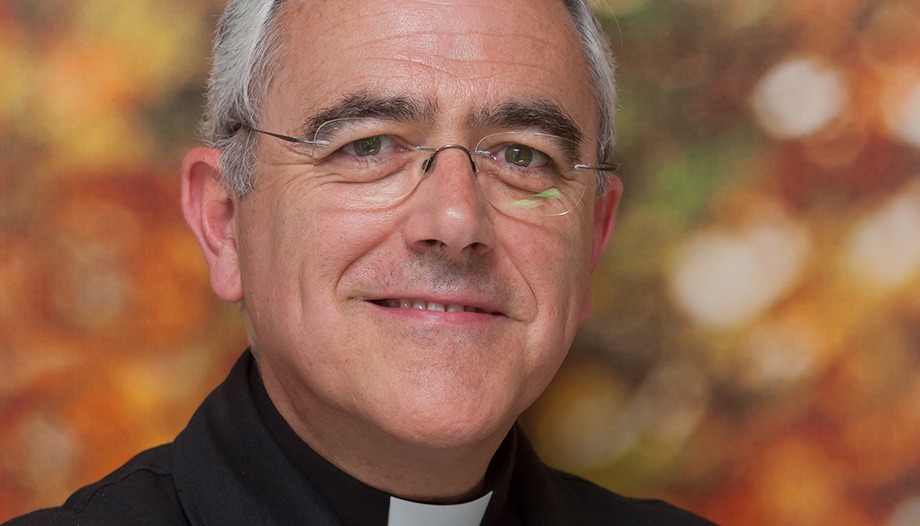
 Ramiro Pellitero: "Pastoral Theology, evangelizing vanguard".
Judging by the slogan (“Raise Your Eyes”) and the logo of the pastoral visit of Leo XIV to Spain, the message you want to convey revolves around the beauty, unity and acceptance. On the other hand, in Spain, as in many other countries and environments, we live in times of polarization and conflict, which can discourage those who try to share their faith. In this context, we interviewed Prof. Ramiro Pellitero, professor of Pastoral Theology at the University of Navarra.
How can we understand evangelization (the proclamation of the Christian faith) today, so that it becomes a source of light and not a source of dispute?
- One key is to understand that the evangelization is not a mere transmission of intellectual information or a debate of ideas, but a living encounter with the person of Jesus Christ, who transforms human existence.
In the face of conflicts, ecclesial discernment acts as a compass for reading the «signs of the times» and carrying out the proclamation of the faith, taking into account the concrete reality of persons and cultures.
To evangelize the world in an authentic way, the Church as a whole and each one of us must first allow ourselves to be evangelized continually by the Holy Spirit.
When we face social challenges or internal divisions, what role does the discernment you mention play?
- Ecclesial discernment is not an organizational technique, but a shared spiritual practice that allows any Christian community (be it a family, a school or a parish) to recognize what the Spirit is saying in relation to problems or projects that arise. It can be seen as a Christian exercise of the classical virtue of caution, in its true meaning as a guide to action.
In a synodal Church, this dialogue helps to interpret life and human reality in the light of the “kerygma” (the proclamation of Christ), helping to make decisions that truly advance the mission.
What personal attitudes would help reduce tension in such polarized environments?
- Fundamental attitudes such as humility for personal conversion and a sincere willingness to listen are required. We must first listen to God in the prayer and the Church in its magisterium, it is also vital to listen to ourselves and to others.
This «pedagogy of discernment» reminds us that God communicates with us gradually, with what the Fathers of the Church call divine «condescension,» adapting himself to our human capacity.
There are those who feel alienated from the Church because they see it as a set of rigid norms. How can we show them that the Gospel message is truth and love, and that it calls for closeness to people?
- Absolutely! We must privilege the «way of beauty» (Via Pulchritudinis). Education in the faith is effective when it attracts the human heart by showing the radiance and goodness of Christian truth. Moreover, we must overcome the dichotomy between doctrine and life, recognizing that daily existence is a «theological place» where God continues to speak, through the events of life and prayer, also with the help of the luminous criteria of the ecclesial tradition and the language of faith.
A catechumenal-style formation, as it was done in the first centuries (i.e., with an initiatory style), not only instructs the mind, but also helps to mature the identity and sense of belonging.
In the digital environment, where discussions are sometimes aggressive, how can we be heralds of peace?
- Digital culture is a new «areopagus» that challenges us to be communicators of faith. In this communication, testimony (“martyria”) has primacy, which is more eloquent than words and can be offered in the midst of daily activities, without the attitude of giving lessons, through friendship and cultural and social tasks, with serenity and a positive sense.
St. Paul VI famously said: “contemporary man listens more to witnesses than to teachers”. As the Pope Francis’, We must use the «living language» of mercy, acting as a «field hospital» that heals wounds and makes itself available to those who are farthest away, focusing everything on the saving love of God. On the other hand, none of this detracts from the value of reasoning and intellectual formation.
Finally, how do we maintain a balance between being faithful to Christian doctrine and being sensitive to current problems and personal situations, without falling into extremes that take us out of reality?
- We can visualize the Christian mission as an ellipse with two focal points: one is the fidelity to the salvific plan of God (the revealed divine will) and the other, attention to the concrete and complex condition of history. This tension is fruitful and calls for an integral formation that unites doctrinal solidity with human maturity and social sensitivity.
As I pointed out earlier, it is important to take into account the conditions of people, so often vulnerable, and of cultures, with their lights and shadows. It is also important to foster the dialogue that can enrich us, while at the same time shedding new light and helping us to go deeper into the issues - listening to how others see them - and to purify our intentions.
In addition, many issues do not have a single solution and can be approached in different ways. On a highway, you can go faster or slower, on one side of your lane or the other, but without getting in the way or endangering your own or other people's lives.
The Christian life is a highway that can be very well illuminated. By uniting the Word of God, whose fullness is Christ, with the action of the Holy Spirit (Word and Spirit form the “double mission” that comes from God the Father), faith becomes an interior reality or «connaturality» that enables us to see more clearly, to judge events better, to choose to do good wisely and to live more fully. Proclamation of the faith and Christian experience, doctrine and life, are thus united in our existence. Participating in evangelization is a service to all so that they can discover that life in Christ is a path of fullness and beauty.





 Español
  English
  Italiano