



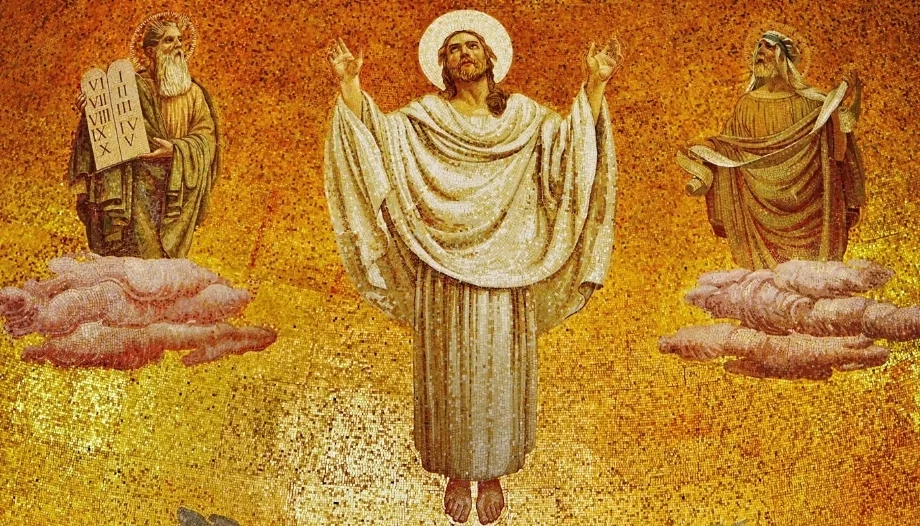
Every year, the Catholic Church celebrates the Feast of the Transfiguration on August 6. The story of Jesus’ Transfiguration appears in the three Synoptic Gospels (cf. Mk 9:2–10; Mt 17:1–8; Lk 9:28–36). Almost all biblical scholars and spiritual writers agree on the importance of this fascinating story. They also agree that it almost defies interpretation.
The renowned biblical scholar Julius Wellhausen (1884–1918) was the first to suggest that this account was originally a description of an appearance by the risen Jesus. He suggested that the account originally dealt with the appearance of the Crucified One to the three disciples. This theory was very popular for many years, but it is not currently supported by most commentators.
The context in which the story appears is the same in all the Gospels, and it is quite easy to describe. Jesus asks his disciples who they think he is. They all give the same answer: the Messiah. Jesus then explains what this means by offering the first of his three predictions about his passion, emphasizing his suffering, death, and resurrection. The disciples cannot grasp the idea of the Messiah in connection with suffering and death. It is at this point that Jesus takes Peter, James, and John, leads them up a high mountain, and is transfigured before them.
The true purpose of the story of the Transfiguration is to reveal Jesus’ true identity. It is almost as if each of the three evangelists had been gradually unveiling it as they told their stories. Suddenly, in the middle of the narrative, they stop speaking and visually show us this amazing event in which Jesus is spectacularly transformed.
It is like an apocalyptic vision that invites us to discover who Jesus really is and to catch a glimpse of his future glory. However, this event of the Transfiguration begins and ends almost immediately. Everything quickly returns to normal.
However, we are left with some important questions. What just happened? What did we just see and hear?
The three Synoptic Gospels offer a unique perspective on these questions, as well as on the meaning of the story of the Transfiguration. They even agree on the main points of the account. However, we must pay attention to the details provided by each evangelist.
Marcos
Mark provides the basic plot that Matthew and Luke follow faithfully. The Transfiguration is presented as a revelation intended for the disciples to deepen their understanding of Jesus’ identity. This theme of Jesus’ true identity is a recurring one throughout the Gospel of Mark. With the Transfiguration, Mark’s Christology is further developed. Alongside the transfigured Jesus, Moses and Elijah appear, conversing with him. Peter fails to grasp the meaning of all this, but suggests building three shelters: one for Jesus, one for Moses, and another for Elijah.
The disciples were terrified, but perhaps they thought this was similar to the Feast of Tabernacles, which commemorated the giving of the Law to Moses on Mount Sinai, as well as their journey through the wilderness (cf. Lev. 23:34–44).
At this point in the story, a mysterious cloud covers them all, and a voice says, «This is my beloved Son. Listen to him.» (This is similar to the experience Moses had in Exodus 24:15–16: «Moses went up the mountain. Then the cloud covered the mountain. The glory of the Lord rested on Mount Sinai. The cloud covered it for six days, and on the seventh day, from the midst of the cloud, He called to Moses»). This divine voice affirms Jesus« identity as the Son of God, the Messiah, and the Son of Man who is to come. The disciples are commanded to »listen to him!”.
Immediately after the voice fell silent, the vision would end and everything would return to normal. As they were all coming down from the mountain, Jesus instructed the disciples not to tell anyone what they had experienced until after the Resurrection. Only then would the true meaning of the Transfiguration be understood. .
Matthew
Matthew interprets the Transfiguration as an apocalyptic vision directed at the disciples Peter, James, and John. This apocalyptic tone, which underscores Jesus’ status as the Son of Man, is based in part on Daniel 7:9 and 10:6. Matthew also emphasizes Jesus’ sovereignty (cf. Matt. 17:4).
Furthermore, it adds the detail that Jesus’ face shone like the sun, and that his clothes were dazzlingly white. Matthew’s account, similar to Mark’s, includes Moses and Elijah conversing with Jesus. Many commentators interpret Moses as a symbol of the Law and Elijah as a symbol of the prophets. Together, the Law and the prophets constitute the fullness of divine revelation.
In Matthew 5:17–19, Jesus proclaimed that he had come to fulfill the Law and the Prophets, not to abolish them. Here, at the Transfiguration, it is shown that Jesus not only fulfills the Law and the Prophets, but surpasses them. Matthew’s account of the Transfiguration adds some details at the end. The disciples fall to the ground when they hear the voice from the cloud. Jesus calms their fear by touching them and encouraging them not to be afraid.
Lucas
Luke’s account is also similar to Mark’s, but it includes some unique details. First, the Transfiguration is presented as an experience for both Jesus and the disciples. For Luke, prayer is of the utmost importance. Almost every significant aspect of Jesus’ ministry is preceded by prayer in the Gospel of Luke. Therefore, Jesus takes Peter, James, and John with him and goes up the mountain to pray (cf. Luke 9:28).
During prayer, Jesus« face is transformed and his clothes become dazzling white. For Luke, Jesus» transfiguration is an experience of prayer. In describing what happens to Jesus and his clothes, Luke does not use the term «transfiguration» (in Greek, “metamorphosis”). Instead, he refers to Jesus’ face and clothes as transformed.
Luke also mentions the presence of Moses and Elijah, who are conversing with Jesus. Although Mark and Matthew also depict Moses and Elijah speaking with Jesus, they do not reveal the content of that conversation. Luke, however, tells us that they were discussing Jesus« departure (in Greek, »exodus«), which was about to take place in Jerusalem (cf. Luke 9:31). This, of course, is a reference to his death, understood as a new redemptive act, just like the first Exodus of antiquity. Although the disciples are described as fast asleep, they are fully awakened upon seeing Moses and Elijah. Once again, the mysterious cloud covers them all, and the divine voice declares: »This is my chosen Son; listen to him” (9:35). Jesus replaces both Moses and Elijah.
According to Luke, Jesus is a prophet mighty in deed and word. He is the prophet like Moses mentioned in Deuteronomy 18:15. Therefore, Luke’s account of the Transfiguration confirms Peter’s original recognition that Jesus is the Messiah and, furthermore, elaborates on what that messianism entails. It is an exodus that passes through suffering and death to reach glory.
Possible Meanings
Most commentators and scholars focus on the encounter between Jesus, Moses, and Elijah as the central meaning of the story of the Transfiguration. As mentioned earlier, Moses symbolizes the Law and Elijah symbolizes the prophets. Jesus, standing between them, symbolizes how he fulfills the Law and the Prophets—or even how he surpasses them. This is confirmed by the voice that comes from the cloud, declaring Jesus’ identity as the beloved Son of God. And because of this relationship, we must listen to Jesus.
Another way to understand the Transfiguration is to view it as a mystical encounter in which Jesus« identity is revealed through this »cloud of mystery.” At the center of the encounter are Jesus, Moses, and Elijah. Watching from the outside are Peter, James, and John. The challenge for all of them is not to decipher the meaning of the cloud, but simply to step into it.
In other words, the encounter is what matters most. From this perspective, the Transfiguration is part of Jesus« identity; it is not merely the result of it. This search for identity cannot be reduced to a name. Let us recall Moses“ fruitless effort to discover God’s name. ”God said to Moses, “I am who I am.” And he added, »This is what you are to say to the Israelites: “I AM has sent me to you”’” (Exodus 3:14). Jesus’ identity is intimately linked to this cloud. The cloud is the very presence of God. Jesus’ Transfiguration is an invitation to enter this mysterious cloud and experience the glory of God. This is what the glory of God looks like: a great, radiant cloud.
This experience answers the two questions posed earlier when describing the Transfiguration: What has just happened? What have we seen and heard? What has just happened is that the disciples have entered the sacred cloud and, in doing so, have experienced the fullness of Jesus as they beheld the glory of God. This is who Jesus truly is. All of this is confirmed by the divine voice that reaffirms Jesus’ true identity.
Venturing into the Cloud
It is tempting to think that the challenge posed by the story of the Transfiguration lies in deciphering the symbols and uncovering the meaning behind the figures and the cloud. This is understood as part of the search for Jesus’ true identity. The problem with this approach is that it will never allow us to go beyond the limits of the story. From this perspective, we will never discover Jesus’ true identity.
The true challenge of the Transfiguration lies in entering the cloud. Once inside, we will discover Jesus, Moses, and Elijah, and the fullness of God’s glory. And how can we enter that cloud? I suggest that Luke’s approach may hold the key. And that key is prayer.
Remember that, for Luke, the entire event of the Transfiguration was an experience of prayer. It was through prayer that Luke came to understand the meaning of this new exodus that Jesus was undertaking. And it was through prayer that Peter, James, and John were able to overcome their fear and enter the divine cloud. Only then will we be able to say with Peter, «Master, it is good for us to be here!» (Luke 9:33). Once inside, in the presence of God’s glory, we too will be able to hear the voice that says, «This is my chosen Son; listen to him.».
By Eugene Hensell, OSV News
Eugene Hensell is a Benedictine monk at St. Meinrad Archabbey in St. Meinrad, Indiana, and an associate professor of Sacred Scripture at St. Meinrad Seminary and School of Theology.







 Español
  English
  Italiano