



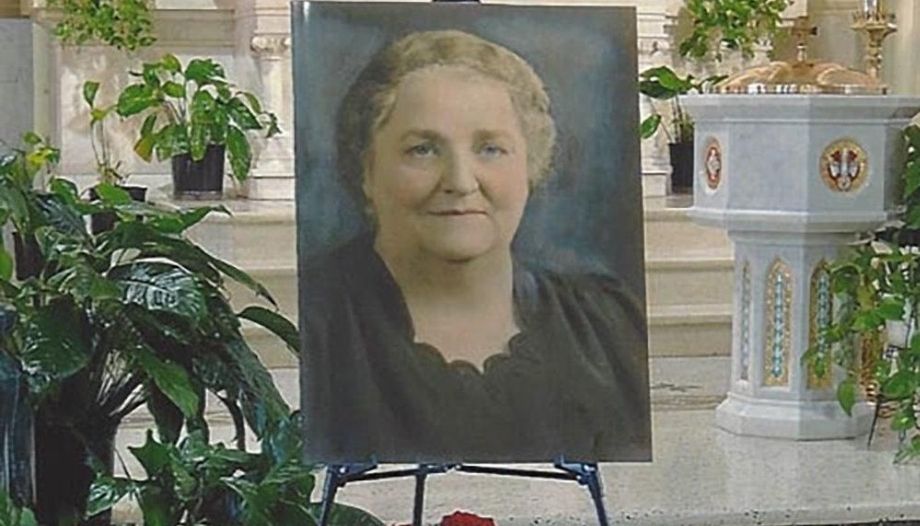
– Anna Dougherty, OSV News
Wise’s cause for canonization took an important step forward on July 7, when the Diocese of Youngstown, Ohio (United States), announced that the official “positio”—a comprehensive document detailing his life of virtue and the alleged miracles—had been submitted to the Vatican’s Dicastery for the Causes of Saints.
The Dicastery will investigate her life, determine whether she should be declared venerable, and recommend to the Pope that he make such a declaration.
The Life of Wise
Wise was declared a Servant of God in 2017 when the late Bishop George V. Murry of Youngstown initiated her cause for canonization. She was born into a Protestant family of modest means in 1888, according to the EWTN program “They Might Be Saints” (They might be saints),” broadcast July 7, 2022. She endured a life of adversity, including infertility, the loss of one of her two adopted daughters, and an alcoholic husband who couldn't hold down a job.
In the 1930s, Wise suffered from several health problems, including an 18-kilo ovarian cyst and a foot fracture that did not heal properly. During one of her hospital stays, she befriended the Sisters of Charity of St. Augustine, who taught her to pray the rosary and told her about St. Thérèse of Lisieux, to whom she eventually developed a deep devotion. According to her diary, she was received into the Catholic Church on January 1, 1939.
Miraculously healed after a vision of Christ and Saint Teresa
On May 8, 1939, doctors at Mercy Hospital in Canton, Ohio, sent her home to die. The painful wound in her abdomen, resulting from abdominal surgery, had become infected, and several surgical attempts to remove an abscess had failed. Shortly after returning home, she began to have visions of Christ and, later, of St. Teresa.
After having a vision of Christ and Saint Teresa on June 28, 1939, she wrote in her diary that she had been miraculously healed.
“I was amazed to discover that the wound on my abdomen had completely healed,” he wrote. “My family and friends were overjoyed, and in the days that followed, many people came to my house to see me.”.
According to the website for Rhoda Wise's House and Grotto, She continued to have visions until her death in 1948, and beginning on Good Friday, April 3, 1942, she experienced the stigmata every first Friday of the month, from 12:00 to 15:00, until 1945.
Stigmata on his forehead, hands, and feet
Bleeding stigmata appeared on Wise's forehead and continued to appear and bleed intermittently over the next two years. In 1943, bleeding stigmata appeared on his hands and feet, as well as on his forehead. Many visitors to Wise's home witnessed these stigmata.
As her reputation for holiness spread, many visitors came to speak with her and pray outside her home, which remains a place of pilgrimage to this day.
Ryan Schweitzer, who has served as assistant director of the Wise home and nonprofit organization in Canton since the fall of 2023, said that in 2025 alone, 5,500 people from 19 countries visited the home. Healing—both physical and spiritual—is common at the home, Schweitzer said.
The Lord told him that there would be many miracles there
“Our Lord had told Rhoda that there would be many more miracles here, in this place—many more wonderful miracles than the ones she experienced—and Our Lord has kept His word,” Schweitzer told OSV News.
In 2018, Dr. Mark Shoag was diagnosed with stage 4 sarcoma and given six months to live. As chemotherapy took its toll on his body, his wife, Betsy Shoag, read Wise’s diary to him, according to the EWTN program.
One day, when Mark was too weak to get out of bed, Betsy took his shirt to the Wise family's house to pray for a miracle. When she returned, she found Mark awake and asking for permission to leave the house.
“I went from believing that science could explain everything to believing that… miracles exist,” said Mark, who survived eight years longer than expected before passing away in 2024.
“Without Rhoda Wise, there would have been no Mother Angelica, founder of EWTN”
EWTN traces its origins to a miracle that took place at the Wise family home.
According to EWTN, As a teenager, Mother Angelica—then Rita Antoinette Rizzo—was taken to see Wise in the hope of being cured of a debilitating stomachache caused by a rare condition called gastrointestinal ptosis. .
The EWTN program about Wise recounts that Rhoda recommended that Rita pray a novena, after which her stomach ailment suddenly disappeared. This miracle changed the course of her life, prompting her to take religious vows and, later, to found EWTN.
Rita joined the Congregation of the Poor Clares of Perpetual Adoration, taking the name Sister María Angélica de la Anunciación, and in 1981 she founded what is now a global Catholic media organization.
“If Rhoda Wise hadn’t existed, Mother Angelica wouldn’t have existed, because her healings led her to her vocation and to EWTN,” said Karen Sigler, who directs the Rhoda Wise Shrine.
Next Steps
Father John Sheridan, of the Diocese of Youngstown and the liaison for Wise’s cause, said that Wise’s “positio” will be reviewed by two Vatican commissions: the theological commission and the historical commission.
“The historical commission will examine the life and times of Rhoda Wise, who grew up in Ohio, United States, beginning in the 1880s, and lived through the Great Depression and World War I and World War II,” Father Sheridan told OSV News. “Theologians will examine the claims that she was a mystic and that she experienced stigmata.”.
These commissions will submit separate recommendations to the bishops, cardinals, and experts who make up the Dicastery for the Causes of Saints. The dicastery may then recommend to the Pope that he declare the candidate’s heroic virtues and that the Church grant him the title of “Venerable.”.
The next steps in the canonization process are beatification and canonization. In general, each step requires that a miracle attributed to Wise’s intercession have been verified.
She could be the patron saint of those who struggle with addiction
If she is ever canonized, Father Sheridan remarked that she could be the patron saint of those struggling with addiction, since her husband eventually overcame his alcoholism. She could also be the patron saint of homemakers or adoptive mothers.
“Rhoda Wise embodies the virtues of patience and perseverance,” Sheridan said. “She lived in poverty, and even though many people came to her home, she never tried to get rich. She continued to live in the same humble home and lead a life of extreme poverty. I think there’s something beautiful about that.”.
——————
Anna Dougherty writes for OSV News from Texas.
This information has been originally published in OSV News, and can be found at here.






 Español
  English
  Italiano