



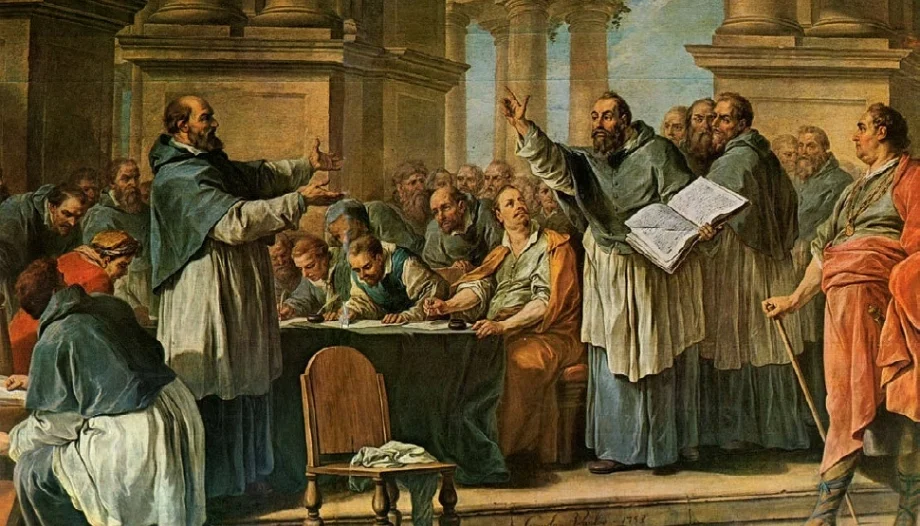
 10 times Pope Leo has quoted St. Augustine in his speechesWhy read St. AugustineSt. Augustine and the search for God: reality of modern man.
The political thought of St. Augustine of Hippo (354–430 AD) is not found in a systematic treatise but emerges primarily from his monumental work *The City of God* (*De Civitate Dei*). His view is deeply theological: politics is a consequence of fallen human nature and a tool for maintaining a minimal order in an imperfect world.
These are the fundamental ideas that define his thinking:
1. The «Two Cities» Theory»
It is the central tenet of his philosophy. Augustine divides humanity into two groups based on the object of their love: the Earthly City (Civitas Terrena), made up of those who live according to human standards and love themselves to the point of despising God. Their motivation is the ambition for dominion and worldly goods; the City of God (Civitas Dei), made up of those who live according to God and love Him to the point of self-denial. Their goal is eternal peace. These cities are not strictly identified with the state and the Church. They are mystical and moral realities that coexist, intertwined, throughout history until the end of time.
2. The Origin and Function of the State
For St. Augustine, the state is not a «natural» institution in the sense of perfection (as Aristotle believed), but rather a necessity arising from Original Sin. Remedy against evil: The state exists to impose order, punish crime, and guarantee a minimum «earthly peace» that allows people to live together without destroying one another. Coercive power: Political authority has the right to use force and the law to curb human wickedness. Without justice, Augustine asserted that kingdoms are nothing more than «great bands of thieves» (magna latrocinia).
3. The Concept of Justice and Peace
Augustine redefines these classical concepts from a Christian perspective: Justice: In keeping with tradition, it is «giving to each what is due,» but he adds that there can be no true justice in a society that does not give God the worship He deserves. Peace: He defines it as the «tranquility of order» (tranquillitas ordinis). The ruler’s goal must be to preserve this order so that citizens (including Christians) can go about their activities in safety.
4. Church-State Relations (Political Augustinianism)
Although Augustine defended the autonomy of the two spheres, he laid the foundations for what would later be called «political Augustinianism.» Collaboration: The state must serve the interests of the City of God, protecting the Church and, on occasion, using its power to combat heresy (as it did with the Donatists). Moral Subordination: The Christian ruler must be a «minister of God,» acting with humility and placing his power at the service of piety.
5. The Theory of Just War
St. Augustine was one of the first to systematize the conditions under which it is lawful for a Christian to participate in a war. A war is just if: It is declared by a legitimate authority. It has a just cause (such as responding to an attack or recovering stolen property). It is carried out with the right intention (the ultimate goal must always be the restoration of peace, not revenge or cruelty).
St. Augustine’s thought is not only relevant today but has also experienced a resurgence in contemporary political science (especially through what is known as «Augustinian realism»). His vision offers a critical counterpoint to ideologies that promise utopias or definitive solutions through the state. Some areas where his thought remains most vibrant today include:
1. Political Realism and a Critique of Utopias: In contrast to modern views that believe in unlimited progress or that politics can «save us,» Augustine reminds us that the state is a limited tool. Relevance: It helps us understand why institutions often fail. His «anthropological pessimism» (the idea that human beings are fallible and selfish by nature) forms the basis of modern political realism, which favors systems of checks and balances rather than blindly trusting in the goodness of leaders.
2. The State as the «Lesser Evil» and Social Peace: For Augustine, the purpose of the state is not to make us happy or virtuous (that belongs to the personal or spiritual sphere), but simply to prevent us from killing one another. Relevance: In polarized or conflict-ridden societies, his idea of «civil peace» (a minimal, functional order) is highly pragmatic. It suggests that an imperfect order is better than absolute chaos, a notion that resonates in debates about failed states or international interventions.
3. Justice as a Measure of Legitimacy: His famous quote: «Without justice, what are kingdoms but large bands of thieves?» remains the standard by which political corruption is judged. Relevance: Augustine gives us a tool to delegitimize governments that, even if they have laws, do not seek the common good. Today, it is used to criticize kleptocracies or regimes where the law is merely a facade for the plundering of resources.
4. Pluralism and «Two Cities»: Agustín argues that citizens live in a constant tension between their ethical and spiritual values and the demands of the state. Relevance: In a globalized and multicultural world, his idea that a person’s identity is not limited to their nationality or obedience to the state is fundamental to defending conscientious objection and freedom of belief in the face of totalitarianism.
5. The Theory of Just War: It is perhaps his most practical legacy and the one most frequently consulted by experts in military ethics and international law. Relevance: The Augustinian criteria (legitimate authority, just cause, and right intention) continue to form the basis of modern protocols regarding when it is lawful to use force and how harm to civilians should be limited.
In short, Augustine is «relevant» today because he serves as an antidote to political fanaticism. By teaching that no political structure will ever be perfect («the City of God is not of this world»), he calls for a more humble, less dogmatic approach to political participation, one focused on practical solutions for peaceful coexistence.
Some modern philosophers (such as Hannah Arendt and Reinhold Niebuhr) reinterpreted St. Augustine in the context of 20th-century politics.
Modern «political Augustinianism» suggests that: We must not treat politics as sacred: No party or leader is a savior; they are merely stewards of an imperfect order. Critical vigilance: Since power tends toward the «desire for domination» (libido dominandi), citizens must always be on guard against abuses of justice. Commitment without fanaticism: We can work toward a better world without falling into despair when things go wrong, because we know from the outset that perfection is not of this world.







 Español
  English
  Italiano
  Français
  Deutsch
  Polski