



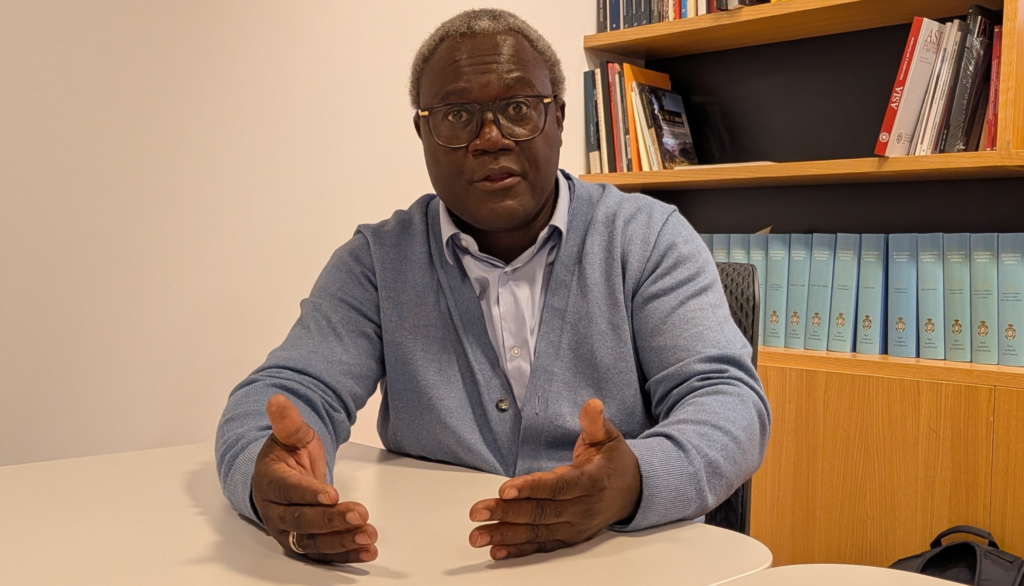
 "Manos Unidas projects show that another world is possible."Fidele PodgaEnd hunger is not a "utopia" : "Putting an end to hunger is not a "utopia".
What does peace have to do with hunger? Aren't they unrelated concepts? Although they seem like separate realities, food and peace go hand in hand. This was recently analyzed at a roundtable discussion organized by Manos Unidas with development experts.
Fidèle Podga Dikam, coordinator of the Studies and Documentation Department at Manos Unidas, was one of the speakers at the “Hunger Roundtable” organized at the Botín Foundation headquarters in Madrid to mark World Food Day and the International Day for the Eradication of Poverty. The participants, specialists in humanitarian action and human rights, analyzed how violence and conflict destroy food systems and discussed what actions could protect the right to food. Podga explains his perspective on food systems to Omnes.
What is the priority to solve, famines or violence and armed conflicts?
—Both aspects are linked, but famines are the priority. We must save human life, because otherwise the other issues wouldn't make much sense. Famines don't arise spontaneously; we know where they will occur. Instead of solving them once they happen, let's focus on prevention, because that can also be done.
Is it true that a large part of famines are related to war, at least in contemporary times?
—Hunger has multiple causes. Depending on the focus, the time, the context, the country, or the region, there may be a major cause. But, in any case, world hunger stems from a single overarching cause, and that is called “global food systems.” Through these systems, food is not produced where it is needed for people to live or eat according to their cultural traditions, but rather where it is not needed in order to sell surpluses. For example, wheat, rice, sugar—all the essential foods for human life—come from abroad.
Years ago, Haiti, one of the poorest countries in the world, lived more or less adequately off its rice production. But then rice began arriving from the United States, and given the country's nonexistent agricultural infrastructure, production ceased. The food systems are geared towards products exported to the North: palm oil, cotton, and even mining operations. Consequently, these systems produce hunger.
It's a matter of distribution, not production.
Do you maintain that the problem is distribution, not a lack of food production in the world?
—A global perspective on resource analysis leads me to say that the problem is an unequal distribution. We produce enough food to feed almost twice the world's population, and it still isn't enough, precisely because food systems force us to throw away a third of our food in order to keep prices down.
For example, I've been to Mallorca and seen boats dumping bananas into the sea. At a macroeconomic level, we can say the problem is one of distribution, but at the level of the population itself, the problem is the inability to produce food where it's scarce. For example, the land grabbing that takes it away from local communities for other uses. That's the underlying issue: the inability to invest in local agricultural production so that people can live according to their cultural traditions.
Why?
—Because behind food systems lie conflict and climate change. The common thread is an agricultural production model where you produce cheaply, where labor costs nothing, and sell where you make huge profits. They don't care what the population eats. And Spain, sooner or later, will also fall victim to hunger.
How to achieve long-term food security?
—Education for development and social transformation is necessary, to raise awareness that what one does here has repercussions elsewhere. We need to convey the idea of ‘eat enough, eat what you need; even if you can afford it, the world cannot.’.
On the other hand, immediate attention must be given to those dying of hunger: human dignity is at stake, life is in crisis. France is going to cut aid funding by 45%, but what will those who depended on that funding for their immediate survival do? Where is the human conscience and the value of human dignity? Europe must recover that ethical foundation that speaks to us of what it truly means to be human.
Is it possible to correct these errors within the capitalist system without a radical revolution?
—I am neither a capitalist, nor a communist, nor a socialist. The issue is not about labeling ourselves, but about verifying what guarantees we have that human dignity is at the center. Human rights constitute our dignity regardless of political affiliations. Otherwise, what is the point of the Universal Declaration of Human Rights? The economic system has cultural underpinnings that affect it.
How can we prevent economic gain from taking precedence over the consideration of food as a human right?
—Minimum prices can be established for essential foodstuffs, especially during times of crisis, and local agriculture and food sovereignty can be promoted. So-called poor countries are not poor: they are poorly managed countries or countries where the benefits remain in the hands of elites. Responsible consumption should also be encouraged in destination countries, by buying local products, to benefit the local economy.
The Manos Unidas event focused on peace and food. But to what extent are conflicts around the world rooted in food problems?
—Most conflicts originate, if not from hunger, then at least from poverty and discrimination. When a group is excluded from the management of public affairs, a kind of poverty is created for those excluded people, as this is the foundation upon which conflict arises. There is a devious exploitation of the population's discontent by warlords, who fan the flames to control land, livestock, or mining. The issues of hunger, poverty, misery, and exclusion are always there, underlying. And the population's discontent is always used by one side or the other.






 Español
 English
 Italiano
 Français
 Deutsch
 Polski