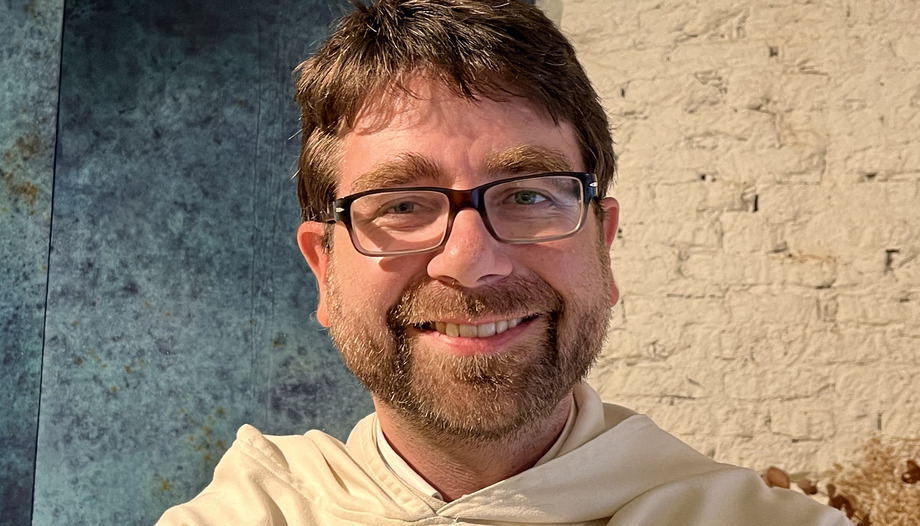



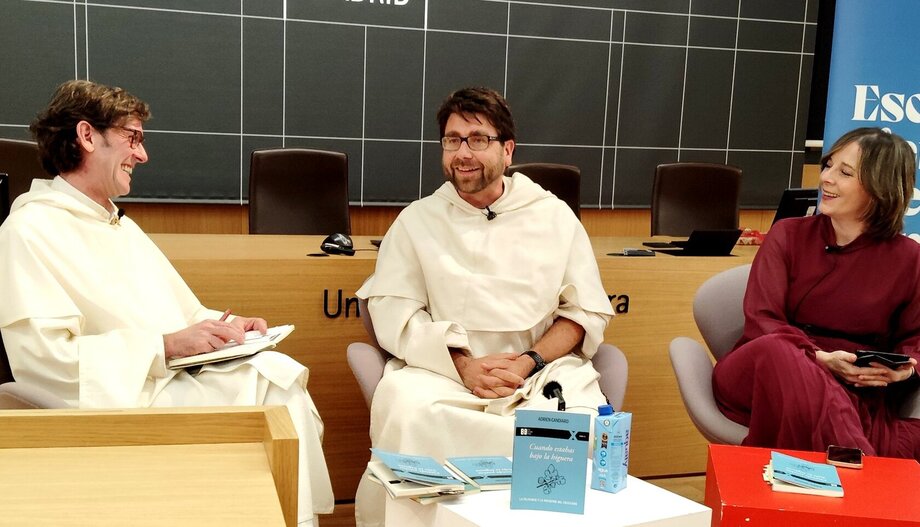
Adrien Candiard's penultimate book—he has another one about to be published in French—discusses happiness and vocation in the Christian life. It does so in relation to the enigmatic Gospel episode of Nathanael and his encounter with Jesus. When you were under the fig tree, The book, published by Encuentro, was presented at the Omnes Forum in a colloquium between the French Dominican and the Dominican Vicente Niño, moderated by the director of Omnes, María José Atienza.
Adrien Candiard (Paris, 1982) is currently a member of the Dominican Institute of Eastern Centers in Cairo. He has studied History, Political Science, and Theology. He has published numerous books on spirituality, with considerable success. In the colloquium, he began by asking about happiness. “I am happy,” he affirmed. “The deepest reason is that I am happy because I feel I can live my life. Because I have the possibility of giving my life, I can live for myself and for others.”.
In response to questions from Vicente Niño (head of Communications for the Dominicans in Spain), Candiard presented a thesis that might seem groundbreaking at first glance: “Consecrated vocations are not necessary for the Church. The Church can survive without friars, without Dominicans, without Jesuits… Consecrated vocations are a gift. God wants them. We don't know why, but He wants them.”.
Sacrifice and Christian life
He also spoke about how “the Christian life cannot be understood without sacrifice. But that sacrifice doesn't mean ruining your life.” In this sense, he insisted: “When the reason for a vocation is fear or guilt, or the lack of priests (this is a sociological idea…), it's a mistake. Jesus gave his life for you. And do you want to ‘ruin’ your life to please him?” He continued: “God doesn't call us ‘against’ ourselves. Grace doesn't go against nature; it perfects it.” In reality, he maintains, “God wants us to be happy and holy, perfecting who we are.”.
As a spiritual guide for young people, Candiard referred to those who aspire to be someone else: to resemble a “holy picture.” “But that’s not freedom,” he asserted. “When you want to be someone else, you’re not free. God is found in real life, not in our ideals.”.
For the French Dominican, vocations to the priesthood or consecrated life “are exceptions. Most people don't experience their vocation as a single decision—as happens in these cases—but rather through many decisions.” He explained that “it's normal for a layperson to be unable to say anything about their vocation until at least fifty years have passed. Marriage isn't a vocation; it's a state of life. But their political dimension, their marital status, their social life are all part of their vocation…”
He believed that, when speaking of vocation, it is also necessary to speak of the experience of unhappiness. “There is no human life without catastrophes: death, illness, unemployment… Unjust things. But we must have a place for disasters.”.
In this regard, he added that “the opposite of happiness is bitterness. Closing oneself off to the possibility of joy because life isn't fair to oneself. But we must understand that perfect, fulfilled lives don't exist.”
The Holy Spirit is at work
Finally, Candiard reflected on his experience as a spiritual guide: “Whenever someone tells me that ten years ago I said something very important to them, it’s usually not something I recognize as my own, or that were my ideas. Sometimes they even misunderstood them, but words are free. And the Holy Spirit can use those words without my permission to move souls,” he concluded.
The presentation took place in the OMNES Forum, as an activity of Master's Degree in Christianity and Contemporary Culture from the University of Navarra in Madrid, on whose campus the meeting took place. It was sponsored by CARF Foundation and of Sabadell.




 Español
 English
 Italiano
 Français
 Deutsch
 Polski