


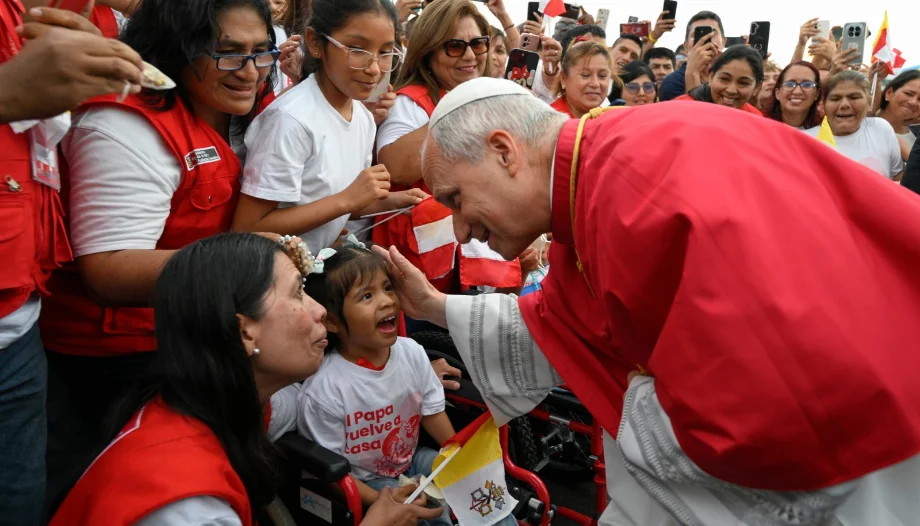
 Leo XIV prays again before the saint who inspired his episcopal ministry
Pope Leo XIV met with the bishops of Peru on November 12 in the chapel of the Archbishop's Palace in Lima, where he asked them to work for communion, pastoral closeness, and the unity of the Church. «No bishop should feel alone on his journey. No particular Church should live its mission as if it were separate from that of others,» he affirmed.
In his address, the Pope used the Qhapaq Ñan, the Great Inca Road, as a reference point to reflect on the episcopal mission. He recalled that, just as that network of roads united territories, communities, and cultures, the Church is also «a path of communion and hope,» a path «that crosses the mountains of indifference, the deserts of individualism, and the distances that separate people.».
Taking inspiration from the motto of his visit to Peru, «Let us open our hearts!», Leo XIV explained that, for a bishop, this means «knowing the path to God in order to walk it with the faithful and to allow God and the people to question their priorities.» In this sense, he emphasized the need to know the dioceses from within, «entering homes, accompanying the sick, meeting young people, and reaching out to communities» that, due to their geographical distance or social vulnerability, rarely have the opportunity to be heard: «the shepherd is called to go out to meet everyone.».
Examples of missionary spirit
The Pope recalled the example of Saint Toribio of Mogrovejo, whose mission required being close to the communities and ensuring that the Gospel could also be proclaimed in the languages of the indigenous peoples. He also mentioned Saint Rose of Lima, Saint Francis Solano, Saint Martin de Porres, and Saint John Macias as examples of dedication, missionary spirit, and care for the most vulnerable.
In his address, Leo XIV also addressed abuses perpetrated by members of the clergy or within the Church. Faced with this reality, he stated that the Church must respond «with truth, justice, forgiveness, reparation, and an ever-stronger commitment to a culture of prevention and protection of the most vulnerable against these crimes.».
The Pope also recalled the words Pope Francis addressed to the Peruvian bishops in 2018, when he urged them not to be held captive by divisions. «Communion among you, among us, is the foundation of the credibility of the Gospel you proclaim,» Leo XIV emphasized.
Therefore, he has asked them to be «bridge builders, to foster dialogue, to educate for encounter, and to help heal the wounds that divide Peruvian society.» He has also warned them that social or political polarizations should not weaken their prophetic and evangelizing mission.
What does Peru need today?
Referring to the current situation in the country, the Pope pointed out that Peru needs pastors capable of listening to the questions of their time and illuminating it with the Gospel. Among their responsibilities, he mentioned accompanying families, supporting young people, defending the life and dignity of every person, promoting justice, and caring for creation. In particular, he asked that bishops commit themselves to those who suffer from «poverty, exclusion, corruption, violence, and lack of opportunities.».
Leo XIV also reminded everyone that «the Church does not belong to us; it belongs to Christ» and that bishops are messengers who will one day complete their journey: «Only God remains!» In closing, he summarized his exhortation in three invitations: «Do not cease walking with this people,» «Let us not cease walking together, in episcopal communion,» and «Let us not cease opening our hearts: to God, so that He may renew our vocation; to our brothers and sisters, so that divisions may be healed; and to your people, so that they may find in you a “father bishop” who is close, courageous, and merciful.».
Reconciliation and peace, in the cathedral of Lima
After the meeting with the bishops, Leo XIV walked to the Cathedral Basilica of St. John the Apostle and Evangelist to celebrate Midday Prayer with the bishops, priests, religious men and women, seminarians, members of the synodal teams and pastoral councils.
In his homily, the Pope expressed his joy at being back in Peru, «close to a Church that is so dear to me.» «I come as a father and brother in faith; as a shepherd who loves his flock,» he said. He recalled that he first arrived in the country many years ago, sent to serve the People of God and to build his Kingdom, «to promote peace in justice, with special care for the most vulnerable.».
In this celebration, the Pope proposed several attitudes for being Church and building a civilization of love founded on the common good. The first is to believe «in the name of his Son, Jesus Christ,» whom he presented as the sole foundation upon which to build the Church. To illustrate this, he recalled Saint Toribio de Mogrovejo, «a tireless, enterprising, and creative apostle, a courageous defender of the poor, a generous shepherd, willing to wear himself out for his flock.».
The second value he emphasized is reconciliation. «Peru desperately needs it; it needs a Church that sows love, capable of building bridges where others erect walls, of listening, healing, and forgiving,» he affirmed. He also asked the Church to be willing to acknowledge its own infidelities and humbly ask for forgiveness, assuming responsibility for the wounds it has caused within itself and around it.
Next, Leo XIV stressed the need to promote a «disarmed and disarming peace,» an urgency that, he explained, must be addressed by cultivating «the values of dialogue and fraternity, and avoiding any polarization that causes division.».
«Peace always begins “here and now” and depends on how we behave, how we look at each other, how we respect and listen to one another,» she said. Therefore, she encouraged everyone to first cultivate peace within themselves and among loved ones, and then to spread it in communities and in the various spheres of social and political life.
The Pope clarified that communion does not mean «complete homogeneity» nor does it necessarily require immediate consensus. Rather, it is a space in which «different voices, with the help of the Spirit and under the guidance of pastors, learn to blend without canceling each other out, creating harmony.» To this end, he considered it necessary to listen even to what does not coincide with one's own perception, to welcome the pain of others without judgment, and to allow oneself to be touched by their story.
Finally, the Pope reminded everyone that the Church is missionary by nature and exhorted all those present to keep the flame of God's love alive. He specified this call in terms of the various vocations: bishops must recognize God's voice in the lives of their flock and be close to priests; priests must cultivate an intense love for Christ, fidelity and obedience to the Church, and accompaniment of those entrusted to their care; consecrated men and women must renew their commitment each day; and seminarians must nurture their relationship with Jesus and their interior life.
He asked the lay members of the pastoral councils and synodal teams to continue the work they had begun, because «the Church needs you, your contribution, your faith.».
Leo XIV concluded by inviting everyone to join «in the great symphony of communion whose Master is Christ» and to walk together with hearts open to grace.




 Español
 English
 Italiano
 Français
 Deutsch
 Polski