



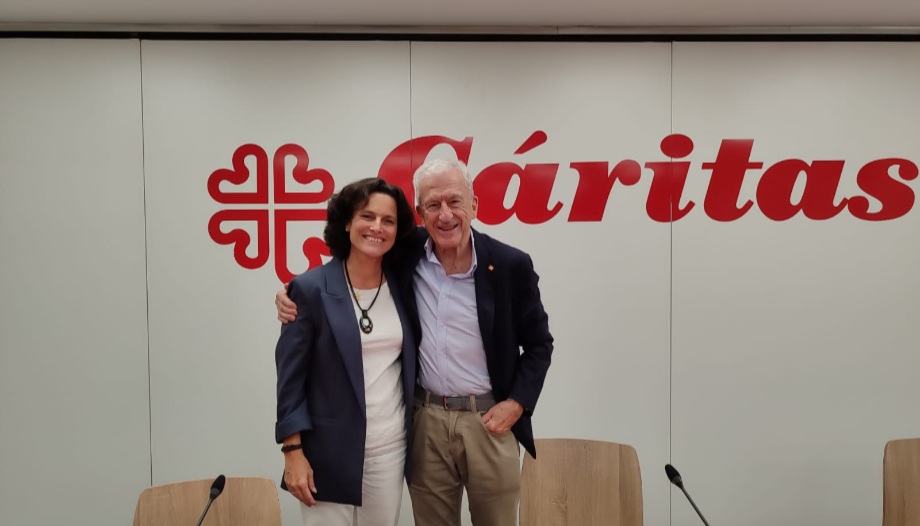
The Caritas Confederal Report, presented this Tuesday in Madrid, paints a picture of a year marked by social fragmentation resulting from two decades of economic, health, military, and political crises, which have left a growing number of people struggling to meet their most basic needs.
The organization’s president, Manuel Bretón, and its secretary general, María González Dyne, presented the results of the work carried out in 2025 by the network of 70 diocesan Caritas organizations throughout the country at a press conference held at the organization’s headquarters.
A record investment
Over the past year, Caritas allocated 529.9 million euros—an increase of 8.11% over the previous fiscal year—to its various programs and projects, both within Spain and through international cooperation initiatives in other countries. This financial investment made it possible to assist 2,132,112 people: 1,098,476 in Spain and 1,033,636 through international cooperation.
Food: A Word of Caution
The organization’s day-to-day work highlights the disconnect between economic growth and social well-being, exacerbated by difficulties in accessing housing and the rising cost of living. Throughout 2025, more than 4,923 parish Caritas chapters met the food needs of over 615,000 people through the Welcome and Assistance Program, a figure representing 56% of all the people supported by the network within Spain.
The data reflect the magnitude of the problem: nearly 2.8 million people are food insecure, and another 686,000 (1.4%) go entire days without eating due to a lack of resources.
Both housing and food—the two categories to which families allocate the majority of their income—are also the ones experiencing the sharpest price increases. Over the past year, the cost of buying a home in Spain has risen by 13%, and the cost of renting one has risen by 4%. Inflation in basic food prices continues to strain family budgets, with increases of 16% for legumes, 15% for vegetables, 14% for eggs, and 10% for fish.
More migrants assisted
57% of the people assisted by Caritas in 2025 were migrants, many of whom were undocumented. Initiatives related to Human Mobility saw a sharp increase in participants—a 35.8% rise—from 34,767 people served in 2024 to 47,226 in 2025.
Beyond providing direct support, the organization has stepped up its advocacy efforts. Networking has helped keep the Popular Legislative Initiative (ILP) moving forward in Congress, which has led to a Royal Decree on the extraordinary regularization of migrants.
In the economic sphere, Caritas has established itself over the past decade as one of the leading drivers of the social economy, with business models that combine profitability with environmental stewardship and social well-being. Notable among these initiatives are Moda Re, a leader in textile recycling, and Maná, a pioneering project in food recovery.
Demand for legal services skyrockets
Other programs that saw a notable increase in the number of people served were those for Families, Children, and Youth (63,742 people), People Experiencing Homelessness (44,475), and Legal Services (28,766). Of the three, the increase of nearly 58% in legal services stands out in particular.
Throughout 2025, Caritas continued to support those affected by the DANA in October 2024, which impacted Valencia, Letur (Albacete), Mira (Cuenca), Málaga, and Jerez.
Private donations have increased by 25%
Caritas’s significant financial impact last year was made possible by the support of thousands of members, donors, companies, and private partners, whose contributions exceeded 378 million euros—a 10% increase over the previous year. The secretary general particularly highlighted the commitment of individual donors and members, whose contributions grew by more than 25%, and thanked them for their collaboration «in the effort to build a more just world.».
In addition to this private funding, various public administrations contributed a total of 151.8 million euros to Caritas programs. Overall, 71% of the organization’s total revenue comes from private sources, and 29% comes from public funds.
Finally, the Annual Report also highlights the human element that underpins all of this activity: 67,966 volunteers and 6,071 staff members form the foundation of Caritas’s confederal work throughout Spain.






 Español
  English
  Italiano
  Français
  Deutsch
  Polski
  简体中文
简体中文