


 Catholics and Public Life vindicates the shared history between America and Spain Catholics and Public Life: The answer to the decadence of the West is to preach and live the Gospel of the CrossEvangelization at the heart of the 25th Congress of Catholics and Public Life
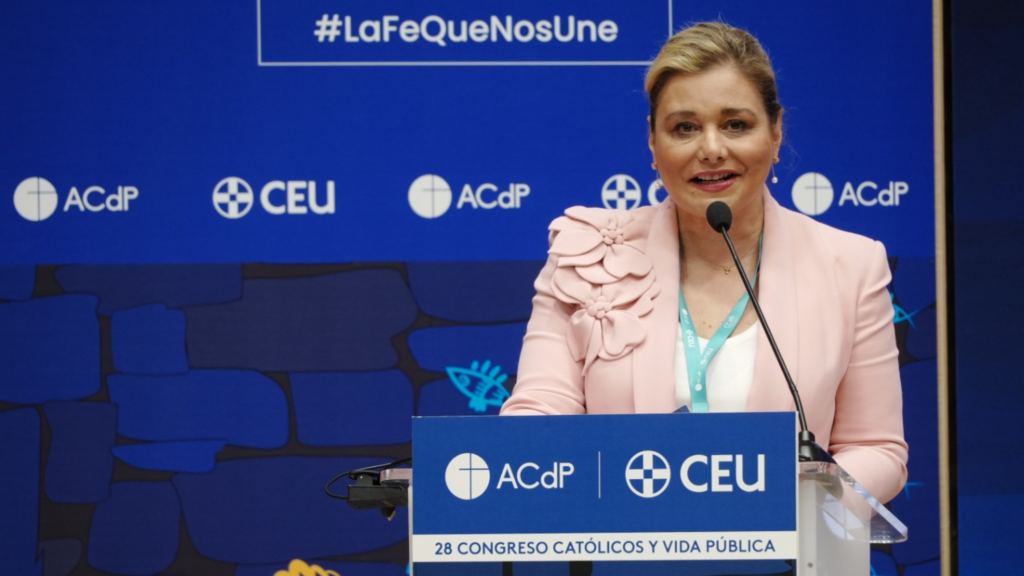
“Faith doesn’t make us morally superior. But it does shape our conscience, reminding us that power has limits and that no one, absolutely no one, can be reduced to a mere instrument of our interests,” asserted María Eugenia Campos Galván, governor of the Mexican state of Chihuahua. She was closing the 28th Congress of Catholics and Public Life, held at the San Pablo CEU University, focused on the faith that unites America and Spain.
Against the backdrop of the debate on the roots of the Americas, numerous voices have championed Spain's role and expressed gratitude for bringing the faith to the New World. Testimonies of conversion and calls to evangelization have been abundant. The congress can be summarized in four key moments.
1. From Mexico, a call for consistency
In a much-applauded speech, the concluding one of the meeting, the governor of the Mexican state of Chihuahua, María Eugenia Campos Galván, championed the role of Catholics in politics, encouraging them to be consistent.
He affirmed that defending life from conception involves many aspects and a responsibility for those in power: “When a woman faces a pregnancy in abandonment, when someone suffers from a serious illness, when an elderly person loses their autonomy, our responsibility becomes even more demanding. Therefore, defending life requires providing support, offering alternatives, and caring for everyone, ensuring that no one, absolutely no one, is left behind.”.
“My conviction remains that all human life possesses a dignity that deserves to be recognized and protected from its very first moments,” he added. This also implies opposing crime: “When a candidate is threatened or assassinated, a campaign is financed, a journalist is killed, or voters are intimidated, what is at stake is a people’s right to freely elect their leaders. From Saint Thomas Aquinas to the jurists of the Hispanic tradition, Christian thought has distinguished legitimate power from arbitrary force. A criminal group can impose rules and subjugate entire populations, but it will never have legitimate authority. A country is sovereign when, within its borders, no one is above the law.”.
He recalled the most powerful tradition that unites America: “In times of uncertainty, Mexicans always look to Tepeyac and remember the words of the Blessed Virgin of Guadalupe: ‘Am I not here, I who am your mother?’ Juan Diego was able to complete his mission because he found in these words the strength he needed. May they lead us to trust, to rise up, and to fulfill our mission.”
2. From Chile, an invocation to pluralism and Hispanic alliance
Former Chilean Minister of Justice and Human Rights Hernán Larraín stated, “Faith implies a public responsibility and a commitment.” He emphasized that Catholics cannot confine their convictions to the private sphere or to religious practice. Human dignity, he maintained, must be the foundation of social and political action, which requires protecting the vulnerable, promoting justice, combating corruption, and strengthening solidarity.
He also warned of the risk that the defense of dignity could degenerate into new forms of dogmatism, with censorship of dissenting opinions or the imposition of unquestionable truths. “A free society must protect pluralism,” he stated.
He also championed the enduring relevance of the School of Salamanca and spoke of “a culturally rich community” whose pillars are language, Christian heritage, and legal and intellectual tradition.
3. From Peru, a reminder of subsidiarity as a guarantee of freedom
Former Peruvian congresswoman Adriana Tudela defended subsidiarity as one of the fundamental principles of Western tradition and a guarantee of freedom, moral autonomy, and human dignity. She emphasized the role of the family as a basic support network: if it is absent, the State begins to replace it, generating dependency and diminishing autonomy.
He also defended private property as a condition of independence from political power and an economic freedom that is justified not only by its results, but also because it allows for choice, cooperation, and the assumption of responsibilities. He concluded that “being free and making decisions is the only way to exercise our morality.”.
4. Testimonies of faith
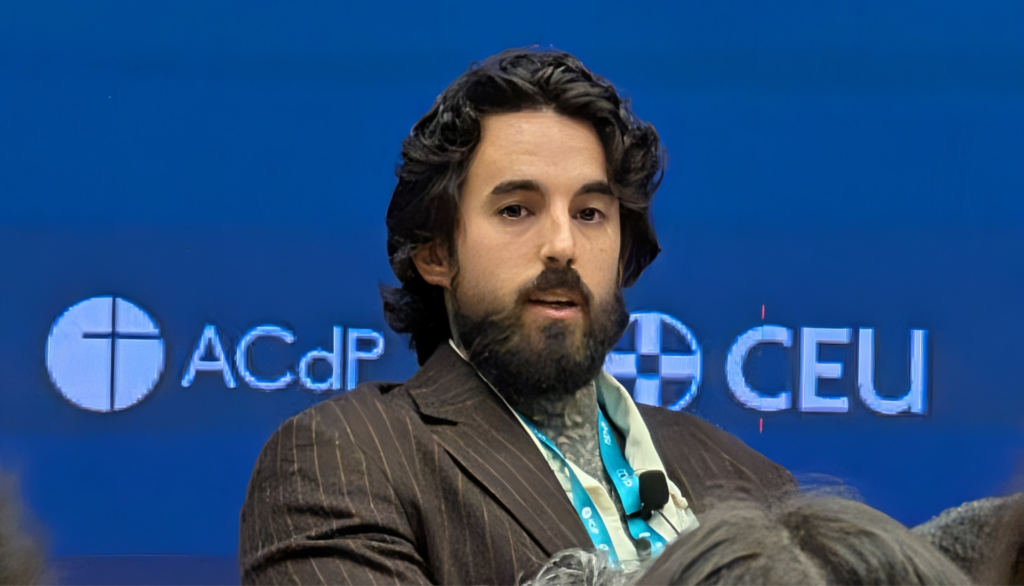
In addition to the conferences, there was an opportunity to hear several testimonies. René ZZ, A content creator with two million followers on each of his social media accounts, and a renowned global expert in tattoos, shared his conversion to faith and how he tries to transmit his convictions.
Pablo Sánchez Bergasa, winner of the Princess of Girona Social Award, recounted how his invention of a low-cost incubator has managed to save dozens of children's lives in Africa.
Two other popular writers, José María Zavala and Cristian Gálvez, They discussed the creative process behind their writing, which has led them, in their case, to become authors of religious bestsellers. They agreed that they don't write to evangelize, but that they have discovered the Holy Spirit uses them to bring people closer to faith.




 Español
 English
 Italiano
 Français
 Deutsch
 Polski