


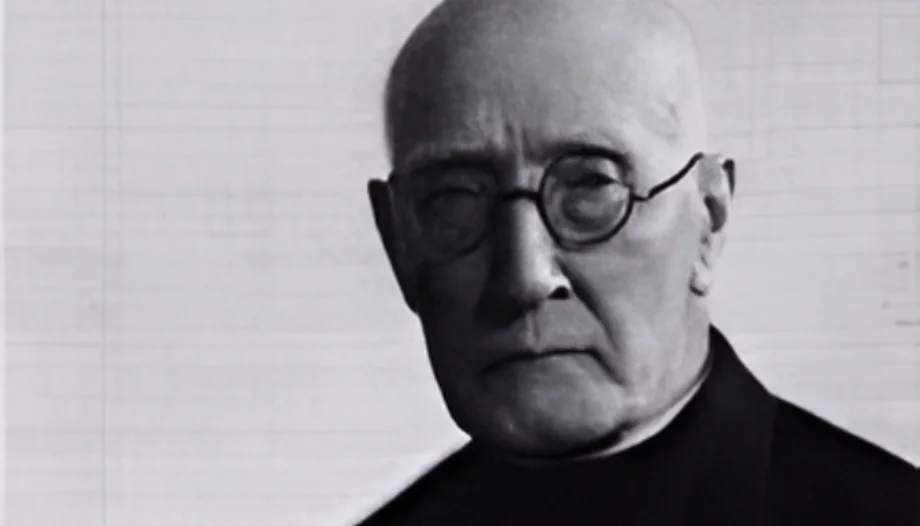
Eduardo Vitoria Miralles (August 25, 1864 – September 22, 1958) was a Spanish Jesuit and chemist, considered the founder of catalysis in Spain, a key discipline in industrial chemistry.
Orphaned by his father at the age of four, he attended high school at the Colegio de San José in Valencia, run by the Jesuits, where he discovered his calling for science, and from 1881 to 1885 he studied exact sciences, but he left those studies to enter the Monastery of Veruela (Zaragoza) as a novice in the Society of Jesus, where he completed his training in the humanities and philosophy. However, he did not abandon his scientific calling. Under the guidance of Antonio Vicent and Luis Montesinos, he became the first person in Spain to earn a bachelor’s degree in Physical Chemistry (1896), graduating with the highest honors. He was later ordained a priest and continued his scientific training at the Catholic University of Leuven, where he earned his doctorate under the supervision of Louis Henry, with a thesis in organic chemistry focused on catalysis, specifically the synthesis of 1,1,1-trichloro-2-propanol.
After furthering his studies in Germany, he had a solid foundation on which to establish the Ebro Chemical Laboratory (1905) in Roquetas, which would move to Barcelona in 1916 and become the Sarrià Chemical Institute (IQS). As director of the IQS, he developed a curriculum focused on applied chemistry and carried out extensive teaching and research, along with the publication of several pioneering textbooks. He also launched the journal Affinity, a leading figure in Spanish chemistry.
He was a member of the Royal Spanish Academy of Physics and Chemistry, the Royal Academy of Sciences and Arts of Barcelona, and scientific institutions in France, Germany, Portugal, Mexico, and Argentina, among others.
Following the expulsion of the Jesuits in 1932, the IQS continued under various names, and Vitoria remained involved as a professor and editor of the journal Affinity. During the Civil War, he sought refuge in Italy, but returned to Barcelona in 1939, where he helped with the reconstruction and expansion of the Institute.
He passed away in 1958, leaving behind a great legacy in teaching, research, and the popularization of chemistry in Spain. As a result, he received numerous honors, including the Grand Cross of Alfonso X the Wise and the title of “Honorary Son” of Alcoy.
Public University of Navarra and SCS-Spain / Researcher at the CSIC.





 Español
  English
  Italiano