




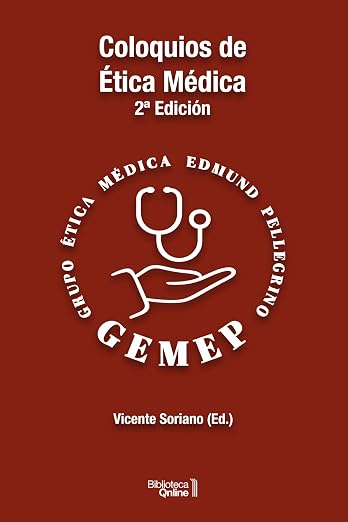
This insightful publication addresses many of the ethical dilemmas in contemporary medical practice. It was written by a group of physicians passionate about the ethical debate in medicine, who take as their guiding light the American professor Edmund Pellegrino (1920-2013), a pioneer of medical ethics and one of the most brilliant minds of the last century, following in the long tradition that began with the great Hippocrates. They also cite Marañón, Osler, and Lejeune as influences. Their aim is to contribute to the recovery of a sense of vocation dedicated to serving the patient and accompanying human suffering, without being intimidated by political or other forms of interference.
Its seven thought-provoking chapters are: Medicine and Humanism (identity of medicine, Edmund Pellegrino and the Virtues in medical practice, Gonzalo Herranz and respect for the patient, intrinsically evil medical acts, pain and suffering, medical humanism), Medicine and Society (organization of health systems, conscientious objection, patient autonomy, patient safety, integral ecology, medical education), Beginning of Life (human infertility, artificial placenta and uterine transplantation, abortion, prenatal diagnosis, eugenics), End of Life (death - definitions and meaning, dignified death, palliative care and sedation at the end of life, therapeutic obstinacy, the vegetative patient, euthanasia and assisted suicide, euthanasia in patients with mental disorders), Biotechnology (artificial intelligence, neurotechnology and neuroethics, screens, social networks and mental health, genetic diagnosis, gene therapy and gene editing, stem cell experimentation, organ transplantation, xenotransplantation), Sexuality (adolescent brain and sexuality, Contraception, surrogacy, research on sexuality: development, identity, orientation and behavior, clinical management of sexual disorders, pre-exposure prophylaxis for STIs and other infections) and Medical research (clinical research and clinical trials, scientific publications, freedom of expression in medicine and academia, healthy longevity and human fulfillment, origin and meaning of life).
The topics covered in the book are drawn from real patients, the authors' professional practice, the media, and widely circulated medical journals. Ultimately, this is a work that will be of great interest to those who wish to stay informed on these crucial ethical issues, as well as to ethics professors who want to incorporate the thought-provoking case studies described within into their classes.
Colloquia on Medical Ethics






 Español
 English
 Italiano
 Français
 Deutsch
 Polski