



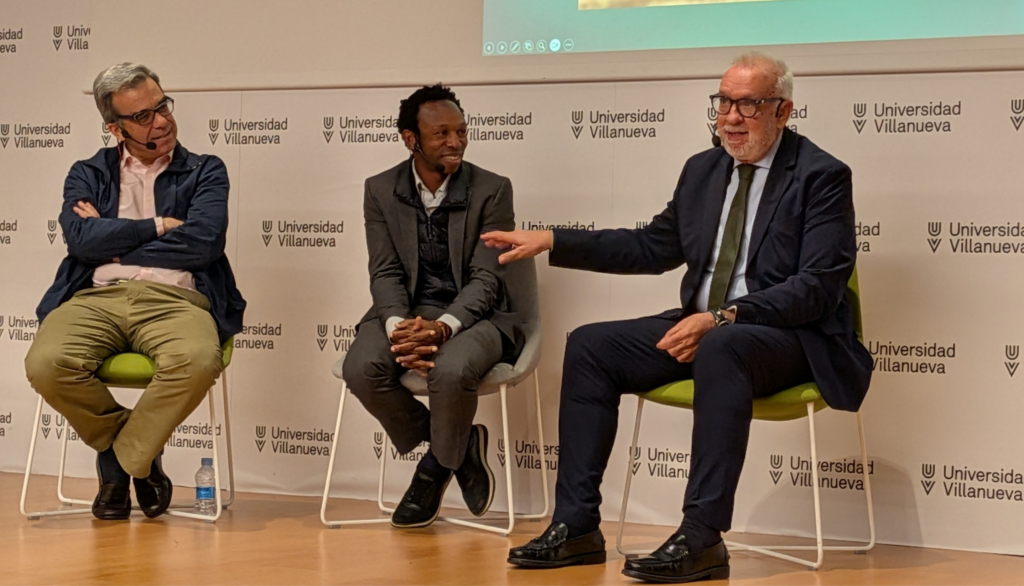
 20 years of Harambee
“Africa needs a Marshall Plan. And there will be no prosperity without education.” These are the ideas of Ousman Umar, co-founder of the NASCO Foundation and CEO of NASCOTech, are some of the proposals expressed at the NGO colloquium Harambee on the problems, and solutions, of the African continent.
Umar, originally from Ghana (the former colonial Gold Coast), is an entrepreneur whose life was depicted in the film “Journey to the Land of the Whites.” At just 12 years old, he left his homeland in search of a better future. His journey lasted five years, crossing half of Africa. He walked through the Sahara Desert, survived the sea crossing in a small boat, and witnessed the deaths of almost all his fellow travelers. He finally reached Spain. He trained and began working as a mechanic in Barcelona. With his earnings, he started buying computers and sending them back to Ghana. Today, he leads technological initiatives in Ghana, providing 600 computers to schools.
He asserts: “I’ve lost count of the times I’ve been close to death. And it can’t be a coincidence that I survived.” “My purpose is to be the voice of those who didn’t make it and to prevent others from coming in boats,” he adds.
For him, the first thing is “feeding minds,” education.
Opportunities in Africa
Regarding emigration, he stated: “We cannot allow so many to continue dying on the journey to Europe. But if there are no opportunities in Africa, they will continue trying to come, whether by canoe or otherwise.” That is why he proposes investing in education, through initiatives like the one he launched. He has 58 schools integrated into his computer project, plus another 17 classes in rural areas. He concludes: “If you provide people with education, they won't get on a small boat.”.
He also alluded to the opportunities on his continent. “Talent has no color,” he stated. “I find it difficult to make people understand that a computer scientist in Ghana can be just as good as one in India.”.
Pablo Martínez, project director of CECFOR (Congolean Center for Culture, Training and Development) in the Democratic Republic of Congo, which has carried out 17 development projects with Harambee.
With twenty years of experience working in the former Zaire, Martínez emphasized that cooperation projects can only be sustained if they are led by the local population. “They are the protagonists and they are the ones who have to take the initiative. We need to find young people, support them, and guide them,” he stated.
Economic potential
For his part, Eduard Messegué, CEO of GBFoods Africa, highlighted the economic potential of the African continent and the success of a business model based on local management. He emphasized that they have four thousand employees in Africa, only one of whom is Spanish, and that the company generates around 25,000 jobs (direct and indirect).
Messegué refuted the notion that business cannot be done in Africa, and, on the contrary, emphasized the importance of creating wealth and opportunities on the continent. His company develops agricultural projects in countries such as Nigeria, Ghana, and Senegal, where it promotes African talent.






 Español
 English
 Italiano
 Français
 Deutsch
 Polski