


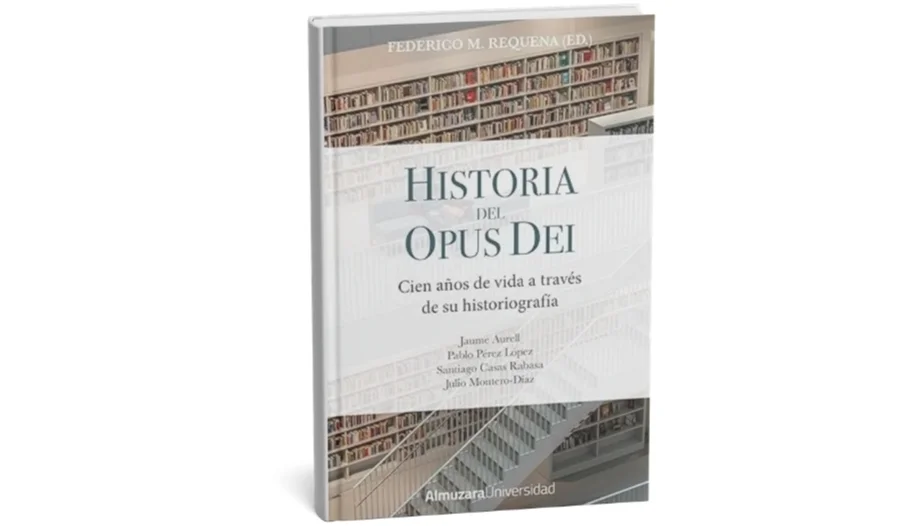
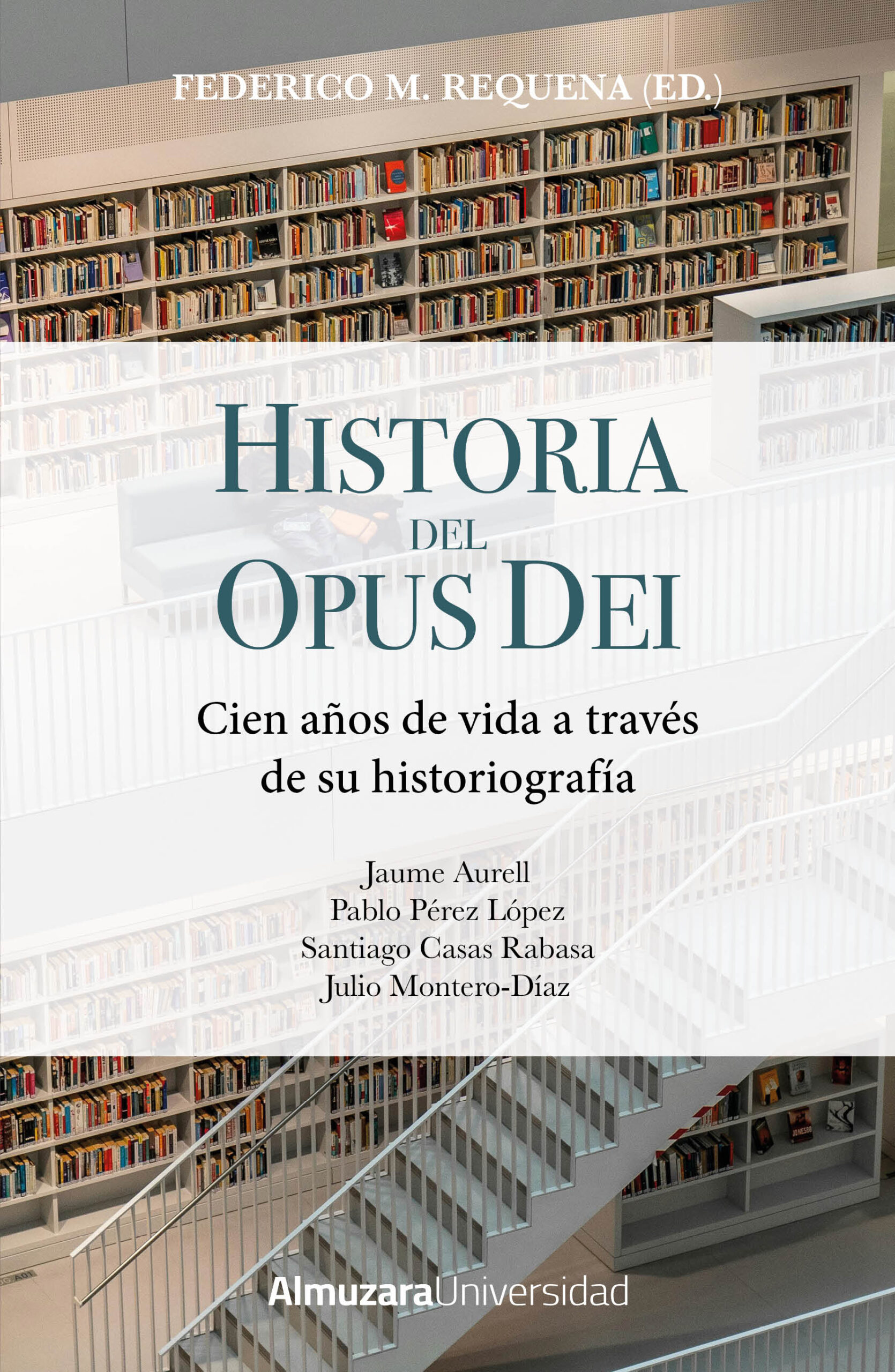
On the occasion of the centenary of Opus Dei, four Spanish university professors of recognized prestige, coordinated by the deputy director of the St. Josemaría Historical Institute in Rome, Federico Requena, offer us an assessment of the historiography of Opus Dei. The issue is so important that, thanks to the four extensive works provided, the reader has the conviction of having attended an authentic master class on history with a capital letter, on historical work and the interpretation of data and institutions, both in civil and ecclesiastical society.
It is a unanimous comment among people outside the field of history that educated readers appreciate of this volume to have learned a great deal about the religious, political and cultural ideas of 20th and 21st century Spain.
It is logical that recent history takes a long time to unfold with sufficient clarity before the eyes of historians, since there are still few open archives available and there are still many books of memoirs, always deeply subjective, as were the chronicles of kings in ancient times.
The «grand narrative» constructed with malicious intent
The first work, by Jaume Aurell, analyzes how the «great story of Opus Dei» was constructed with very bad intentions by certain ecclesiastics and politicians at the end of the civil war, when the positions of dominance in the political and ecclesiastical spheres were being settled, in that strange marriage between the throne and the altar that caused so much damage to a country that aspired to rebuild itself and to take the pulse of European democracy.
The work of this Catalan professor is especially important because it reveals with depth and clarity a problem that will take time to be resolved in the conscience of our citizens. Sown since the 1940s, the misunderstanding was deepened from the early days of the Transition by the same power groups that metamorphosed and maintained themselves in both the civil and ecclesiastical spheres. The faithful and politicians who belonged to Opus Dei never acted as an organized group.
The comparison with the «great story of the 19th century», which for years distorted the image of the government of Carlos III and the emergence of the first liberalism in the Cortes de Cádiz of 1812, has just found an answer in the recent biography of Jovellanos, published in the collection of eminent Spaniards directed by Javier Gomá, Juan Pablo Fusi and Ricardo García Cárcel.
Reception in history textbooks
The extraordinary and patient work of Pablo Pérez, professor of History at the University of Valladolid and currently at the University of Navarra, studies the reception of Opus Dei in civil history textbooks and in the major studies carried out in Spain and other countries. His reading allows us to learn relevant aspects of Spanish historiography from the twentieth century to the present day, as well as other countries in Europe, the United States and Canada.
Of special interest is the review of the turn of great historians such as Santos Juliá in his monumental work on the Spanish political Transition. The publication of serious documents and the opening of archives led him, at the end of his life, to offer a much more rigorous and documented version of Opus Dei than that which many others have been unwilling or unable to produce.
Opus Dei in Church History
The work of Santiago Casas, professor of Church History at the Faculty of Theology of the University of Navarra, studies the presence of Opus Dei in the manuals of Church History, especially in the most recent ones. These are, certainly, much less numerous than those in the civil sphere, also outside Spain and Europe.
This section clearly shows the lack of studies on the theological and juridical figure of Opus Dei outside the institution itself. It is expected that, once the reception of the Second Vatican Council and the phenomenon of the contestation in the archives of the pontificate of Pius XII have been studied in depth, a better understanding of the actions of the institutions of the Church in that period and in the most recent period will be possible.
Original sources, key for the historian
The last of the works in the volume is by Julio Montero, professor of History of Communication, who focuses on studying the bibliography on the history of Opus Dei used by the authors of the first institutional history of the Work.
This section may seem of little interest to the general reader, but it is of capital importance to the historian, since it offers him the possibility of discovering the original sources on which these stories are based and of using them to deepen his knowledge of Opus Dei: its aims, its problems, its difficulties and its successes throughout the world, as well as the context in which it all took place.
With a sense of humor, Professor Montero brings the contemporary reader closer to the real historical Opus Dei and helps those who are already faithful to the Prelature to better understand the institution, thanks to his knowledge of the contexts and problems of the times in which we live. The author himself accurately summarizes the scope of his work: the public primarily interested in publications on Opus Dei is made up of its members and people close to its apostolic activities.
History of Opus Dei. One hundred years of life through its historiography.






 Español
  English
  Italiano
  Français
  Deutsch
  Polski
  简体中文
简体中文