


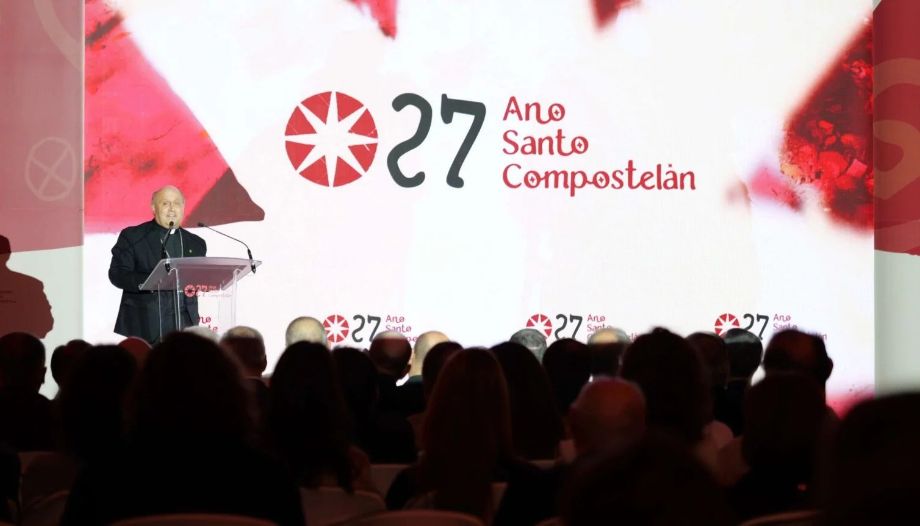
It was precisely the motto of the Jubilee 2027 – ”When they saw the star they were filled with immense joy” (Mt 2:10) – that centered an evening that brought together representatives of the Church, institutions and different areas of society.
The presentation unveiled the Hymn and the new visual identity for the Holy Year. The star of the Botafumeiro mechanism, the marks of the Cathedral stonemasons, and the figure of the Apostle James as a guide to Christ served as references to express the meaning of the jubilee through music, design, and audiovisual presentations.
A time of encounter with Christ, forgiveness, and welcoming of pilgrims
Archbishop Monsignor Francisco José Prieto presented the motto, and invited everyone to live the Holy Year as a time of encounter with Christ, forgiveness and welcoming of pilgrims.
He called for communities open to listening to and accompanying those who travel the Way, and urged them to preserve their Christian identity through a hospitality that welcomes everyone.
Numerous attendees
Representing the Archdiocese were canons of the Cathedral Chapter, vicars, archpriests, parish priests, and members of the Diocesan Pastoral Council, along with religious men and women and lay people. Also in attendance was Bishop Mikel Garciandía of Palencia, president of the Subcommittee on Popular Piety (Brotherhoods, Confraternities, Shrines, and Pilgrimages).
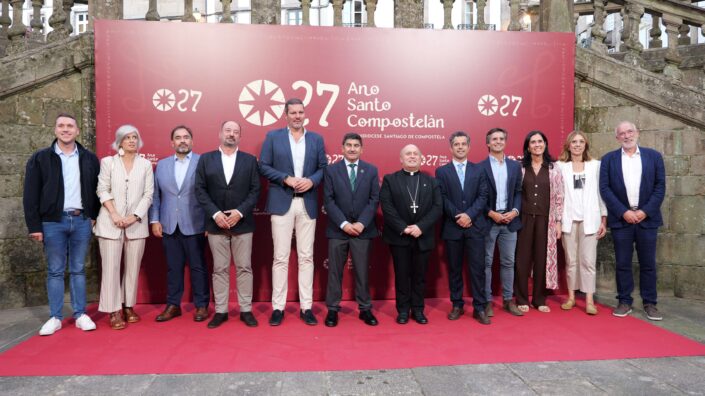
Among the institutional representatives were the Government Delegate in Galicia; the Minister of Culture; the Mayor of Santiago; members of the Board of the Parliament of Galicia and regional deputies, and other political, military and police authorities, along with representatives of associations, companies, the university, culture, heritage and social entities.
First proposal, music video of the Anthem
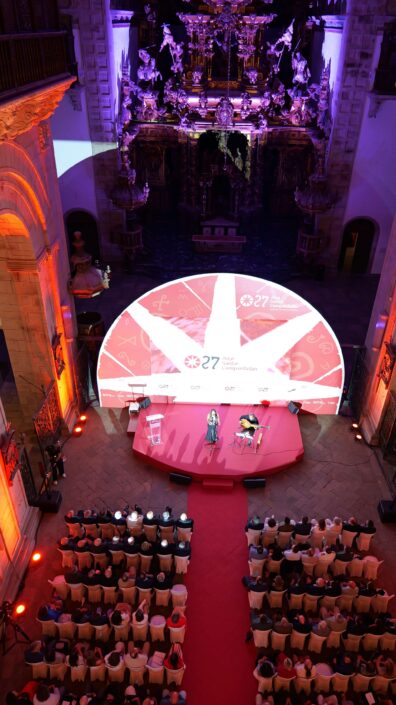
Following the welcome address, the first presentation was the music video for the National Anthem. Attendees listened to 'Un campo cheo de estrellas' (A Field Full of Stars), a composition by Galician musician Carlos Martínez Movilla, presented in an audiovisual production by Hugh McGinley..
Holy Year Identity Video
Next, the video announcing the identity of the Holy Year of Compostela was shown. Both pieces were followed by a round table discussion with Óscar Valado, director of the Diocese's Music Department and coordinator of the jubilee's musical works; Fernando de Castro, the brand's designer; and Daniel Lorenzo, director of the Cathedral Foundation, who spoke on behalf of the Archdiocese.
Two hymns, one for liturgical use
During the conversation, Óscar Valado explained that the Compostela Holy Year will have two hymns: one for clear liturgical use, composed for choir and organ, and another designed for the dissemination of the Holy Year in other spaces, whether in the digital environment or pastoral meetings.
An image born from the Cathedral and the memory of the Camino
At the same round table, Fernando de Castro explained the references that shaped the new visual identity. Its main symbol was the eight-pointed star present in the Botafumeiro mechanism, linked to the tradition of the star that pointed to Compostela and to the apostle James, as before the Round Table.
Hospitality expressed in an open welcome to all
For his part, Daniel Lorenzo placed hospitality among the priorities in the preparation for the Compostela Holy Year 2027. He highlighted the work carried out in recent years to ensure that the International Pilgrim Reception Center offered comfortable service, in reasonable timeframes and in the native languages of those arriving in Santiago, with the participation of people of different nationalities who shared their culture.
A call to live a jubilee of hope
Bishop Francisco José Prieto Fernández placed the motto of the Holy Year at the heart of his address, in which he outlined the main convictions of his pastoral letter. Drawing on the story of the Magi, he explained that the star had not eliminated the difficulties of their journey, but had allowed them to recognize that their quest had meaning and that they were progressing toward a goal.
Three convictions: pilgrims, joy, and evangelization
Monsignor Prieto developed three convictions. The pilgrim condition of humankind. He described life as a quest in which each person must learn to choose what is essential, accept their limitations, and allow themselves to be helped. The Camino de Santiago made this experience visible through silence, encounter, and everyday acts of assistance.
The second conviction was directly linked to the Jubilee motto: joy could be reborn on the Way. The archbishop explained that Christian joy is born from knowing oneself to be loved, forgiven, and accompanied by God. It can coexist with tears and difficulties, help rebuild relationships, and restore the desire to live and serve.
The third point was addressed to the Church: to seize the Holy Year as a great opportunity for evangelization. Bishop Prieto noted that its fruitfulness would depend not primarily on the number of events organized, but on the capacity of communities to show the face of Christ and make the Gospel visible. He called for a Church that is close to its people, willing to listen without hasty judgment, to welcome questions, and to accompany each person, respecting their own pace.
Jacobean tradition: material and spiritual support for those who travel the path
Hospitality featured prominently in his address. Bishop Prieto recalled that the Jacobean tradition had united material and spiritual care for those who traveled the Way. To welcome meant making room for the other, listening to them, and recognizing their dignity.
He also called for preserving the Christian origins, spiritual horizon, and apostolic goal of the pilgrimage, given the risk of reducing it to a tourist product or a series of experiences. He emphasized that safeguarding this identity was compatible with welcoming everyone, whatever their motivations: those with a firm faith, those who doubted, and those who arrived weary or seeking a new beginning.
The archbishop placed the meaning of the Jubilee gestures in the encounter with Christ. The arrival at the Cathedral, the embrace of the Apostle, the prayer at his tomb, and the passage through the Holy Door expressed a journey of conversion, reconciliation, and openness to God. The goal could thus become the beginning of a renewed life.





 Español
  English
  Italiano
  Français
  Deutsch
  Polski
  简体中文
简体中文