


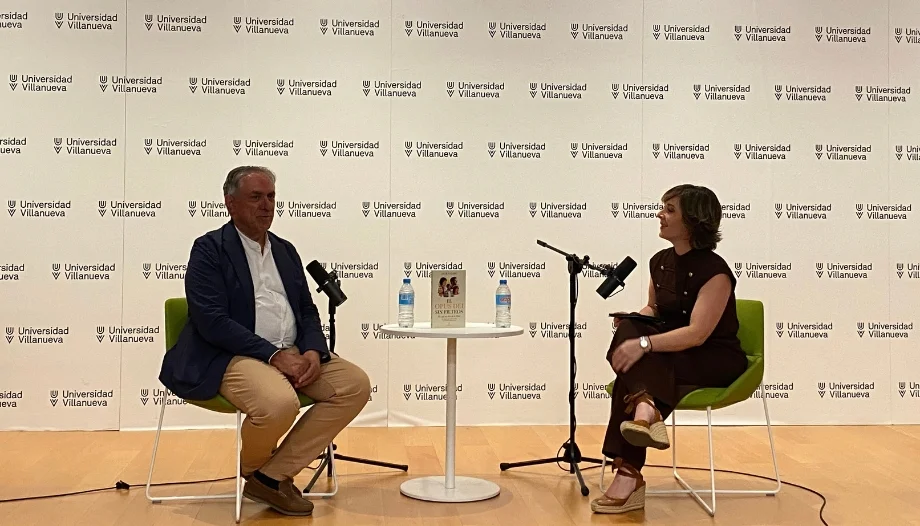
«These aren’t positive or negative stories. They’re ordinary stories of people trying to do things, who are imperfect, who suffer, who see God enter their lives and respond in this way or that, who enter the work, who leave the work.» That’s how Jack Valero explained the purpose of Opus Dei unfiltered, During a dialogue held on September 22nd at Villanueva University with María José Atienza, director of Omnes, the book, published by Almuzara, brings together the stories of 18 people linked to Opus Dei and aims, according to its author, to answer some of the questions that are usually raised about the institution "from below," through the lives of its members.
Valero, spokesperson for Opus Dei in the UK, explained that after 33 years of answering questions about power, money, influence, and the role of women, he had perceived a limitation in always doing so "from a top-down perspective." That's why he decided to share the concrete experiences of very different people. The book features a taxi driver, a businessman, people who have traveled their entire lives, and others who have always stayed in the same place. "There's a bit of everything, a cross-section of what's out there," he noted.
Freedom in Opus Dei
What does Opus Dei seek? Valero answered this question by saying that its purpose is "to help people find God in their ordinary, everyday lives." He explained that it's about helping each person discover that God is present in what they do and "to be a better person in everything you do." This task, he added, is carried out with the awareness that people are imperfect and make mistakes.
One of the issues he dedicated the most time to was freedom. Valero believes this is one of the aspects most difficult for those outside Opus Dei to understand. In his experience, members intuitively grasp the possibility of making decisions about their lives: studying one degree or another, living in one place or another, participating in a demonstration or not, supporting one political party or another, or following certain priestly directives. "They understand it and live it accordingly," he stated.
Regarding the testimonies of former members who claim to have experienced a lack of freedom or pressure, Valero acknowledged that these experiences must be examined. "That's not good, but we're going to see where it comes from and what happened," he stated. In his opinion, those who joined Opus Dei did so seeking something good, although some later discovered that this vocation wasn't for them and left the institution. He also emphasized the need to listen to those who have suffered and "change the things that need changing." "If we try to do good and don't listen to those who are already inside, we're doing something wrong," he added.
Auxiliary Numeraries: "I want them to explain what they are."«
Valero wanted to focus particularly on the auxiliary numeraries. He didn't want to explain their vocation himself, but rather preferred that they themselves bear witness to it. That's why he decided to include the stories of Patricia and Nula in his book. "I want them to explain what they are, how they do it, and why they do it," he stated, even placing their testimonies at the beginning and end of the work. For him, these testimonies have allowed him to understand this reality "from the ground up.".
The spokesperson also acknowledged that there have been situations that "weren't handled well" and that these must be rectified, with apologies offered where necessary. However, he also insisted that these specific cases should not diminish or obscure the vocation of the auxiliary numeraries: "Because, while 43 people in Argentina felt they were mistreated, there are also 500 others who wrote a letter asking for respect for their vocation, for understanding of what they do and why they do it.".
Listen to those who have suffered
Regarding the issue of those who have suffered within Opus Dei or who have felt displaced after leaving, Valero emphasized the importance of listening. He recounted that during his 33 years as director in England, he was particularly attentive to ensuring that those who felt Opus Dei was not their vocation could leave "happy" and grateful for their time there. He acknowledged, however, that his experience is "just a small sample" and that there may be different cases elsewhere.
«When something bad happens, we have to listen, and we have to address it properly,» he stated. In this regard, he mentioned the listening offices and other mechanisms implemented to handle these situations. «Many things have changed; we have listened for many years,» he affirmed, although he added that it is necessary «to continue listening.».
Power and money
Regarding accusations that Opus Dei seeks political power or influence within the Church, Valero denied the existence of any such plan. "Opus Dei doesn't have a plan to improve the world, but it does have a plan to help people and inspire them to change the world," he explained. In his view, the institution doesn't tell its members what to do, but rather encourages them to take their Christian vocation seriously and act freely in the world.
Therefore, he believes that attributing to the institution a coordination of political plans stems from a difficulty in accepting the freedom of its members. "If there is no plan, power is irrelevant," he stated. According to Valero, the people who appear in his book do not describe Opus Dei in terms of power, but rather as a family, a means of formation, and a place of support. He says that the word "power" is not even mentioned in the book.
He also explained that each member has their own independent finances. Three-quarters of the members are supernumeraries and support their own families, while the numeraries contribute to the institution what they do not need for their own expenses. Valero noted that the works promoted by members of Opus Dei—universities, schools, residences, or social initiatives—can handle significant sums of money, but he rejected the idea that the institution accumulates that money for itself.
«"I like people to be seen as they are."»
Another element Valero highlighted in the book is precisely the imperfection of its protagonists. "I like that everyone is seen as they are, imperfect, because that's reality," she stated. In contrast to an idealized image of the institution's members, the 18 stories portray diverse individuals with difficulties, flaws, and varied experiences.
As he explained, all 18 people gave different but compatible answers to the question of what Opus Dei means to them. Among the aspects that most caught his attention was their trust in God. He cited the testimony of a woman from the Netherlands who discovered that she didn't have to ask God to come and help her because "God was always there.".
For Valero, one of the pending tasks is learning to communicate this experience better. Catholics, he affirmed, «have a lot to say,» but sometimes they lack the confidence to express it. «It’s not about telling them what to say, but helping them say it better,» he explained. In his opinion, speaking about one’s faith from personal experience can help avoid both imposing one’s beliefs and creating a sense of superiority.





 Español
  English
  Italiano
  Français
  Deutsch
  Polski
  简体中文
简体中文