


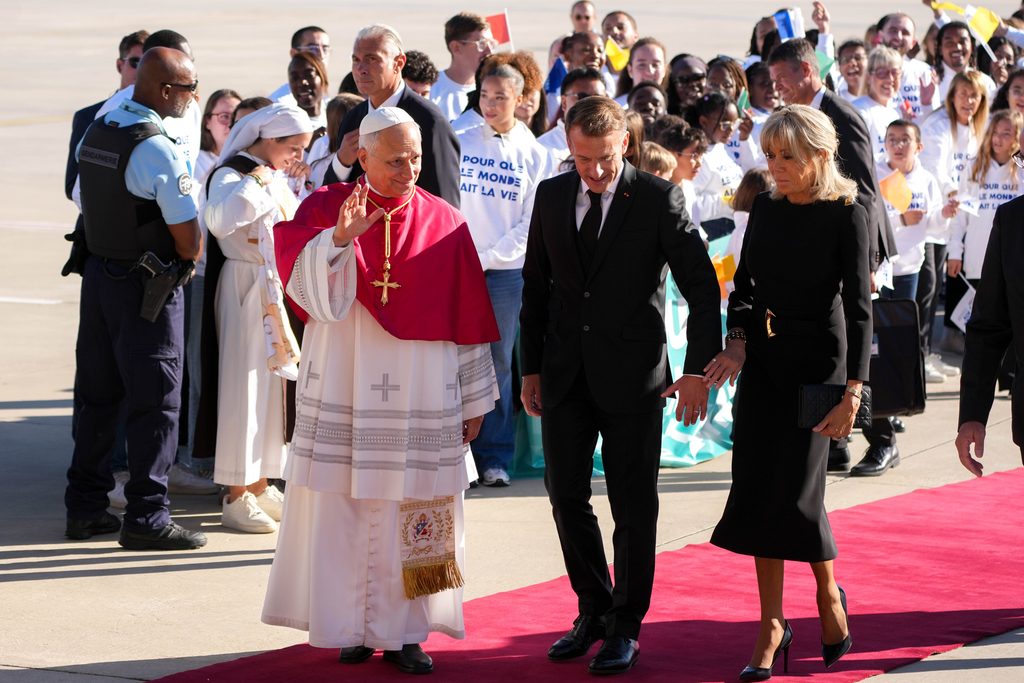
The first greeting to the Pope, whose ITA Airways A321 plane landed at Paris/Orly at 9:56 a.m. on Friday, September 25, was the ringing of bells. Bells from French churches rang for seven minutes to celebrate the arrival of Leo XIV on French soil. And some rang again as he approached Notre Dame in the afternoon.
The affection was palpable after every event the Pope attended in Paris. People wanted to be with the Pope, to talk to him, to greet him. Benedict XVI was there in 2008, 18 years ago, and, to put it colloquially, many French people were eager to see a Successor of Peter smile and touch them.
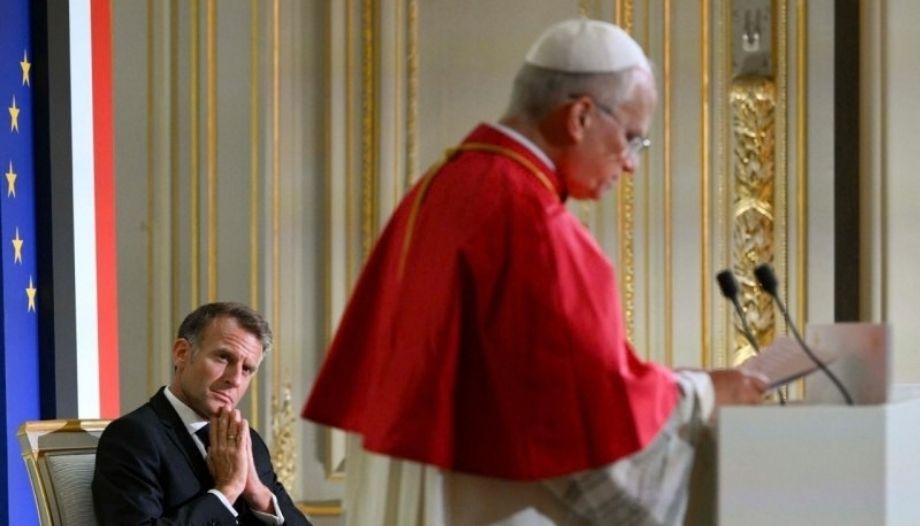
And so it happened at the Élysée Palace, with the president Emmanuel Macron (and his wife) who introduced the Holy Father, almost one by one, to the authorities, members of civil society, and diplomats. Everyone wanted to greet the Pope. This was also the case at the United Nations Educational, Scientific and Cultural Organization (UNESCO), where hardly anyone blinked during his extensive speech of more than 20 minutes, which received prolonged applause.
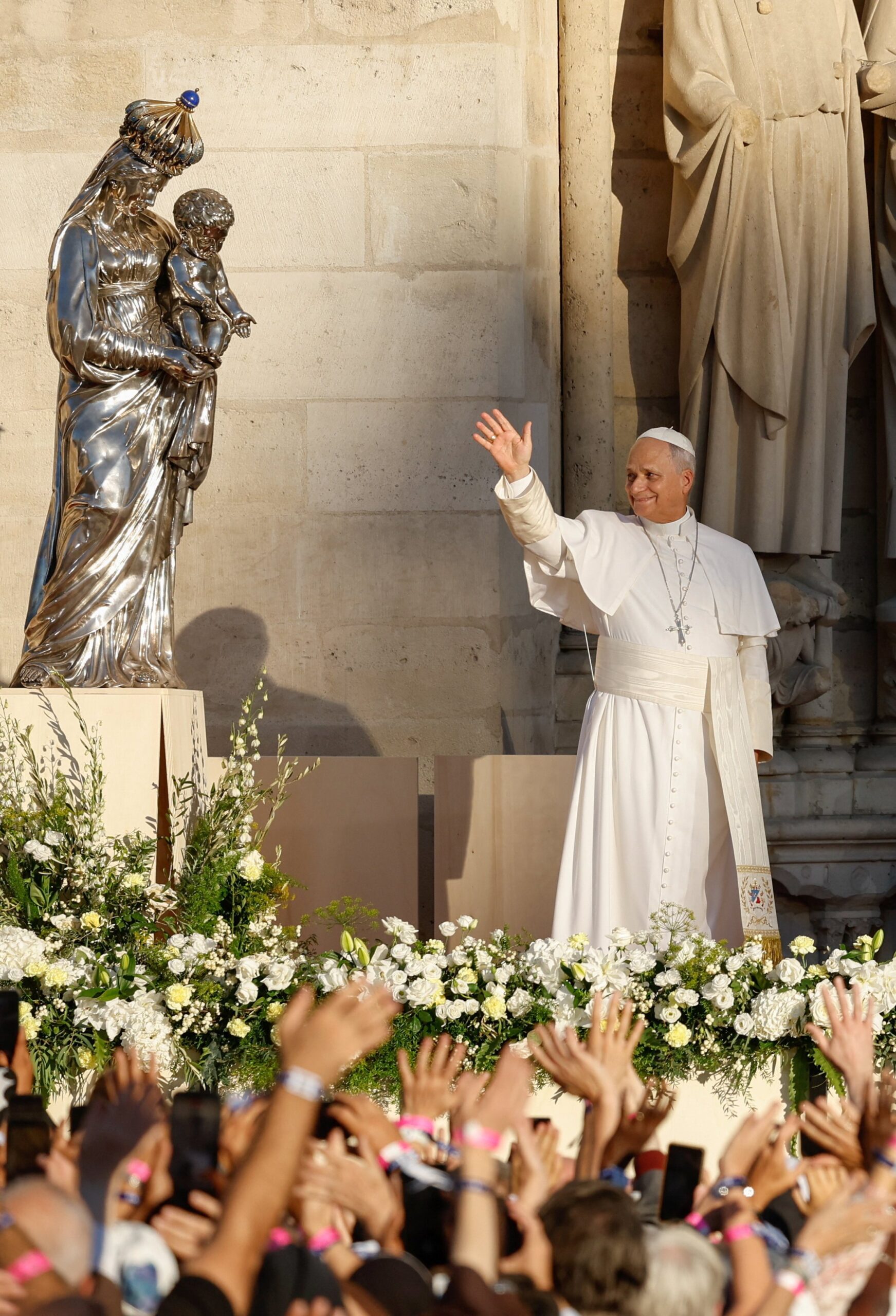
It could be seen on the journey in the Popemobile to the beautiful and restored Notre Dame Cathedral, where so many people waved banners, cheered and greeted the Pope, far from secular coldness.
The Parisians wanted to see the Pope
The Archbishop of Paris, Monsignor Laurent Ulrich, said it shortly before the Pope's homily at Notre Dame Cathedral: 'The Parisians wanted you to come.' And Leo XIV came to see them. Unity.
Don't be fooled by Saint Denis at night. The Youth Vigil only held 80,000 people, aged 17 to 35. No exceptions. Many were unable to get tickets long ago, and are seeing it (as I write these lines) through digital media, television, etc.
Protect all human life
On paper, there were four main events on this first day of Pope Leo XIV's visit to France. And all of them were in Paris: government officials, UNESCO, Notre Dame with the local Church, and the Youth Vigil.
The motto for Leo XIV's visit, proposed to the Pope by Cardinal Jean-Marc Aveline, president of the French Episcopal Conference, is "That the world may have life," an expression inspired by the Gospel of Saint John.
It is not surprising that the Pope addressed this issue during the meeting with President Macron and other officials. In his speech at the Élysée Palace, the Pontiff reminded French leaders of their duty to "protect all human life," condemning "assisted suicide, abortion, and surrogacy," as reported by OSV News.
Foundation of all other human rights
“The protection of the right to life constitutes the indispensable foundation of all other human rights,» said the Pope, who expressed his concern about «trends in society that risk turning science and technology into profit-driven businesses that promote genetic manipulation, surrogacy, the trade in human organs, or the possibility of arranging one’s own death.».
Leo XIV stressed the need to “welcome life unconditionally, to support the vulnerable with love, to accompany each stage of life with respect and mutual trust, and to defend with courage and compassion those who cannot make themselves heard and those who feel ignored or forgotten.”.
Defense of the Church and “France’s deep Christian roots”
Furthermore, the Successor of Peter highlighted the care of French saints for the disadvantaged. He mentioned, among others, the example of the charitable works of Saint Vincent de Paul in 17th-century Paris and the numerous Catholic institutions that continue that legacy today.
“The Catholic Church in France has shown a constant concern for the well-being of the poor and disadvantaged, and has sought to be the living face of God’s mercy and compassion,” he noted.
Furthermore, Leo XIV emphasized the central importance of the Catholic faith in French culture for many centuries, describing it as “a land with deep Christian roots,” from St. Irenaeus of Lyon in the 2nd century to the baptism of Clovis, King of the Franks, in 496, whose conversion led to France being known as the “Firstborn Daughter of the Church.”.
UNESCO: Promoting dignity and peace
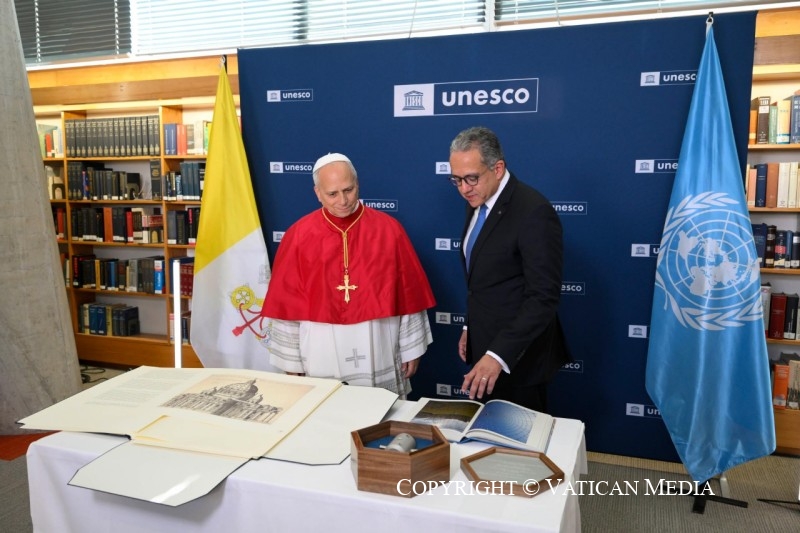
In 2027 we will celebrate the 75th anniversary of the Holy See's presence in the UNESCOA presence that arises from the conviction that the future depends, above all, on respect for and promotion of the inalienable dignity of every human being created in the image of God, the Pope declared in the UNESCO, where he was received and accompanied by the general manager, Khaled Ahmed El-Enany.
The Holy See considers this organization “as a privileged interlocutor in the service of the common good, which is the 'social form of dignity' that we all share in an original and equal way (cf. Encyclical Letter Magnifica Humanitas, 59).‘.
Not the domination of Babel, but the peace of Pentecost
In his speech, the Pope stressed that “it is not the domination of Babel, but the peace of Pentecost, that makes this communion between all peoples possible.
Each culture, therefore, reaches its highest wisdom when it seeks peace and the good of all, bearing witness to the true meaning of our humanity.”.
Touchstones of our commitment
The touchstone of the commitment to care for the person and for creation, the Pope affirmed, is “the care we give to the smallest and the poor: children in their mothers” wombs and in the various scenarios of war; people with physical and intellectual disabilities; the elderly; migrants and refugees; and all those whom arrogance excludes for considering them unproductive.”.
“They are the true proof of our claims about respect for human dignity, and their protection and promotion extend to creation as well,” he added. Therefore, “the current ecological crisis is also an anthropological crisis,» he emphasized.
Notre Dame, vital center of a civilization
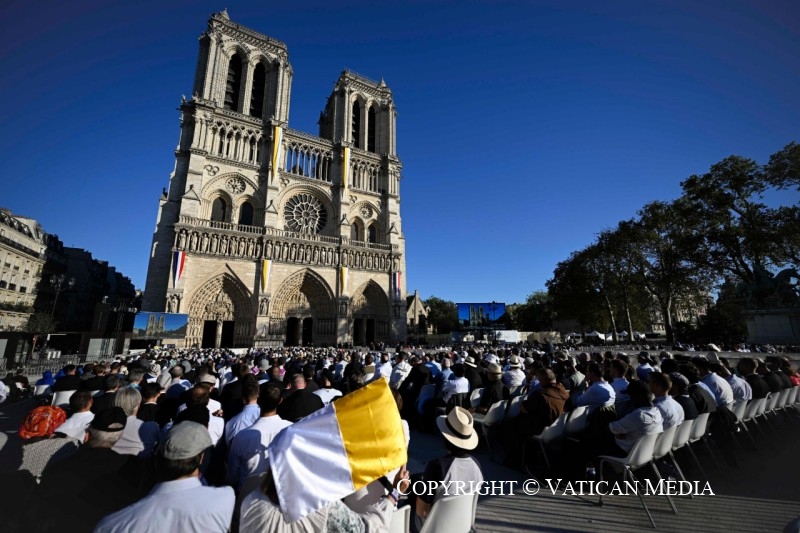
The Pope then traveled in the popemobile to Notre Dame Cathedral to pray Vespers, where he opened his heart again and shared some messages with the Church that journeys in France.
First, the reference to the fact that "seven years have passed since the whole world, holding its breath, watched as the cathedral was devoured by a terrible fire," and to the pain of all.
“Notre-Dame is much more than a monument,” the Pope said. “The participation of everyone in its reconstruction and, today, the splendor of the result, show that in this place beats the heart of a people; that we are at the vital center of a civilization; that here the past and the future embrace and heaven and earth meet.”.
“The Christian community is not a refuge to retreat to.”
At another point in the homily, the Pope asked bishops, priests, deacons, consecrated persons, and seminarians of France: “Let yourselves be inspired by what has happened here! Give priority to Evangelii gaudium, that is, to that missionary conversion to which Pope Francis bore witness from his first Apostolic Exhortation.”.
“As disciples of Christ, you know well that the Christian community is not a refuge to retreat to in order to protect yourselves from your times,” he encouraged everyone.
On the contrary, it offers itself, like the ancient cathedrals, as a space of welcome, respect, revelation, and meaning for all. (…) May it be a living, multifaceted, and approachable Church.”
Furthermore, the Holy Father asked them to “value with confidence the missionary presence of the lay faithful, who are the living vanguard of the Church at the crossroads of daily life.”.
“An authentic love for the liturgy”
Near the end, Leo XIV said: “To you, who celebrate the Eucharist daily, I ask that you ensure that liturgical celebrations are always lived with dignity and decorum, even where smaller communities gather. Be conscious heirs of the Fathers and Saints of the Church who, throughout the centuries, have transmitted to us the profound meaning and beauty of the liturgy, always bearing witness to great humility before the Mystery being celebrated.”.
“I therefore urge all of you, bishops, priests, deacons and consecrated persons, to cultivate an authentic love for the liturgy.”.
At nightfall, as these lines were going to press, the Vigil of the young people with the Pope at the Olympic Stade de France, with nearly 80,000 young people and a few testimonies, such as those of Chloé and Francois, which were answered by the Holy Father.





 Español
  English
  Italiano
  Français
  Deutsch
  Polski
  简体中文
简体中文