


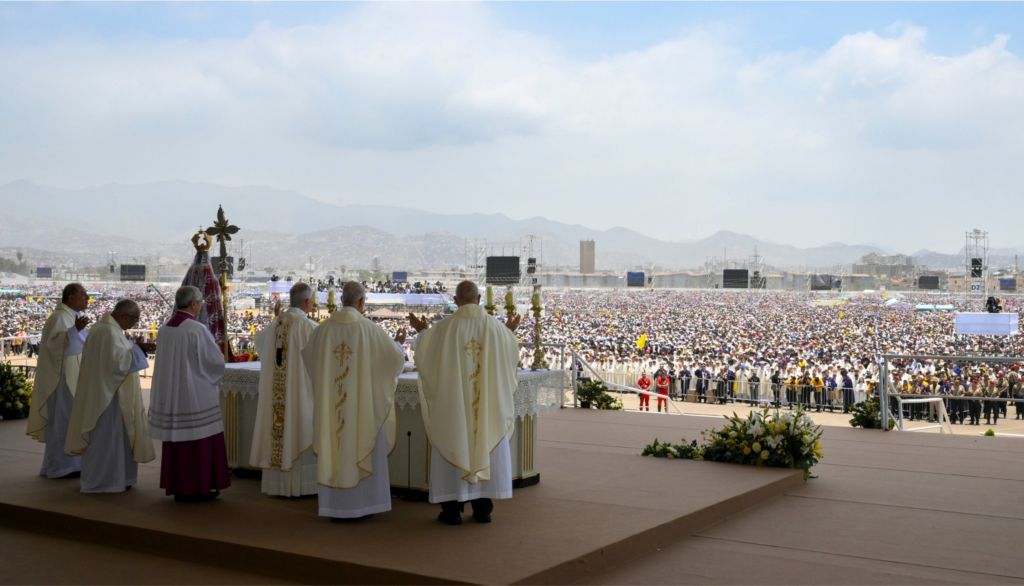
“Dear brothers and sisters: at the end of my apostolic visit, I too wish to confirm you in faith and charity, and assure you that I will always carry you with me. Yes, the Peruvian people are also my people,” Leo XIV declared to the Peruvians who have been showing their support for their Pope these past few days.
Your message in the Final Mass From the Las Palmas Air Base in Lima, before a veritable multitude—a million and a half people, according to Vatican sources (and exceeding the expectations of the Archdiocese of Lima)—his journey ended, “but the mission continues! Let us remember that at the end of every Mass we are sent out to evangelize. Therefore, go and proclaim the true God! Bear witness to what you have seen and heard! Let no one be left without knowing this Good News!”.
The essence of the Church's mission
“The mandate of the one true Lord (…) helps us understand the essence of the mission of the Church: to carry forward the work of Jesus Christ, with his power, so different from worldly powers,” the Successor of Peter pointed out.
And as if afraid of leaving them alone, the Holy Father dedicated a large part of his homily at the final Mass to speaking to them about Saint Toribio of Mogrovejo, ...at a votive Mass dedicated to him and other Peruvian saints. Leave them in good company.
The testimony of Saint Toribio
On several occasions, the Pope has referred to the example of the patron saint of Latin American bishops. He began by saying: “Three hundred years after the canonization of Saint Toribio de Mogrovejo, the second Archbishop of Lima, we Peruvians give thanks for the gift of the Christian faith that his apostolic witness has deeply rooted in our people.”.
“The saints are the true interpretation of Sacred Scripture. The saints have verified, in the experience of life, the truth of the Gospel; thus they introduce us to the knowledge and understanding of the Gospel,” the Pope continued, quoting his predecessor Benedict XVI.
His calling: he set out on his journey
“Like the first disciples on the Sea of Galilee, he (Saint Toribio) received a unique invitation from Jesus, a vocation that took him by surprise,” the Vicar of Christ noted. “Despite being a layman with a promising career in law, Toribio was called to be a pastor of the Church. From then on, like the apostles, he set out following the Lord.”.
He crossed the country on foot, hundreds and hundreds of kilometers, aware that he was following Jesus himself as he went to meet the indigenous peoples. “That is why he sought his presence in the midst of those communities, while still learning their language and understanding their beliefs, all with the purpose of recognizing the silent work of the Holy Spirit,” the Pope noted.
Dedication to pastoral visits
“Toribio wanted the indigenous people themselves to evangelize their relatives, friends, and neighbors. He wanted, in fact, for the longed-for abandonment of ancestral beliefs to come of their own free will, without coercion. This is demonstrated by his tireless dedication to pastoral visits, carried out to get to know, help, and, if necessary, correct his faithful, to instruct them in the divine Word and administer the Sacraments,” continued the first Peruvian Pope in history.
He continued: “Those visits caused him opposition and slander, even from the authorities; however, they allowed him to be and show himself as a missionary, evangelist, father and pastor, with no other concern than to communicate the divine life offered by the Good Shepherd.”.
With his example, Leo XIV emphasized, “Saint Toribio invites us to sanctify our relationships in the Church; his life proposes that we recognize ourselves as living members of one body. He opened his heart to ecclesial communion, experiencing the Church as a missionary communion: the communion that springs from being the true dwelling place of the Trinity, and which therefore values differences, sensibilities, and distinct thoughts within the unity of faith. This unity is manifested and consolidated in the Eucharist, the sacrament of unity, which for Saint Toribio was the center of life.”.
Architect of the civilization of love
“Saint Toribio de Mogrovejo was an architect of the civilization of love,” the Holy Father concluded. “Contemporary saints are also protagonists of that civilization: Rose of Lima, Martin de Porres, Francis Solano, among others. Looking to them, let us rediscover with gratitude the gift of being the Church of Jesus Christ and, each time we celebrate the Eucharist, let us return to his promise: ‘Know that I am with you always, to the very end of the age.’”.




 Español
 English
 Italiano
 Français
 Deutsch
 Polski