


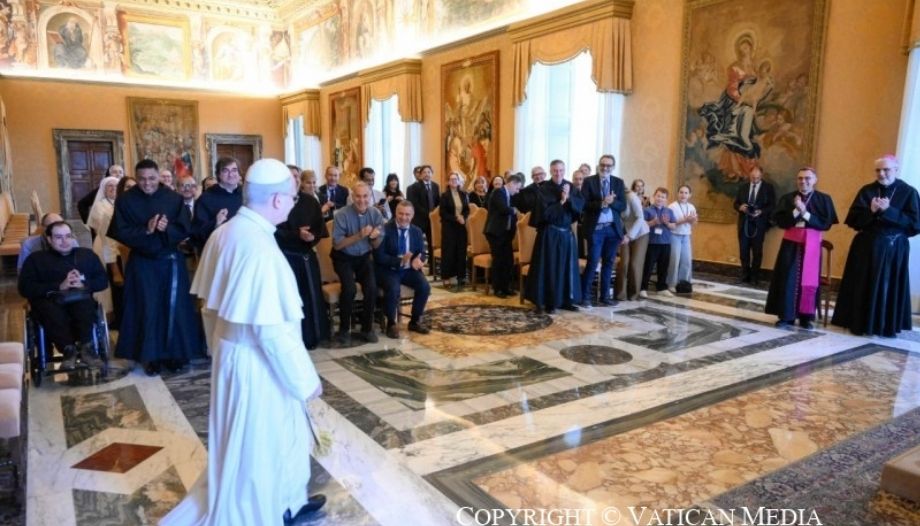
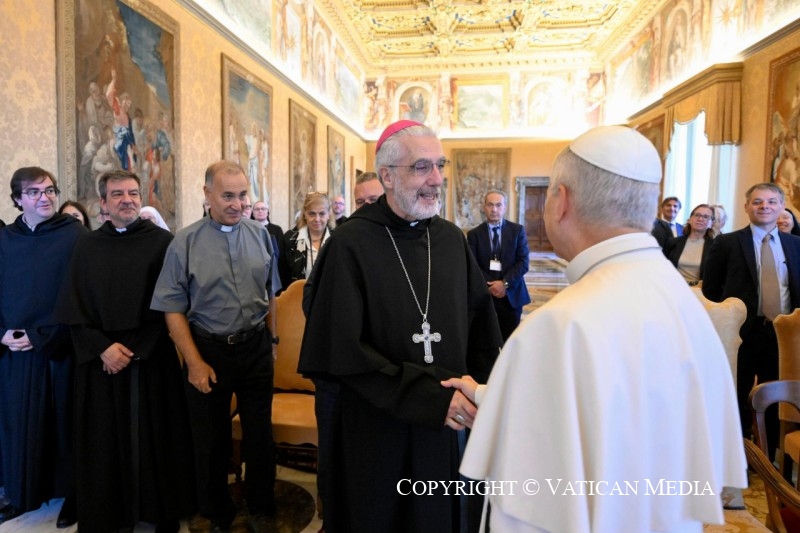
On Friday, the Holy Father received at the Vatican the members of the “International Center for Pope Leo XIV Studies,” a research and cultural organization founded in October 2025 on the initiative of the Order of St. Augustine to promote the figure and teachings of Leo XIV, and education in public life for the common good.
"I am particularly grateful to you for that," said the Augustinian Pontiff in his Speech, given the importance of reflection and critical thinking in building a civilization of love, to which the Church’s Social Doctrine has much to contribute.
Broad Dialogue and Collaborative Relationships: “Always Walking Together”
“From the very beginning, I have appreciated the Center’s willingness to engage in ”a broad dialogue,’” the Pope emphasized, “with universities, academic institutions, public agencies, civil society, ecclesial institutions, and associative networks, fostering collaborative relationships and exchanges at the national and international levels.”.
This commitment is evident in the collaboration with the Faculty of Theology of Central Italy and the Pontifical Patristic Institute Augustinianum, which are also mentioned in the Center’s founding charter. “The secret lies in always walking together, without ruling out encounters even with those who are different and seem to think, speak, or act differently,” the Holy Father said.
The Work of Laypeople and Men and Women Religious in the Social Doctrine of the Church
«The contribution of the Church’s Social Doctrine also has these popular roots that we must not forget,” the Pope continued. “Its reinterpretation of Christian Revelation in the context of modern social, labor, economic, and cultural circumstances would be unimaginable without the laity who faced the challenges of their time. Working alongside them were men and women religious, witnesses to a Church that was moving away from well-trodden paths.”
The turning point we are facing today, Pope Leo XIV added, “makes continuous interaction between the baptized and the Magisterium, between citizens and experts, and between the people and institutions even more necessary” (Apostolic Exhortation Dilexi te , 82). ”May your Center for Studies promote this endeavor, which requires pioneers and facilitators, especially when mistrust and resignation threaten to take hold.”.
Building relationships based on solidarity, justice, and peace
“At the risk of swimming against the current,” the Successor of Peter continued, “its mission of hope consists in promoting, in Italy and throughout the world, an education in public and political life ”understood as service to the common good, responsibility toward the community, and the building of relationships based on solidarity, justice, and peace. Therefore, the opposite of resignation!".
Furthermore, as he emphasized Pope Francis, speaking in Florence, said, “There is no authentic humanism that does not view love as the bond between human beings, whether interpersonal, intimate, social, political, or intellectual” (Speech at the Fifth National Convention of the Italian Church, November 10, 2015).
Love commits us to building
The Augustinian reflection underlying this initiative has much to offer in this regard in today’s international context, the Pope stated, “for an understanding of love as a principle of renewal in personal, economic, and political life. Love unites to set free, unites to create, and commits us to building.”.
If we look at history in light of the Crucified and Risen […], he continued, “We do not view the present as a predetermined fate, but as a space open to personal and collective transformation,” and “we believe in the power of the Kingdom, which springs from the smallness of a mustard seed” (Magnifica humanitas, 210).
“Experts on the Newness of God”
“Let us be experts in God’s newness: not the kind that dazzles with its speed and effectiveness, but the kind in which He works silently, freeing the old world from its dead ends and opening paths along which we can move forward together toward His city,” concluded Leo XIV, alluding to St. Augustine’s well-known work *The City of God*.






 Español
  English
  Italiano