


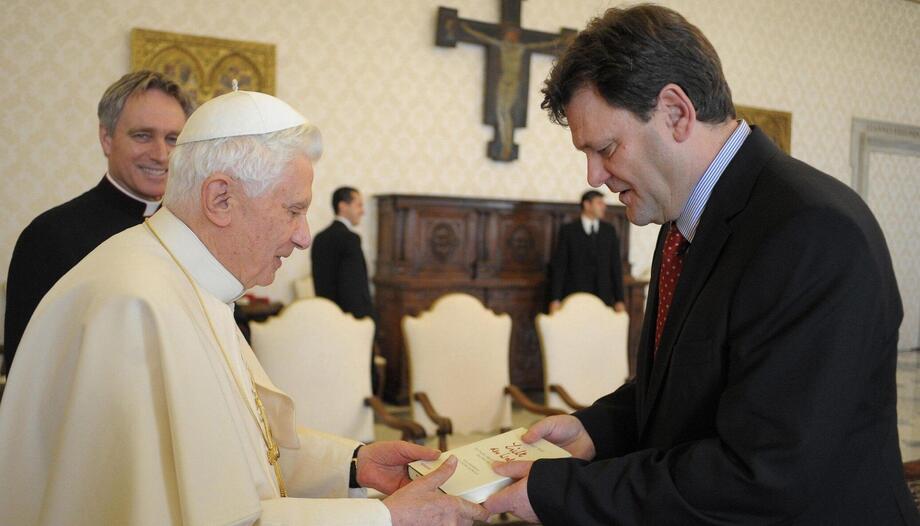
 Benedict XVI more intimateJesus of Nazareth' is the life's work of Benedict XVIBenedict XVI's unpublished letter: "My resignation is full and valid".
Peter Seewald will be the main speaker at the second session of the commemorative events that CEU San Pablo University is carrying out on the occasion of the centenary of the birth of Joseph Ratzinger.
The event will take place on November 18th, at 7:00 pm in the Auditorium of the Faculty of Economics at CEU San Pablo University. (C/ Julián Romea 23) and is jointly organized by the Ángel Herrera Oria Cultural Foundation and the one itself CEU San Pablo University. This meeting will feature the special participation of the German journalist and writer Peter Seewald, considered the main biographer of Benedict XVI and the closest interlocutor of the Bavarian pontiff.
An open conference for anyone who wishes to attend, featuring the author of titles such as The Salt of the Earth: Who Benedict XVI Is and How He Thinks o Light of the world: the Pope, the Church and the signs of the times.
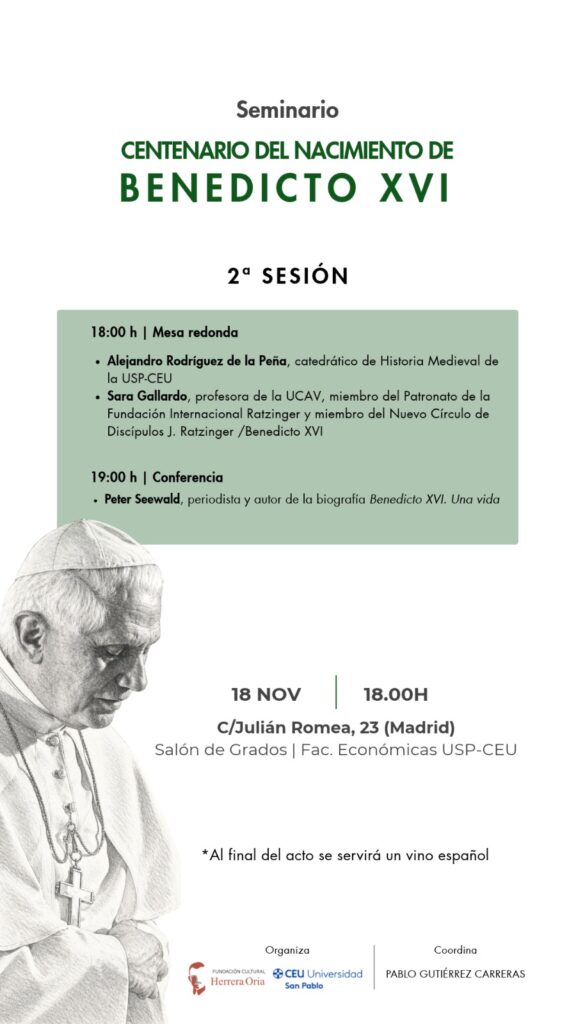
The second session of the commemorative events for this centenary will begin an hour earlier with a round table discussion featuring Alejandro Rodríguez de la Peña and Sara Gallardo, who will delve into the intellectual, cultural, and historical significance of Joseph Ratzinger's thought.
The career of Peter Seewald
Peter Seewald is one of the journalistic voices that has most profoundly portrayed the contemporary Church. Seewald began his professional relationship with Ratzinger when the latter headed the Congregation for the Doctrine of the Faith, and from extensive conversations and unprecedented biographical access emerged fundamental works: The salt of the earth (1996), God and the world (2000), Light of the world (2010), Latest conversations (2016) and his monumental two-volume biography, Benedict XVI: A Life.
Through these dialogues, Seewald explored not only the theological debates surrounding modern secularization, but also the intimate dimension, his renunciation of the Petrine ministry, and the most complex milestones of his papacy.
The centenary of an intellectual and spiritual icon
Born in Marktl am Inn (Bavaria) on April 16, 1927 and died on December 31, 2022 in the monastery Mater Ecclesiae From the Vatican, Joseph Aloisius Ratzinger left a profound mark on the Church of the 20th and 21st centuries.
A prominent theological expert during the Second Vatican Council and university professor in Bonn, Münster, Tübingen and Regensburg, he was appointed Archbishop of Munich and Freising before assuming the prefecture of the Congregation for the Doctrine of the Faith in 1981 alongside Saint John Paul II.
Elected head of the Catholic Church on April 19, 2005, Benedict XVI centered his teaching on the harmony between faith and reason in the face of the «dictatorship of relativism,» as stated in encyclicals such as Deus caritas est, Spe salvi y Caritas in veritate. Its history resignation In February 2013, he inaugurated an unprecedented stage as Pope Emeritus, dedicated to study and prayer.



 Español
 English
 Italiano
 Français
 Deutsch
 Polski