


ARTISTIC COMMENTARY
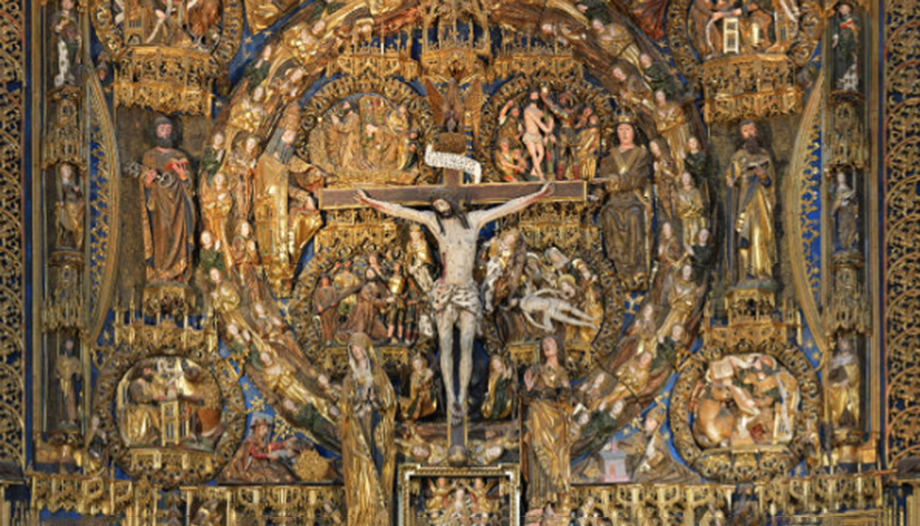
Located in the lower section of the main altarpiece of the Church of the Cartuja de Miraflores (Burgos) is one of the most frequently depicted scenes in religious art: the Annunciation.
The figures are arranged in a semicircular space enclosed by four angels. In the upper right corner is a six-pointed star, alluding to the light that would later guide the shepherds and the Three Wise Men. The Virgin Mary is depicted in an imaginary setting, reclining before an open book—a symbol of meditation on the Scriptures. At her feet, a vase of white flowers symbolizes her purity.
Although the Gospels do not mention that Mary was praying at the time of the Annunciation, Christian tradition and many spiritual authors have interpreted her attitude as one of contemplation and openness to God’s will, consistent with the expression “full of grace.” The angel Gabriel, a divine messenger, appears accompanied by two other angels and reveals to Mary the mystery of the Incarnation. After the “fiat”, the “Let your word be done in me "”, the Holy Spirit descends upon the Virgin while rays of light emanate from the Father, carrying the Child toward his Mother’s ear; a vivid and deeply symbolic way of depicting the Incarnation of the Word.
The Altarpiece as a Visual Bible
It is important to remember that this altarpiece was created in the 15th century, at a time when a large portion of the faithful were illiterate. Mass was celebrated in Latin, a language that many did not understand. The altarpiece, therefore, served an essential catechetical function: it was the “Bible of the poor,” a visual aid for contemplating and understanding the mysteries of the faith. The scene of the Annunciation also served as a reminder of the beginning of Redemption, linking the birth of Christ with the Eucharistic offering depicted in the central scene.
We can appreciate the richness of the Virgin’s and the angels’ garments, as well as the lavish use of gold. This pictorial language sought to bring the faithful closer to the heavenly realm through the use of the most valuable materials. Divine events were depicted using the most expensive pigments and materials, such as lapis lazuli—imported from Afghanistan—for the color blue (the Virgin’s mantle is typically rendered in this intense blue) or gold, as an evocation of heavenly light. The figures are depicted wearing clothing contemporary to the time of the painting’s creation, a common device used to make sacred scenes more accessible to late-medieval viewers. The faithful were not merely contemplating a biblical episode, but also a model of virtue and devotion, presented with the greatest possible realism.
A work of the Spanish-Flemish Gothic style
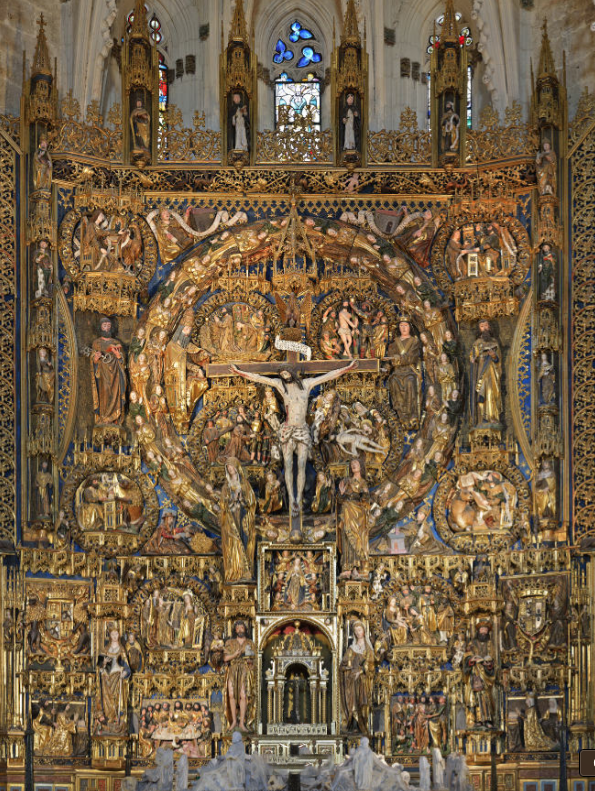
The altarpiece is a monumental wooden structure located in the sanctuary, organized into panels depicting scenes from the history of salvation. The central scene celebrates the Eucharist through the figure of Christ on the cross, surrounded by scenes from the Passion, the Nativity, and other key moments, as well as depictions of saints, evangelists, and notable figures.
The carving and design of this original altarpiece were carried out by Master Gil de Siloé and his workshop. A work of such magnitude required the collaboration of numerous artisans under the master’s supervision, which explains the stylistic differences in the execution of some scenes. Once the carving was complete, the painter Diego de la Cruz was responsible for the polychromy and embellishment, applying complex and costly techniques.
Among these techniques, the most notable are “estofado,” which involves applying gold leaf to the wood and covering it with tempera paint, then scraping away the paint to reveal the gold, creating patterns that mimic brocades, embroidery, or rich fabrics; and pastillage, which involves adding reliefs made of paste to simulate halos, the edges of garments, jewelry, flowers, and other ornaments, which were then gilded and polychromed. Late Gothic Spanish artists were true masters of these techniques, which lent a sense of luxury and spirituality to the sculptures.
The main altarpiece of the Miraflores Charterhouse was created between 1496 and 1499 as a commission from the Catholic Monarchs, driven in particular by Isabella the Catholic. It is considered one of the masterpieces of Spanish-Flemish polychrome sculpture and an exceptional example of the union between art, theology, and visual catechesis in 15th-century Spain.
CATECHETICAL COMMENTARY
At the center of the altarpiece at the Miraflores Charterhouse stands what constitutes the heart of the Christian faith: the Incarnation of the Son of God in the humanity of Jesus of Nazareth, who gave himself for the redemption and salvation of humanity. This wondrous event—a decision existing in the eternity of the Father, the Son, and the Holy Spirit (the three divine persons who form the horizontal axis of the altarpiece) is fulfilled at the time of the Annunciation, when the Word is incarnated in the virginal womb of Mary to devote Himself to God’s plan of salvation (the Cross and the Exaltation, situated on the vertical axis).
From the very beginning, the Incarnation has been the central pillar of the Christian faith, the great mystery of piety: God became flesh. Hence, to properly honor this mystery—whose complex depth is expressed in the magnificent catechesis of the Miraflores altarpiece—Queen Isabella turned not only to the finest artistic workshop but also to the finest materials, techniques, and pigments. Ultimately, the Incarnation is the mystery of faith that lies at the very heart of the Creed: “For us men and for our salvation, He came down from Heaven, and by the power of the Holy Spirit was incarnate of the Virgin Mary".
The Purpose of the Incarnation
To understand the purpose of this eternal decree of the Holy Trinity is, therefore, to grasp at its very root the meaning and purpose of the entire Christian revelation. The purpose is not singular; rather, we can view it as unfolding in three broad stages, through which we come to see the immense richness of this central mystery of the faith.
God’s first goal is the salvation of humanity. To bring about salvation, He first frees us from sin, reconciling humanity to Himself. Second, also to save us, He reveals to us the immensity of His love for us (1 John 4:9–14). Both of these—reconciliation from sin and the testimony of divine love—are what shine forth on the Cross, the first stage of this work of salvation and the central figure of the Miraflores altarpiece.
The second step is to instruct humanity, since the risen Christ presents himself to us as the way and model of perfect humanity and holiness. It is no coincidence that the central circle of the altarpiece, which encloses the divine mysteries, is surrounded by the four tondos depicting the Doctors of the Church, who are charged with instructing the Church in the teaching of the Incarnate Word. In fact, Christ is presented in the Gospels as the Teacher from whom we are to learn (Mt 11:29), the Way to follow (Jn 14:6), the divine Voice to be heeded (Mk 9:7), and the supreme Model of Love (15:12), expressed in the gift of himself.
The third step is to lead humanity—redeemed from sin and instructed by the Word—to share in the divine nature. The Incarnation is the path opened to humanity to share in the divine nature of the Word (2 Peter 1:4). Every human being who enters into communion with the incarnate Son becomes a child of God, receiving filial adoption from the Father and entering the path of deification through the gift of the Holy Spirit. The entire altarpiece is a summary of what God offers to humanity through the Incarnation of his Son.
Faith in the Incarnate Word
In short, faith in the Incarnation acknowledges that the Son of God has assumed a human nature in order to carry out, through it, the plan determined by the Trinity for our salvation. It also accepts the true reality of the Incarnate Word, without reducing Him to a sum of parts (divine and human) or a confused mixture of the divine and the human. The Incarnate Word is true God and true man, but the difficulty of rationally accepting this faith gave rise from the beginning to numerous heresies that distorted the faith in the Incarnate Word.
Deviations such as Docetism (Christ’s humanity is only apparent), Arianism (Christ’s humanity is real but united to a created god, not to the Son consubstantial with the Father), Nestorianism (in Christ there is one human person and one divine person), or Monophysitism (the human nature is absorbed and virtually disappears into the divine nature). In response to these, the Church progressively defined the true faith in the Incarnate Word through a series of dogmatic formulations, the best example of which is that formulated at the Council of Chalcedon (5th century): “We must acknowledge one and the same Christ the Lord, the only Son in two natures, without confusion, without change, without division, without separation".
That is why we must affirm that the humanity of Christ, the Incarnate Word, has no other subject than the divine person of the Son, who assumed it and made it his own from the moment of the Incarnation in Mary’s womb, as the scene from the altarpiece selected here illustrates in greater detail. Everything in Christ’s humanity must be attributed to his divine person—including his sufferings and death, not just his miracles and authoritative teaching. Truly God, the person of the Son, died in the sacrifice of the Incarnate Word on the Cross. This is the profound and awe-inspiring truth of the Incarnation, which strikes us powerfully as we contemplate the altarpiece as a whole.
The Incarnate Word, on the other hand, not only takes on a body, but also a human soul and heart—a complete human nature. Christ’s soul truly possesses human knowledge, which as such was capable of and required development (Lk 2:52), and at the same time, because it was united to the Word, knew everything, including the divine. This is where Jesus Christ’s intimate knowledge of his Father God (Mk 14:36; Mt 11:27) comes into play, as well as his knowledge of his saving plans. The soul of Christ also possesses a true human will, always cooperating with the Father’s will, thus demonstrating the perfect fulfillment of the will of a human being. The Son obeys the Father’s decree in eternity by becoming incarnate through the Holy Spirit, while the Incarnate Word obeys this decree even unto death on the Cross.
The human heart of Jesus Christ is depicted in the Eucharistic Pelican that crowns the altarpiece, tearing itself open to feed its young with its own blood. In the heart of Christ, throughout his life and passion, there is a knowledge of and love for every human being. That is why it is also the heart of the Incarnation, and the principal symbol of that love which gives meaning and purpose to the Incarnation—the love with which the Redeemer loves the Father and every human being.
Art historian and Doctor of Theology






 Español
  English
  Italiano
  Français
  Deutsch
  Polski