


Parisians call it "la Catho": the Catholic Institute of Paris (ICP). On Saturday, September 26, it will host Pope Leo XIV, who will meet there with members of the Provincial Synod Assembly, catechumens, and neophytes to listen to and discuss the phenomenon of the exponential increase in adults (mostly young people) requesting baptism in France.
Before the meeting, the Pope will visit the Church of Saint-Joseph-des-Carmes, founded in 1613 by Marie de' Medici and dedicated to Saint Joseph in 1625. He will pray briefly with students, professors, and seminarians. Afterward, he will walk the route of the martyrs of September 2, 1792, to the Georges Bernanos Auditorium.
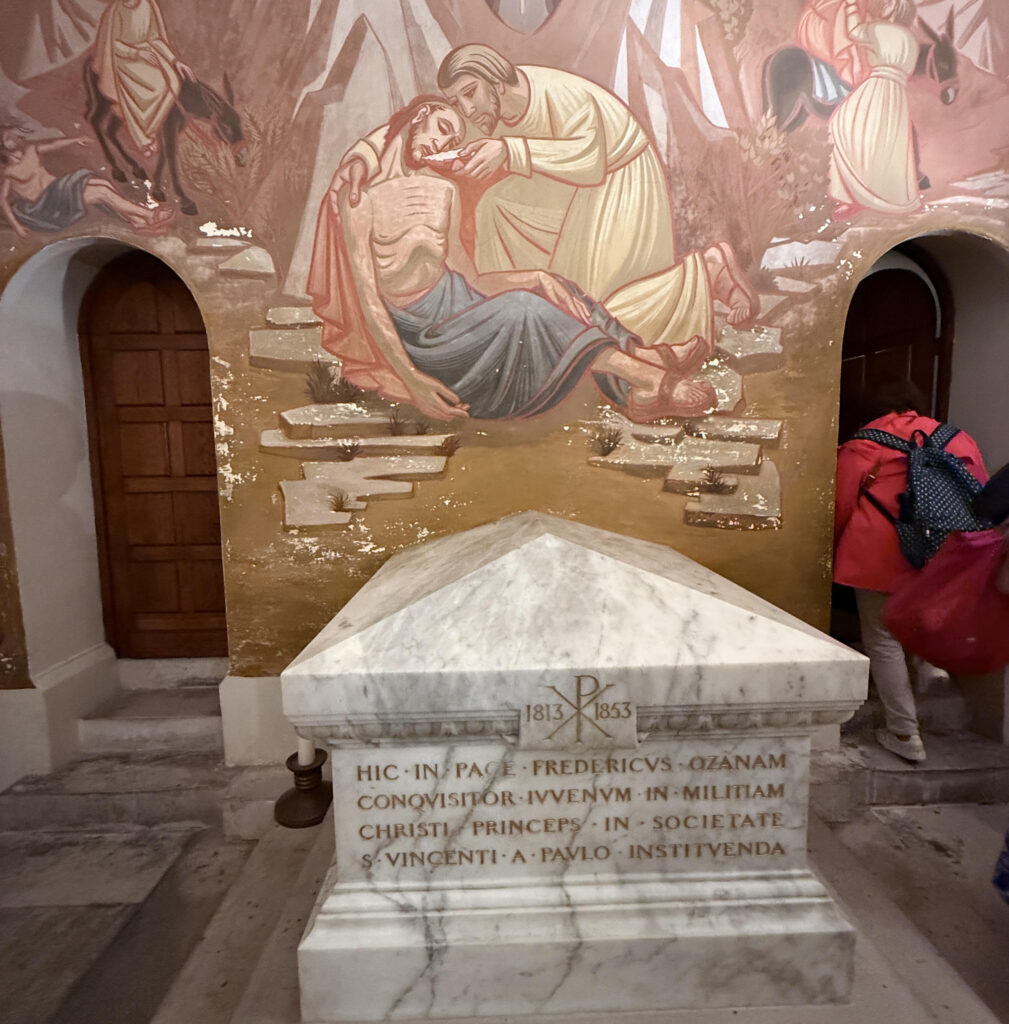
The Saint-Joseph-des-Carmes church belonged to the old convent where, on September 2, 1792, the martyrs of Carmen, Among them is Saint Salomon Leclercq. The tomb of Blessed Frédéric Ozanam is also in the crypt of this church.
The history of the Carmelite convent
In 1610, three Discalced Carmelite friars arrived in Paris: Thomas of Jesus, Denys de la Mère de Dieu, and Bernard of Saint Joseph. Marie de Medici took the foundation under her protection, and in 1611 the convent on Rue Vaugirard was inaugurated.
Here they fell (Hic ceciderunt)
On August 17, 1792, the Carmelite friars received orders to leave the convent. The church had already been converted into a prison for priests who refused to swear allegiance to the Civil Constitution of the Clergy, approved by the French National Assembly in 1790. There were 160 prisoners.
The guards slept inside the church, and the prisoners were not allowed to celebrate Mass. Even so, they organized their religious life into three groups led by the bishops: while some prayed, others recited the Divine Office, and the rest rested.
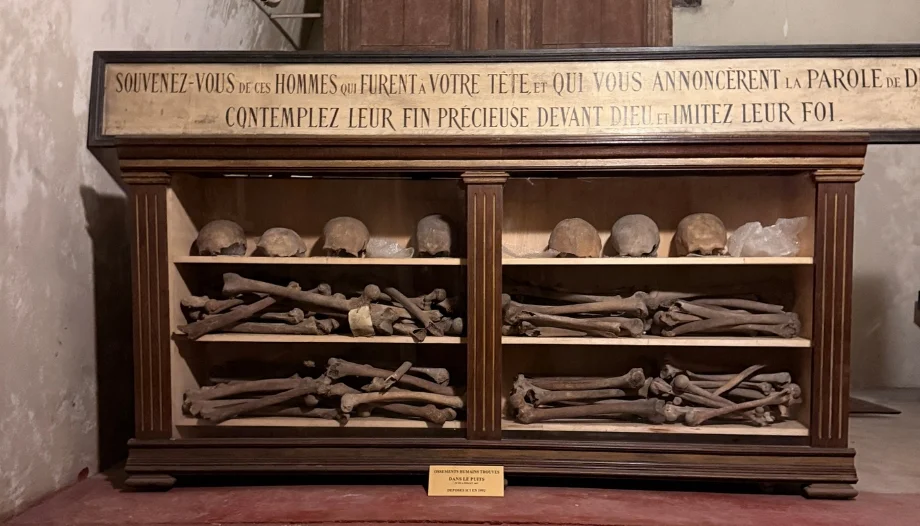
On September 2, around four in the afternoon, armed men entered and staged a mock trial. One by one, the clergymen were invited to take the oath they had previously refused. Those who refused were condemned to death. Within about two hours, there were approximately 115 corpses. The following day, the bodies were thrown into a well or taken to the cemetery.
Today, on the staircase of martyrdom, within the garden of the old convent, a plaque commemorates this: Hic ceciderunt, "Here they fell." In the crypt, another inscription summarizes the reason for their death: «"Having preferred death to violating God's holy law, they were massacred."».
From the convent to the university
Following the massacre of 1792, the Carmelite convent was sold as national property. In 1797, it was acquired by the Carmelite nun Camille de Soyécourt, and in 1845, the nuns ceded it to the Archbishop of Paris, Monsignor Denys Affre, who founded the School of Advanced Ecclesiastical Studies there. In 1875, the convent hosted the first courses of the Catholic Institute. In 1919, the Carmelite Seminary opened, welcoming seminarians from various dioceses in France. It operated until 2026, when its seminarians transferred to the new university seminary in Issy-les-Moulineaux, near Paris.
Salomon Leclercq: «Firm in faith»
Among those imprisoned in the 1792 massacre was Salomon Leclercq, secretary to the superior general of the Brothers of the Christian Schools (De La Salle Brothers). Nearly 130 of his letters, written to his family between 1768 and 1792, have been preserved. From a young age, he desired to live solely for God.
The son of a merchant from Boulogne-sur-Mer, he was sent to Paris to learn the trade. The city bewildered him. In 1767 he entered the Brothers' novitiate. He served as a teacher, formator, and administrator, and in 1787 became secretary to the superior general.
In 1791, when the Brothers were forced to leave their homes, he dressed in civilian clothes and stayed behind to guard the headquarters of the general council. On August 15, 1792, he wrote to his sister: «The tribulations we suffer here below are temporary, and the reward we await will be eternal.» That same night, guards entered the house on the rue Neuve and took him to the Carmes convent.
On September 2, 1792, he was executed on the steps of the inner garden of the Carmelite convent for refusing to swear allegiance to the Civil Constitution of the Clergy. Decades later, in 1831, his sister Rosalie gave those letters to the family with a warning: "Keep them safe; they are the letters of a saint.".
On October 1, 1926, a papal decree recognized the martyrdom of 191 victims of September 1792. Pius XI beatified them on October 17 of that year. They had died in four locations in Paris: Les Carmes, the Abbey of Saint-Germain-des-Prés, the Saint-Firmin Seminary, and La Force Prison. On October 16, 2016, Pope Francis canonized Salomon Leclercq.
Frédéric Ozanam: "the path to holiness"«
Frédéric Ozanam was born in Milan on April 23, 1813, and grew up in Lyon. He moved to Paris to study and there became a lawyer, earned a doctorate in law, and taught at the Sorbonne.
In 1833, at the age of 20, he gathered a group of fellow students to help the poor. A Daughter of Charity, Sister Rosalie Rendu, guided them to the families in the Mouffetard neighborhood. From that first Charity Conference was born the Society of Saint Vincent de Paul, which soon spread throughout Europe and the world. Ozanam also promoted the Lenten Conferences at Notre-Dame, to offer young people a religious formation that met their questions.
He married Amélie Soulacroix and had a daughter, Marie. He lived in the neighborhood and often prayed at the Church of Les Carmes, then served by the Dominicans, where he visited his friend Lacordaire. In 1848, he asked the Archbishop of Paris, Monsignor Affre, to go to the barricades to try to calm the fighting; the archbishop was killed there by a stray bullet.
Ozanam died in Marseille on September 8, 1853, at the age of 40. On September 28, his body was laid to rest in the crypt of Les Carmes, where it remains today. John Paul II beatified him at Notre-Dame Cathedral on August 22, 1997, during World Youth Day in Paris.
In one of Ozanam's letters to his friend Louis Janmot, he speaks of the poor: "You are for us the sacred images of the God whom we do not see, and, not knowing how to love Him in any other way, we love Him in you." Pope John Paul II presented him as a precursor of the Church's social doctrine, because he understood that charity should lead to working against injustices, and as a model for teachers and students. At the end of his homily, he addressed him directly: "Frédéric, your path has truly been the path of holiness.".
The ICP today
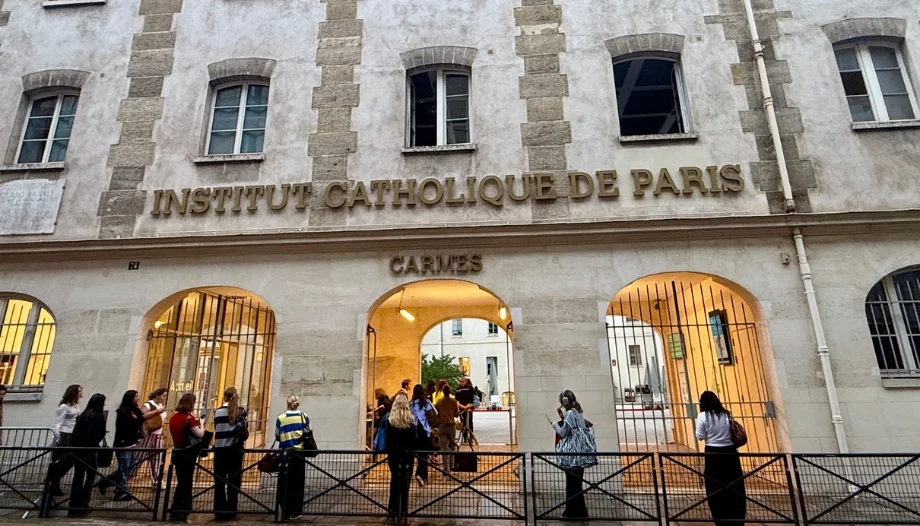
The former convent now forms part of the ICP's main campus. It has six faculties: Canon Law; Philosophy; Social Sciences, Economics and Law; Literature; Education; and Theology. It has approximately 10,000 students spread across three campuses: Paris, Reims, and Rouen. The ICP awards three canonical degrees: Bachelor's, Licentiate, and Doctorate; it also grants state diplomas in partnership with the University of Strasbourg.






 Español
  English
  Italiano
  Français
  Deutsch
  Polski
  简体中文
简体中文