


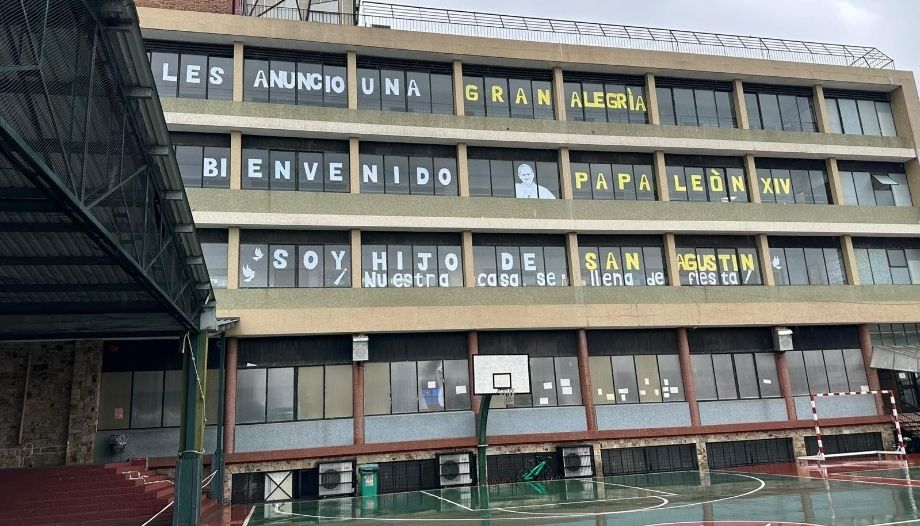
“We are in the context of a very small country and Church,” explains Father José Luis Arias, an Augustinian missionary in Montevideo, where the Augustinians run a parish and a school.
There are currently 50 Spanish missionaries in Uruguay, according to the Pontifical Mission Societies (OMP“We’re talking about a Peru with 34 million inhabitants, and a Uruguay with three and a half million,” explains José Luis Arias. This disparity also exists in terms of faith. “More than 40% of the population declares itself to be without religion, while in Peru it would be less than 10%.”.
¿Freedom to express faith?
“They have excluded the visibility of religion from public life,” the Augustinian missionary states. “One has to ask whether a believer in Uruguay is truly free to express their religious faith in public spaces; it’s not easy,” he adds.
It is precisely within this context that he hopes the visit of Leo XIV will bring a ray of hope. “Because of his approach—one that fosters dialogue, consensus, and courage—the Pope will help legitimize the right to publicly express religious convictions,” says José Luis Arias. “I believe that is the great impact his visit will have on Uruguayan society.”.
A bit of history. Separation of Church and State
What explains this peculiarity in a continent historically closely linked to Christianity? “In the last years of the 19th and the first of the 20th centuries, the country underwent a transformation, a change of secularization, ”And that is noticeable in the population, in the culture, in many dimensions and aspects," comments this Augustinian missionary.
“For example, one of the changes that took place, in addition to the separation of church and state, was the exclusion of Christian holidays from the calendar: here, December 25th is Family Day; Holy Week doesn't exist as such either, but rather as Tourism Week,” he explains. “Although, of course, the terminology is still popularly used and celebrated by the population, the state and public spaces have removed religious expressions.”.
An educational challenge
This reality presents a significant challenge, especially in the field of education, which also faces the challenge of a low birth rate. This is a concern that the Augustinians have addressed at the international congresses of their schools, where José Luis Arias met with the current Pope Leo XIV.
“We were always looking for ways to organize our educational proposals for a society that doesn't seek out schools because they are especially religious, but because of their comprehensive educational approach,” he explains.
“Education must embrace that dialogue between reason and faith, so Augustinian, that dimension of educating the whole person in all their dimensions: intellectual, moral, spiritual, physical…. That is our challenge as educators in Augustinian schools,” he adds.
In this context, the Augustinian religious hopes that the Pope's visit will also be a boost for the Order, which still has a very small presence in the country.
From Argentina, a Spanish bishop
Monsignor José Vicente Conejero, a Spanish missionary from Plasencia, arrived in Argentina 50 years ago. After several years as a missionary, he was ordained a bishop in 1997, and a year later was appointed bishop of Formosa, in the northeast of the country. There are currently 294 Spanish missionaries in Argentina.
“We regret that Pope Francis could not come to his native country as Pontiff, but he loved his Argentine people very much,” he explains to the Pontifical Mission Societies of Spain.
“Furthermore, when he was in Paraguay in 2015, many Argentinians went to visit him.” Now Leo XIV will indeed visit Argentina. “We are all eagerly anticipating his arrival and hoping he will come to us and confirm us in the faith, the mission of the Successor of Peter,” affirms this missionary bishop.
Some topics, visit to the Cottolengo of Don Orione in Claypole
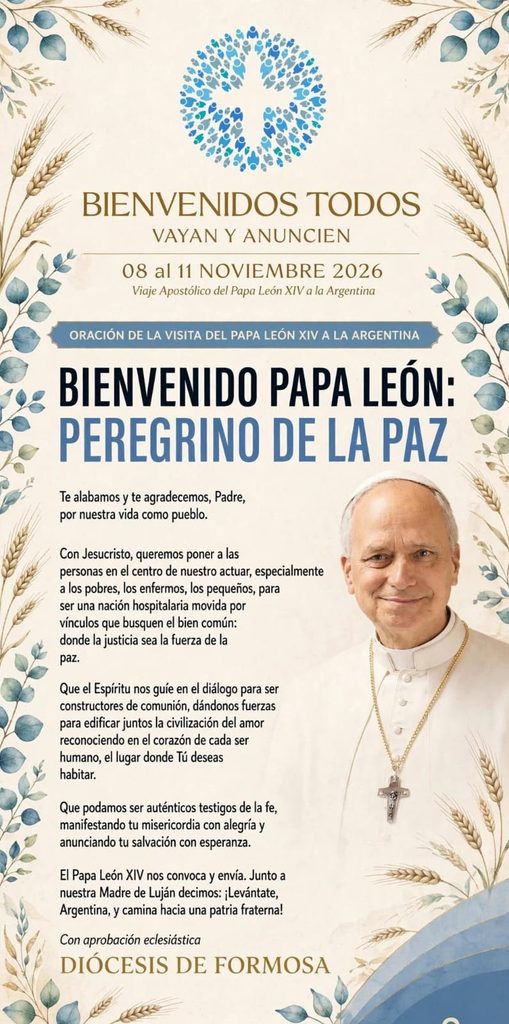
"In the prayer we have been praying ”For weeks now, in preparation for his visit, we have been discussing the themes that I believe the Pope may bring to the forefront,” explains Monsignor Conejero. Among them are the urgent need to place the infinite dignity of the human person at the center, the pursuit of the common good and dialogue, and the preferential option for the poor, the vulnerable, and the sick…
The prelate will attend practically all the events, but he especially highlights the Pope's visit to the Cottolengo of Don Orione in Claypole, a place that is “a whole city” and “where the special and poorest brothers of all are [...]. They must occupy a preferential place in our lives.”.
Hundreds of people from Formosa will also attend the events, “going to Córdoba, participating in Luján and in the vigils in Buenos Aires.”.
Attending in person the meetings with Leo XIV
Monsignor José Vicente Conejero encourages people to attend in person at the encounters with Leo XIV. “It’s worth it; for those of us who have faith, the Pope’s presence is very important, and all obstacles, some of them economic, must be overcome,” he concludes.





 Español
 English
 Italiano
 Français
 Deutsch
 Polski
