


 Pope Leo urges young Peruvians to reject the lie that sin brings happiness«I return to my homeland»: Leo XIV returns to Peru and calls for national unity
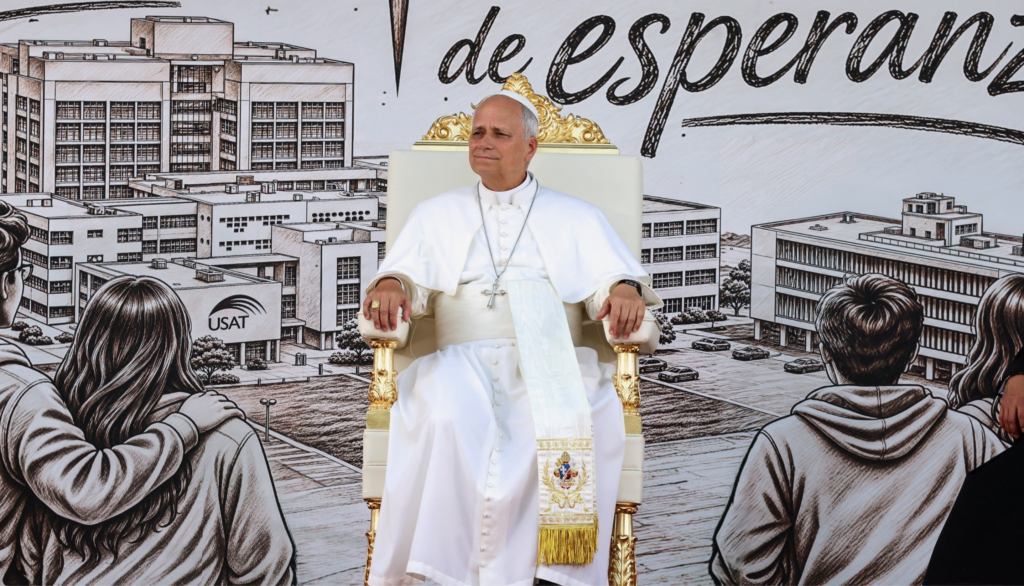
Pope Leo XIV championed the role of the university during his meeting in Chiclayo, at the Catholic University of Santo Toribio de Mogrovejo, and warned of the lethal risk of the technological paradigm and transhumanism, in an emotional visit to the university center where the then Bishop Prevost was Grand Chancellor between 2015 and 2023.
The Pope entered the university campus accompanied by the Grand Chancellor and Bishop of Chiclayo, Monsignor Edinson Edgardo Farfán Córdova, and the Rector, Patricia Julia Campos Olazábal. After welcoming remarks and testimonies from a student, a professor, and an academic authority, the Pontiff delivered his address, beginning by expressing his joy at returning to Chiclayo.
He recalled his years as Grand Chancellor at that university, which “have helped me to understand that authority is service, that government is listening, and that education is a noble act of hope.”.
He praised the figure of Saint Toribio of Mogrovejo, The university's patron, jurist, and Archbishop of Lima, who made his life “a lesson in wisdom, charity, and justice,” was honored. The university emphasized that the faith and science he taught should continue to guide research in the classroom. “The quality of academic training is measured by its capacity to produce wise, honest, and mature women and men,” the university stated.
Against the technocratic paradigm
In the face of today's complex cultural shifts, Leo XIV argued that the university should be “a forge of talent and a laboratory of meaning, a space where intelligence does not bow to utility, but rather serves the truth.” “The Catholic university works for the fruitful encounter between faith and reason, between religion and science: engaging in humble dialogue, rigorous inquiry, and always seeking the common good.” This mission, he explained, frees it from the temptation to produce a skilled workforce for an exclusive and highly competitive market.
He warned that progress indifferent to justice and the dignity of workers becomes “a mechanism of oppression and exclusion,” and that science without conscience “ruins everyone’s lives.” He also reminded them: “Technology, dear friends, is not always neutral”: sometimes it bears the imprint and interests of those who design and control it.
The Pope stated emphatically: “The most lethal risk is submission to the technocratic paradigm, which reduces reality to material data, with efficiency as its supreme value.” Therefore, he urged teachers and students to cultivate critical thinking and seek “that wisdom which neither machines nor computer programs can possess.”.
Transhumanism and the human limit
The Pope dedicated part of his address to transhumanism and posthumanism, movements that posit that technology will one day eliminate disease, pain, aging, and even death. He affirmed that scientific progress must not become a privilege for millionaires who aspire to immortality while entire populations suffer poverty and oppression.
In contrast to this “illusion of human beings enhanced by cybernetics and biotechnology,” he recalled that Christian anthropology understands limitations “not as a manufacturing defect, but as the condition of human greatness.” It is, he added, a call to solidarity and openness to transcendence, while the myth of self-sufficiency leads to selfishness and the marginalization of the weak.
“The limit, in fact, is a call to solidarity and openness to transcendence,” the Pope added. “While the myth of self-sufficiency traps us in selfishness and leads us to discard the weak, recognizing our fragility makes us attentive to the needs of everyone.”.
Referring to the interventions he had heard, the Pope urged the teachers to discover in their work “a high expression of intellectual charity”, to be free thinkers “for whom truth precedes opinion, and justice, interest”, and to translate their scientific competence into works of social justice, for the benefit of the poorest and the care of creation.





 Español
 English
 Italiano
 Français
 Deutsch
 Polski