


“Today, in a single solemnity, we commemorate Saints Peter and Paul, patrons of the city and the diocese of Rome: chosen by Jesus, one as shepherd of his flock and the other as apostle to the Gentiles. In them we venerate two pillars of the Church,” the Holy Father began by saying, in the homily from the Mass for the Feast of Saints Peter and Paul.
In the presence of the cardinals who have gathered at the Consistory, and regarding the new archbishops, the Holy Father has focused on the keys that symbolize St. Peter, and on the word and the cross, symbols of St. Paul.
The Key Symbol
“The faithful and patient concern for unity is well expressed in the symbol of the keys, with which we often identify it (cf. Mt ”16:19)," said the Successor of Peter.
A key is not meant to break down doors, but to open and close them, searching inside for the right handles and guiding their movements, to release the locks, slide the bolts, and allow the doors to swing freely on their hinges, connecting spaces and transforming so many isolated rooms into a single, welcoming home, he described.
“Communion is not built by digging in one’s heels on one’s own positions”
Similarly, “communion in the Church is not built by digging in one’s heels, but by seeking, in everyone’s hearts, points of convergence in the Truth, in whose light alone all become instruments of growth for one another.”.
“Architects of Unity”
«Peter’s example is also an invitation for every Christian to become a builder of unity, placing God at the center of their life and reaching out to their brothers and sisters, attentive to their trials and needs,» he noted, quoting Pope Francis, so as to live with them in charity and thus “carry out the proclamation of the Gospel” (cf. 2 Tm 4,17).
“The book and the sword, closely linked to one another”
"This is also the teaching of Paul, the other great apostle whom we celebrate today, a tireless proclaimer of the Good News," the Pontiff continued.
He, too, has his distinctive symbols: the book and the sword, closely linked to one another. The author of the Epistle to the Hebrews explains this well when he writes that «the word of God is living and active, sharper than any double-edged sword,» capable of penetrating «even to the division of soul and spirit» and of discerning «the thoughts and intentions of the heart» (Hb 4,12).
How Can We Be Like Them?
"Dear brothers and sisters, today it is important for us to look to these two saints—Peter and Paul—to understand how we, too, like them, can be apostles and builders of unity, generous servants of the truth in charity," the Pope said.
The canopies: a commitment to carry our brothers and sisters on our shoulders
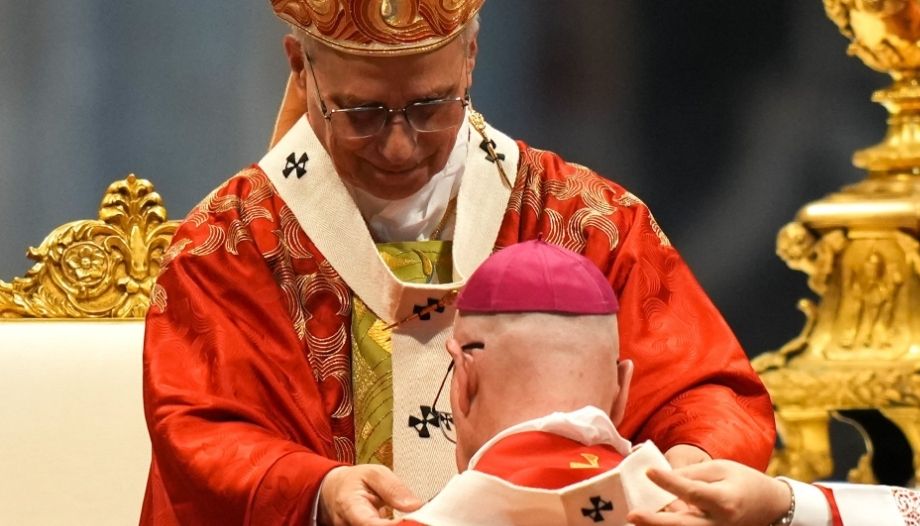
At the conclusion of the ceremony, Leo XIV performed the rite of conferring the palliums on the metropolitan archbishops appointed over the past year—35 in all on this occasion.
The Successor of Peter has said that “this white woolen sash adorned with crosses expresses the commitment of every shepherd—but also that of every Christian—to carry on his shoulders the brothers and sisters entrusted to him, as true lambs of the Lord’s flock.”.
And to devote our energy, time, effort, and even our lives to them, so that the Gospel may reach everyone and the whole world may find harmony and unity in it (cf. Pastoral Constitution. Gaudium et spes, 38)”.
Quote from Benedict XVI
“Let us pray to Saints Peter and Paul,” the Pope concluded, “that they may sustain us on the path of communion, following in the footsteps of the Savior. This is the path He has set for us, the one for which He prayed to the Father at the Last Supper (cf. Jn 17:21–23), the goal that has taught us to long for with confident hope (cf. Benedict XVI, Homily at the Mass for the Presentation of the Pallium to the New Metropolitans, June 29, 2012).
New archbishops who have received the pallium
Among the new archbishops to whom the Pope has conferred the pallium are two Polish cardinals, Rys and Krajewski, the archbishops of Kraków and Łódź, respectively.
Numerous Brazilian archbishops, including the Archbishop of Aparecida; several American archbishops, such as Ronald Hicks of New York; some European archbishops, such as those of Vienna, Westminster, and Prague (no Spanish archbishops this time); the archbishops of Piura (Peru), Bucaramanga (Colombia), and Morelia (Mexico), as well as those of Kolkata and Madurai (India) and Lahore (Pakistan), among others.





 Español
  English
  Italiano
  Français
  Deutsch
  Polski
  简体中文
简体中文