


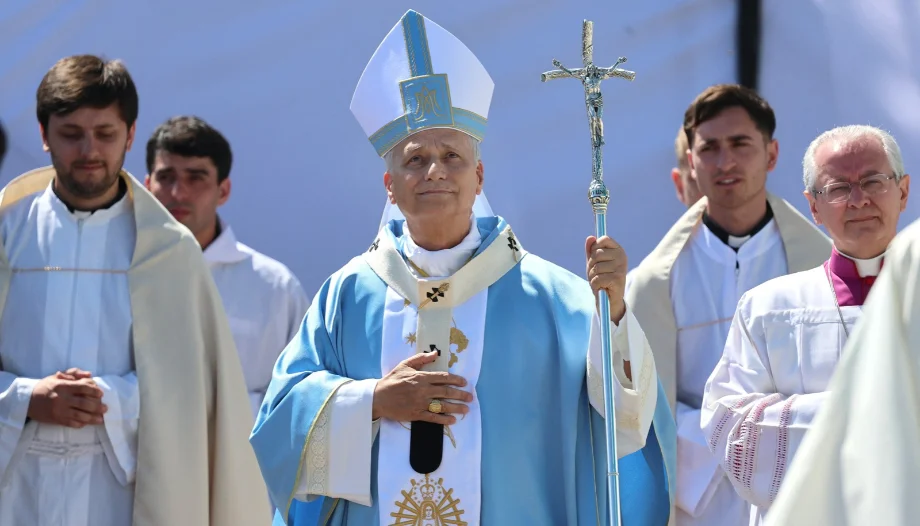
Pope Leo's trip to Uruguay, Argentina, and Peru was a moment of intense ecclesial life for everyone—even for those of us who weren't there. It was a marvel to see the Church spread throughout the world, all united under the staff of the one Shepherd and his Vicar on earth.
For this writer, who spent a significant period of his pastoral life in Chiclayo as a “fidei donum” missionary, these days have been truly heaven on earth. I could recognize many of the faces I saw on television and—along with the Popemobile—I could once again walk those streets and paths I had walked for years, paths that hold a piece of my heart as a pastor and brother who has now become a Peruvian by adoption.
There was a speech by Pope Leo that I found particularly interesting, and that's why I wanted to share the reflection it prompted in me. It was at the Sanctuary of Our Lady of Peace, built by the second Bishop of Chiclayo, Monsignor Ignacio María de Orbegozo, on the outskirts of the city of friendship; where the Pope met with priests, seminarians, religious men and women, and with the synodal teams and pastoral councils.
A Church that walks together
A country like Peru, a diocese like Chiclayo, which maintains the freshness of missionary zeal; where evangelizing efforts are shared by the laity, truly committed and co-responsible for the mission, together with pastors and consecrated persons, is especially fertile ground for living synodality. And Pope Leo X wished to express this by bringing together clergy, seminarians, religious men and women, synodal teams, and pastoral councils in a single meeting, and he outlined the spirit of an authentic synodality oriented toward a missionary Church.
I think it is one of the key speeches of this journey, and its structure and content are a roadmap that we can also follow in our local church and our communities.
Synodality is born from Baptism
The centrality of Christ, with the confession of his divinity and his redemptive action, constitutes the core of Leo XIV's preaching, and this is evident in his speeches. This is also true of the one we are considering, because it is the starting point of his argument: «Coming among you today as Successor of the Apostle Saint Peter, I feel even more strongly the bond that unites us in Christ and in his body, which is the Church, mystery of communion, people of God on their journey through history. You yourselves represent very well the richness of this People, in the variety of charisms and ministries.»
And the Pope asks: «How can we be a more synodal and missionary Church?"»To which he responds that the bond with Christ is not only structural, in terms of the Church, but also personal through the sacraments, especially through baptism, which has configured us to Christ:«Our primary identity is that of sons and daughters of God and members of his People. As baptized Christians, we all share in the priesthood of Christ and his prophetic mission; therefore, the entire community is jointly responsible for evangelization.. Baptism is a permanent vocation to listen to the Word, celebrate the faith, live charity, participate in the community, proclaim the Gospel and serve especially the poor and excluded."
This personal bond, of each baptized person, is the origin of the communion of the Church, which is not ideological agreement with particular groups, but rather «Authentic communion values the diversity of cultures, vocations, charisms, and ministries as a richness and promotes them. In this sense, authority within the Church must be exercised as service, discernment, and appreciation of charisms and initiatives, since the participation of the laity is not a concession, but an expression of their baptismal dignity.
The participation of the laity in the life of the Church is not a concession to a few promoted laypeople, who acquire it as a kind of “title” that enables them to exercise certain ministries in the Church, but rather the mission that every baptized person must discover based on their own baptismal vocation. And Leo asks: «And how? By trying to ensure that each one offers his or her own contribution, like living stones of a spiritual building (cf. 1 Pet 2:4-5), according to the various vocations and the many gifts and ministries animated by the one Holy Spirit (cf. 1 Cor 12:1-31).»
A spirituality that goes beyond methods
And from this emerges the core of the discourse in which he develops what we could call a synodal spirituality:
«This requires a spirituality founded on prayer, listening to the Word, participation in Holy Mass, Eucharistic adoration, fraternal dialogue, and communal discernment. It is a communal and pastoral lifestyle that must be internalized so that it can be put into practice coherently. In fact, it is easy to talk about synodality, but putting it into practice is a challenge and requires everyone to examine their attitudes and behaviors, beginning with the pastors, the primary servants of the community.»
Note how the spiritual journey marked by the Augustinian Pope moves from the personal to the communal: it begins with prayer, listening to the Word, participation in Mass, and Eucharistic adoration, leading from there to fraternal dialogue and communal discernment, founded on all of the above. It is not a method, but a Christian way of life. It is not about putting mere conclusions on paper after a participatory process in which—more often than not—those who, for whatever reason, even having begun this “synodal spiritual journey,” have not been able to reach the participatory bodies, may be left out. As the Pontiff so aptly points out,«It's easy to talk about Synodality, but putting it into practice is a challenge», and it commits us first to the first servants of the community.
To reduce synodality to a kind of participation or constant consultation on any issue, as if the Church had to revise each of its statements from scratch, is to fail to grasp the full depth of the authentic meaning of a way of being in which all the people of God are embedded, including the pastors. The listening upon which we constantly base the synodal method must be not only synchronic, that is, at this particular moment, but also diachronic; for it would be truly rash to think that the Holy Spirit guides the Church now more than two, four, or fifteen centuries ago. Listening to the Church must also include what the Church has discerned through its magisterium throughout the centuries.
Pastoral councils, at the service of the mission
The Bishop of Rome concludes with a practical application, highlighting the important role of Pastoral Councils:«For dioceses and parishes to adopt this synodal style of communion, participation, and mission, it is worthwhile to revitalize the role of pastoral councils, in which some of you here present are involved. Although your vote is consultative, your ecclesial importance is great: you help to listen to the community, to understand the reality, to discern priorities, and to formulate more appropriate responses. Therefore, I urge you to ensure that every community may have its own pastoral council, whose members also commit to receiving adequate training.»
The consultative character of pastoral councils, expressly emphasized by the Pope, does not diminish their importance, but rather is an expression of the way in which the lay faithful (it was necessary to make a digression here between the concepts of people that follow from “eyes", "demos" y "Laos”, but it exceeds my purpose) participate in the life of the Church and which the Pope has summarized in four verbs: listen, know, discern and formulate responses.
The epilogue of that paragraph seems crucial to me, since those who serve on pastoral councils commit to receiving adequate formation. The service of pastoral councils (parish or diocesan) also requires preparation, ongoing formation, to facilitate their mission as a service. Presence on a pastoral council is not by representation, but by participation. One does not represent a group, but rather participates—without thereby exhausting all the participation of the laity—in the mission of the Church through a specific body; and this implies, in addition to the spirituality mentioned above, ongoing formation so that our contributions are not based on our own doubts or personal expectations, but on authentic listening to the Spirit who speaks to the Churches (cf. Rev. 2:29).
Communion, participation and mission
The former Bishop of Chiclayo concluded his address by once again emphasizing the spirit of prayer, but not before reminding everyone that synodality unfolds within the inseparable triad of communion, participation, and mission. He explained that what guides and sustains communion and participation in the Church is the mission of the Church, to which all the baptized are called.
Knowing that land in northern Peru, having been able to experience its missionary zeal and relive it with the journey of Pope Leo, I believe it can be a good model also for our old churches in this Spain, which we want to place on the immediate horizon of our concerns, above all, the mission that Christ entrusted to each and every one of the baptized to go into all the world, to proclaim the Gospel.
Priest and professor of Canon Law




 Español
 English
 Italiano
 Français
 Deutsch
 Polski