


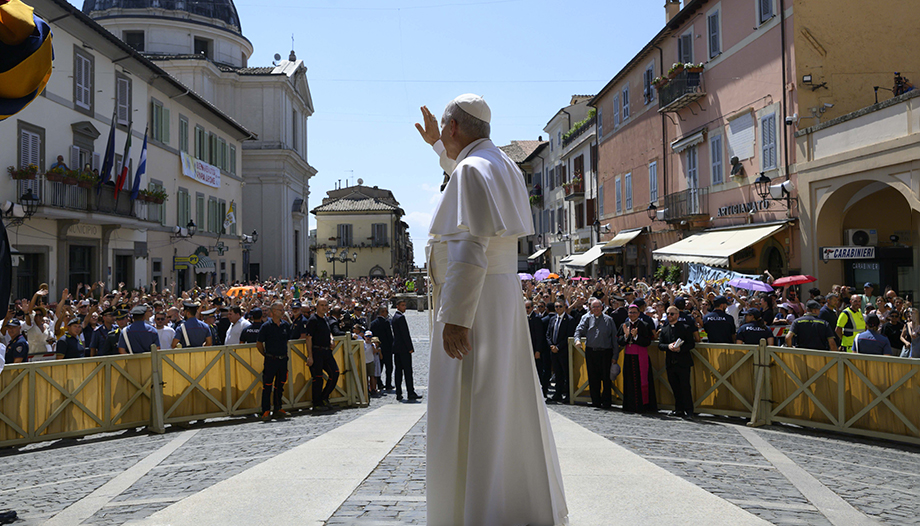
What does the liturgy mean to many? In the background of this catechesis, one can see the desire to counteract certain tendencies, such as experiencing the liturgy almost as a socio-cultural spectacle or, on the other hand, as a purely individual devotion, somewhat disconnected from daily life; without adequately valuing the Word of God that challenges us there and the power of the Church's public prayer, which takes on all that is ours and educates us, and asks to be properly prepared and lived… because all of that is the liturgy.
The liturgy is the Church at prayer
The constitution on the liturgy, Sacrosanctum Concilium (SCThis was the first document promulgated by the Second Vatican Council. It was not simply a matter, as Leo XIV observed, of reforming the rites, but of helping people to contemplate and deepen their understanding of the living bond that constitutes and unites the Church: the mystery of Christ. That is to say, communion with him and with his redemptive salvation through the Church, according to the plan of salvation (cf. Eph 3:3-6).
In the liturgy Christ exercises his priesthood. As the Council teaches, he makes himself present in the proclaimed Word, in the sacraments, in the ministers who celebrate, in the assembled community and, in the highest degree, in the Eucharist (cf. SC, 7). And so St. Augustine can affirm (cf. Sermon, 277) that, in celebrating the Eucharist, the Church “He receives the Body of the Lord and becomes what he receives.”: becomes the Body of Christ, “dwelling place of God in the Spirit” (Eph 2:22). For all these reasons, it is understandable that the liturgy is “the summit towards which the activity of the Church tends and at the same time the source from which all its strength flows" (SC, 10).
"This means –the Pope points out in that context during his first audience on the Sacrosanctum Concilium, May 20th that (the liturgy) is called to develop concretely throughout all of daily life, in an ethical and spiritual dynamic, so that the liturgy celebrated is translated into life and demands a faithful existence, capable of making concrete what has been lived in the celebration: this is how our life becomes a 'living sacrifice, holy and pleasing to God', carrying out our 'spiritual worship'‘ (Rom 12:1).
The reform of the liturgy, between tradition and development
To facilitate the faithful's access to the wealth of gifts of grace dispensed by the sacred liturgy, the Sacrosanctum Concilium It clearly indicates the direction to follow:“Preserving tradition while remaining open to legitimate progress" (SC 23) In this regard, and touching on a sensitive topic for many, Leo XIV quoted Benedict XVI in his general audience on May 27:
“Tradition and progress are often clumsily contrasted. In reality, the two concepts are integrated: tradition is a living reality and therefore includes within itself the principle of development, of progress. It is like saying that the river of tradition also carries within itself its source and flows towards its mouth.”” (Benedict XVI, Speech 5-6-2011).
The Council, Pope Prevost observes, confirmed the legitimacy of this process and its necessity for nourishing the lives of the faithful and promoting evangelization. This is the backdrop for the liturgical reform desired by Vatican II, undertaken with the prudence required to avoid misleading the faithful. He concludes by specifically appealing to priests to be faithful to the liturgical ordinances.
The liturgical school and the path of beauty
The following Wednesday (cf. General Audience, 3-VI-2026), he focused on some elements of the liturgy (rites, signs and symbols), to show that these are not arbitrary ceremonies but an ecclesial mediation through which the divine gift comes to us.
The liturgical rite educates our spiritual sensitivity, enabling us to savor what unfolds there. For this, it is necessary that we participate with our whole being—body, mind, and heart—in the liturgical celebration; and thus we will discover that we are ecclesial communion, united by the same faith.
In contrast to the individualistic tendencies towards spontaneity and the frenetic activism typical of our time,“In the ritual we experience a logic of gratuitousness, we find a rest that regenerates the heart, we recognize that divine grace precedes us, we learn to live at a rhythm inhabited by the Holy Spirit".
"We need –proposes Leo XIV– Let us be educated by the rites of the liturgy, carefully and without arbitrariness tending to the beauty of our celebrations and committing ourselves to an authentic mystagogy. The experience of a living and devout liturgy, accompanied by timely mystagogical catechesis, is the best resource for reawakening in everyone that openness to encountering God which, in the logic of the Incarnation, can only take place by involving the whole person: spirit, soul, and body.”.
The Eucharistic mystery, center of the liturgy
By receiving Christ in his Word and in the Eucharist – teaches Leo XIV – we become what we receive.“We become the Body whose Head is the risen Christ, seated at the right hand of the Father (cf. Col 1:18), which prepares a place for us in heaven (cf. Jn 14:3): the Eucharist is thus the sacrament of the coming Kingdom. It is the Bread of the journey, which leads us to the heavenly Homeland, until the blessed day when “God will be all in all” (1 Corinthians 15:28)”"(General Audience 24-VI-2026).
Thus, he continues, by uniting ourselves to Christ, the Eucharist teaches us to adopt Jesus' way of life, marked by the free gift of himself. We enter into the dynamic of unity, a powerful antidote to the ferments of division that threaten our world, our communities, our families, and our hearts.
This unfolds in the two intimately linked parts of the Mass: the Liturgy of the Word and the Liturgy of the Eucharist. The Word nourishes and sustains us alongside the Eucharistic Bread.“and leads us from the decay of sin to new life in Christ.".
Then, the Eucharistic liturgy incorporates the institution of the Eucharist, where the sacrifice of the Cross and his Resurrection are perpetuated and made present (“memorial”).
The liturgy, prayer of the Church
The Eucharist, and liturgical prayer more generally, has a ecclesial dimension (cf. General Audience 5-VIII-2026). This is due to the action of the Holy Spirit, who is the principle of unity and life in the Church and in Christians. This is also why Saint Paul VI said that“The liturgy is the first source of divine life that is communicated to us, the first school of our spiritual life”(Speech 4-XII-1963). Leo XIV observes that in the conciliar constitution “The liturgy is presented above all as the place of encounter, of God's initiative in drawing near to humanity in his Son, "the Word made flesh, anointed by the Holy Spirit" (SC, 5), to whom we can respond "through Christ, with Christ and in Christ, in the unity of the Holy Spirit," that is, thanks to "Christ's prayer, with his Body, to the Father" (SC, 84).".
Therefore, the Pope adds, “St. Paul VII ardently desired that the Liturgy of the Hours,That is to say, the daily public prayer of the Church, inseparable from the Eucharist, will deeply permeate, revive, guide and express all Christian prayer and effectively nourish the spiritual life of the people of God.”(cf. Ap. Const. Laudis canticum).
The liturgical year, pedagogical update of the mystery of Christ
The general audience of August 12 was dedicated to the liturgical year. In it, the Pope quoted some words of Pius XII:“The liturgical year is not a representation of past events, but rather Christ himself, who wants us to participate in his mysteries, which are permanently present and active." (enc. Mediator Dei, 205). In Leo XIV's synthesis, it is “an update of the work of salvation that Christ performs in history".
Its foundation is Sunday, the Lord's day, the day of the Church, the day of man and, finally, "the day of days" (cf. St. John Paul II, Apostolic Letter). Dies Domini, 1998). A day that we are called to sanctify with the celebration of the Eucharist, gathered in person in assembly, attentive to the listening to the Word and participating in the communion of the Body of Christ.
The liturgical year, the Bishop of Rome concludes, proposes in a sacramental way (through signs appropriate to the times) the pedagogy of salvation history, allowing believers to participate ever more deeply in the mystery of Christ. Therefore, “The liturgical year constitutes the inspiring principle and essential frame of reference for all pastoral action.".
Sacred music
The following week, the Pope focused on sacred music (cf. General Audience, 12-VIII-2026).
– Supernatural Sacrosanctum Concilium It confirms and deepens the ministerial function of music in the liturgy, already highlighted by Saint Pius X.“In fact –Leo XIV points outMusic is an integral part of the liturgical action, not merely an embellishment to the celebration. In the liturgy, singing and playing music signifies prayer, attuning one's heart to the hearts of one's brothers and sisters and to God, through active participation in the mystery being celebrated.".
Hence the requirements for the suitability of sacred music to each moment of the celebration, the participation of the people of God and inculturation, the quality and selection of both the music and the texts, so that they may aid prayer as the “law” of faith. Hence also the importance of Gregorian chant and the care of the choir (Schola Cantorum), of liturgical formation in seminaries, novitiates and Catholic schools, as well as of the people who dedicate themselves to performing such a valuable service.
The motivations for the liturgical reform
Finally, the Pope concluded by reflecting on the motivations for the liturgical reform (cf. General Audience 26-VIII-2026). First and foremost, the need for a more conscious and active participation of the faithful in the liturgy (cf. SC 48). This implies a renewed awareness of the value of the liturgy for the relationship with God and the Christian life.
The conciliar reform sought to make the liturgy shine as “the first source of divine life that is communicated to us”(Saint Paul VI, Address 4-XII-1963).“Of such conviction -Pope Leo observes. The need arose to make the richness of biblical texts and prayers more accessible to all the faithful, and to make the order of celebrations more linear with respect to that provided for in the liturgical books then in force.”A concrete example of all this was proposing the revision of the liturgical books then in force, to better adapt them to the present, taking into account with the utmost respect the traditions of the past.
An important lesson:“The liturgical reform promoted by the Second Vatican Council is therefore situated within the living tradition of the Church. Its correct understanding also allows us to reject the abuses that occurred in some sectors of the Church in the post-conciliar period, and which unfortunately still sometimes occur today, by absolutizing or misunderstanding some of the principles that underpinned the reform itself.".
The Pope concludes by appealing to the responsibility of pastors to care for the liturgy, expressing his “noble simplicity”.
"A liturgy of this kind will also be a fundamental vehicle of evangelization, the instrument of grace through which, as the Council teaches, we can learn to offer ourselves and, through the mediation of Christ, be perfected in unity with God and with one another." (cfr. SC 48).





 Español
  English
  Italiano
  Français
  Deutsch
  Polski
  简体中文
简体中文