



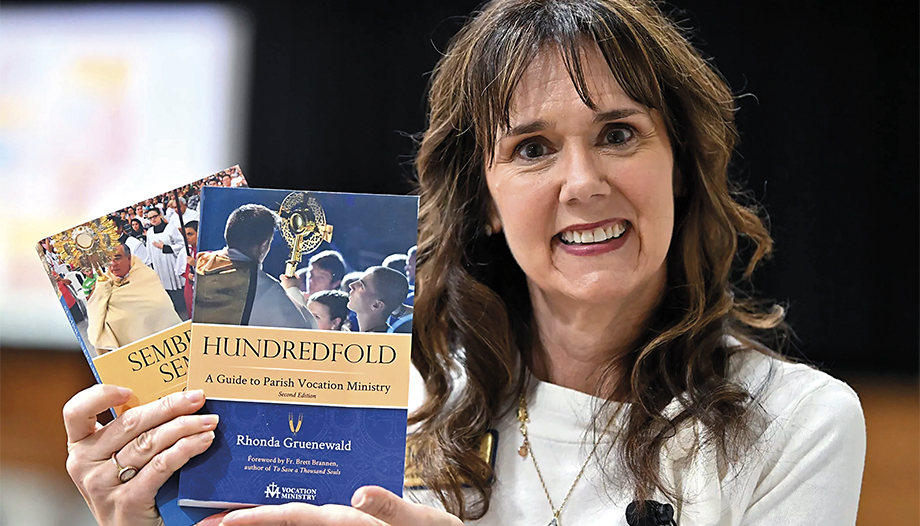
Rhonda Gruenewald is the founder and president of Vocation Ministry, a U.S. nonprofit organization whose mission is to promote vocations throughout the United States by working closely with the dioceses.
This institution began its work in 2011, and since then it has found that promoting vocations is an effort involving the entire Catholic community that yields tangible results from the very beginning.
While they pay special attention to priestly vocations, Vocation Ministry wants to encourage Catholics to discover their vocation, whatever it may be—from religious life to marriage.
In this interview, Rhonda Gruenewald discusses the organization's work, the impact it has had on priestly vocations since its inception, and the importance of uniting the entire Church in this effort.
What specific need did you identify in the parishes and dioceses that led you to create this initiative?
—At first, I didn’t realize there was a need. One of our newly ordained priests, Fr. Víctor Pérez, asked me for help in reviving a parish vocations committee at St. Cecilia Catholic Church in Houston, Texas. At our first meeting, he said: “This is one of the most important activities we could be doing in our parish, and every parish should be doing it.”. So, when I went home to look for resources to promote vocations, I found very little. Why was that? I assumed that all parishes promoted vocations, but that wasn't the case.
It was later, after writing Hundredfold: A Guide to Parish Vocation Ministry (One Hundred to One: A Guide to Parish Vocations Ministry), launch VocationMinistry.com and while I was conducting training workshops throughout North America, I discovered that only between 10 % and 20 % of parishes intentionally promote vocations on their own. That had to change.
What are the biggest myths or mistakes that communities make when trying to foster vocations?
—The first myth is that fostering vocations is a long-term investment that won’t bear fruit for decades. While building a true culture of vocations is certainly a long-term mission, we have found that when a parish or diocese begins to pray intentionally for vocations, to personally invite young people to discern, and to involve the entire community in vocational promotion, the response can come much sooner than people expect.
God calls us every day in every parish. Often, what has been missing is not God’s call, but our invitation.
We have seen this time and again through our partnerships with dioceses across North America. In the Archdiocese of Hartford, only three seminarians began their formation during the three years prior to our partnership with Vocation Ministry. Over the next three years, after implementing a deliberate vocational strategy and providing training, 27 men entered the seminary.
The Diocese of Dallas welcomed 12 new seminarians this year, after having welcomed only two when we began working together in 2024. In the Diocese of Austin, 56 men entered the seminary during the four years following the implementation of a targeted vocational strategy, compared to 25 in the previous four years.
These examples remind us that when the Church intentionally creates fertile ground for vocations, God often blesses those efforts in extraordinary ways.
The second myth is that everyone already understands what a vocation is. In reality, many Catholics hear the word “vocation” and think only of the priesthood or religious life. The Church teaches something much broader. Every person first receives the universal call to holiness—the call to know, love, and serve God. From there, God invites each of us to live out that call through our primary vocation, whether it be sacramental marriage, the priesthood, or consecrated life.
One of the greatest opportunities for the Church is simply to help Catholics understand that discerning God’s calling is not just for a select few; it is the path of every baptized person.
In general, what is the current state of priestly succession in the United States?
—The state of priestly succession in the United States remains one of the Church’s greatest pastoral challenges, but it is not without hope.
Our research shows that the total number of active priests, seminarians, and priestly ordinations has been declining for years. Between 2015 and 2024, the number of active diocesan priests decreased by 12 %, seminarians by 22 %, and priestly ordinations by 29 %.
The deepest concern is generational succession. During the 2014–2023 period, not a single Level 1 diocese (those serving more than 750,000 Catholics) ordained enough priests to maintain its current number of diocesan priests. Only 16 dioceses nationwide—all in Levels 2 through 4—have consistently ordained enough priests over the past decade to maintain or grow their priestly ranks.
However, the story is not simply one of decline. God has not stopped calling men to the priesthood. The evidence clearly shows that some dioceses are fostering vocations in an exceptional way. Places like Wichita, Lincoln, Nashville, Bismarck, Springfield, and others demonstrate that healthy priestly vocations are possible, even in today’s culture.
The real question is no longer whether priestly vocations are possible. The question is: What are these dioceses doing differently, and how can the rest of the Church learn from them?
It is noteworthy that rural and smaller dioceses (such as Wichita, Lincoln, Nashville, and Bismarck) lead in ordination rates that exceed their succession rate. What sets these dioceses apart from large metropolitan areas like New York or Los Angeles?
—Our research found that the main difference isn't geography—it's accessibility.
Smaller dioceses generally allow priests to get to know their parishioners personally. A young man discerning the priesthood is much more likely to have meaningful conversations with his pastor, serve alongside him at the altar, or be personally invited to consider a vocation.
In our 2025 update, we introduced the Priest Availability Index into the report we prepared on this topic, which measures how accessible priests are based on the number of parishioners and parishes they serve. Level 1 dioceses have an average Priest Availability Index of just 29, while Level 4 dioceses have an average of 62—more than double. That difference matters.
The average priest in a large metropolitan diocese serves nearly 7,000 parishioners, while priests in smaller dioceses serve approximately 1,200.
When a priest is responsible for thousands of parishioners, multiple ministries, large teams, schools, and extensive administrative tasks, it becomes much more difficult to build the personal relationships that often lead to a vocation.
How does the ratio of parishioners to priest affect the ability to support and guide young people who are discerning their vocation?
—This may be the most significant finding of our entire research.
In both published reports, one correlation consistently stands out above the rest: the fewer parishioners each priest serves, the better a diocese tends to perform in fostering priestly vocations.
Discernment takes place within a relationship.
Young people rarely decide to enter the seminary because they saw a priest celebrating Mass from a distance. More often than not, they respond because a priest knew them, encouraged them, invited them to serve, answered their difficult questions, or simply spent time with them.
When priests are overwhelmed by thousands of parishioners or multiple parishes, they naturally have less time for that kind of personal support. Our original report even found that dioceses where priests serve more than 4,000 or 4,500 parishioners constantly struggle to maintain stable ordination rates.
That is why the Priest Availability Index is so important. It helps bishops understand that promoting vocations is not just about having a vocations office or holding events. It is also about creating the conditions that allow priests to have the time and freedom to personally mentor young people.
In many cases, priests inspire new priests. When a young man has regular contact with a joyful and holy priest who knows him by name, the possibility of a priestly vocation becomes a reality. We need more opportunities to build authentic relationships between priest and disciple, because that is where vocations most often begin.
In the dioceses with the greatest success in promoting vocations, how important are practices such as perpetual Eucharistic Adoration or Holy Hours specifically focused on vocations?
—Although there are no national statistics tracking how many parishes offer perpetual Eucharistic Adoration or specific Holy Hours for vocations, a clear pattern has emerged from my experience working with dioceses throughout North America.
Over the past decade, I have spoken with thousands of priests in more than 80 dioceses across North America. During these workshops, I often ask the priests to raise their hands if their parish offers Eucharistic Adoration—whether perpetual, weekly, or monthly. In some dioceses, only one priest raises his hand when I ask about perpetual Adoration. Although this is anecdotal and not scientific, it often reveals something important: if we are serious about praying for more vocations, we must also be intentional about creating opportunities for that prayer.
Jesus himself gave us the first strategy for discerning our vocation: “The harvest is plentiful, but the workers are few. Ask the Lord of the harvest, therefore, to send out workers into his harvest.” (Luke 10:2). Prayer is not simply one strategy among many; it is the foundation of every fruitful vocational effort.
At Vocation Ministry, we encourage every parish to start there. Eucharistic Adoration, Holy Hours for Vocations, and regular intercessory prayer invite parishioners to unite themselves with Christ in prayer for future priests and religious. We can implement excellent programs, events, and initiatives, but if they are not rooted in prayer, they will struggle to bear lasting fruit.
There is a strong presence of vocations in communities with strong Catholic schools and homeschooling (homeschooling) and well-prepared liturgical services. What role does the cultural and educational environment play in fostering “fertile ground”?
—Healthy vocations rarely happen by accident. They flourish where the Catholic faith is lived, celebrated, and intentionally passed down from one generation to the next.
Strong Catholic schools, homeschooling communities, parish faith formation programs, and reverent liturgies help create fertile ground by immersing young people in an authentic Catholic culture. They help children and families understand that every baptized person has a vocation and that discovering God’s call is a normal part of Christian life.
But these elements become even more fruitful when they are connected through a purposeful parish vocations ministry. A parish vocations ministry helps unite the parish’s efforts by promoting prayer for vocations, equipping families to discuss God’s call at home, supporting priests in inviting young people to discern, engaging Catholic schools and catechetical leaders, and ensuring that vocational awareness becomes an integral part of parish life—not just something highlighted once a year.
The quality of the liturgy also plays an important role. A devout and reverent celebration of the Mass draws people into an encounter with Christ, and it is often during these moments that hearts open most fully to hear His call. Similarly, Catholic schools and homeschooling communities can provide more opportunities for young people to meet priests, religious sisters, religious brothers, and faithful married couples who radiate joy—whose witness makes every vocation visible and attainable.
However, perhaps the greatest influence is the family. Parents are their children’s first vocational guides. When families foster a spirit of generosity toward God’s will, when parishes intentionally promote a culture of vocations, and when schools and faith formation programs reinforce that message, the entire community becomes fertile ground where vocations can flourish.
The report examines the dynamics within Hispanic and immigrant communities. What are the main barriers or unique challenges to fostering vocations in these increasingly significant communities?
—One of the greatest opportunities for the future of the Church in the United States lies within our Hispanic and immigrant communities. These families often have a deep love for the Catholic faith, strong family ties, and a generous spirit of service—all qualities that provide fertile ground for vocations.
The challenges are not a lack of faith or generosity. Rather, they are often cultural, relational, and practical in nature.
It is understandable that many immigrant families place a high priority on financial stability and educational achievement after having made significant sacrifices to build a better life for their children. Although they deeply value the Church, the priesthood or consecrated life may not initially be the path they envisioned for their son or daughter. An important part of vocational ministry involves accompanying families as they discover that their greatest hope is not simply for their children to fulfill their own dreams, but for them to joyfully embrace God’s will for their lives. Helping parents discover the beauty, purpose, and joy of a vocation to the priesthood or consecrated life can transform the way they encourage and support their children.
Representation matters, too. When young people see priests, seminarians, and religious who share their language, culture, and life experiences, they are more likely to imagine themselves responding to God’s call. Investing in culturally adapted vocational outreach and supporting families in their native language can make a significant difference.
Another challenge is simply extending a personal invitation. Many Hispanic and immigrant parishes are dynamic and growing, but they also tend to be very large. Priests and parish leaders can feel overwhelmed, which makes it difficult to build the personal relationships that often lead a young person to consider a vocation.
A message of hope: In light of the statistics and the decline in many regions, why are you convinced that the crisis in vocations is not a problem of a lack of God’s call, but rather of the response of the ecclesial ecosystem?
—Because God has never stopped calling. The Church must never stop inviting people.
That conviction has been further strengthened after working with more than 80 dioceses throughout North America. We have seen dioceses that experienced years of declining vocations begin to welcome new seminarians after intentionally fostering a culture where prayer for vocations, personal invitations, joyful testimonies, and parish vocation ministry became priorities. God was already calling. The Church became more intentional in helping people hear and respond to His voice.
Pope Benedict XVI captured this beautifully when he addressed the bishops of the United States in 2008. He reminded them that “The ability to foster vocations to the priesthood and religious life is a sure sign of the health of a local Church”and that “It is up to all of us to respond to that call with generosity and freedom”.
That is why I remain hopeful. The statistics show us where the challenges lie, but they also reveal that some dioceses are experiencing remarkable growth. Those dioceses remind us that the vocational crisis is not inevitable. When the Church intentionally creates fertile ground where people can hear God’s call, more people respond generously.
Our confidence does not lie in demographics or trends. It lies in God’s faithfulness—God continues to call—and in the Church’s responsibility to create the conditions in which that call is heard, nurtured, and joyfully embraced.






 Español
  English
  Italiano