


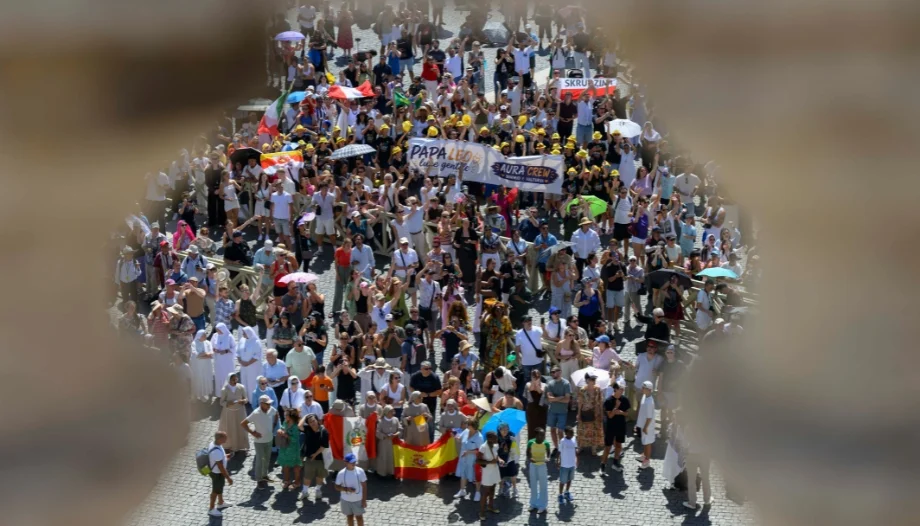
Every Sunday at noon, the Pope appears at the window of the Apostolic Palace to pray the Angelus with the faithful gathered in St. Peter’s Square. It is a scene that has become one of the most recognizable images of the life of the Church. But where does this prayer come from, one that has marked the rhythm of Christians’ days for centuries? Its history begins in the Middle Ages, to the tolling of monastery and convent bells, and it gradually took shape until it became the prayer we know today.
The Angelus is a Catholic devotion that commemorates the Annunciation and the Incarnation of Jesus Christ, particularly recalling the moment in the Gospel passage when the archangel Gabriel announces the Good News to Mary. Thus, its name comes from the first words with which the prayer begins in Latin, The Angel of the Lord announced to Mary («The angel of the Lord appeared to Mary.»).
Monastic origins and the glow of sunset
The earliest precedent can be found in the monastic communities of the Early Middle Ages, where bells were rung to signal the recitation of the second prayer, following Compline (part of the Liturgy of the Hours). In the 13th century, the custom of praying three Hail Marys at the ringing of the evening bell began to spread. The Franciscans played an important role in spreading this practice. Around the time of St. Bonaventure, the General Chapter of the order, held in 1269, recommended this prayer upon hearing the evening bell.
This devotion was linked to the mystery of the Incarnation, as the three Hail Marys served as a reminder of the angel Gabriel’s announcement to Mary. This evening practice gradually spread throughout Europe during the 13th and 14th centuries. Historical records confirm that by the first half of the 14th century, it was already a widespread custom.
From the afternoon to the morning and noon
It wasn't long before the practice came to include other times of the day. During the 14th century, the practice of ringing the bell in the morning, accompanied by three Hail Marys, also began to spread. One of the earliest references to this can be found in a chronicle from Parma dating from 1318. In this way, the prayer gradually took on the rhythm of marking the beginning and end of the day.
Noon was added later. In the 15th century, the ringing of bells at this hour began to spread throughout France, associated both with the commemoration of Christ’s Passion and with a plea for peace and protection. In 1456, faced with the threat of an Ottoman invasion, Pope Callixtus III issued a papal bull encouraging Christians to pray at noon as the bells rang, thus asking for peace and divine protection. The custom subsequently spread to various parts of Europe.
Thus, the three times of day—morning, noon, and evening—became associated with Marian prayer. However, the Angelus did not yet have the exact structure we know today.
The sentence takes on its current form
The final form was also the result of a gradual process. The earliest known document that records the structure of the Angelus as it is prayed today appears in a Venetian catechism from 1560, featuring the three biblical verses, their responses, the Hail Marys, and the closing prayer.
In 1571, Pope Saint Pius V incorporated the Angelus into the “Little Office of Our Lady” (a liturgical devotion to the Virgin Mary). Later, in 1724, Benedict XIII made a decisive contribution to its universal spread by granting indulgences to those who prayed it, through the publication of the document “Iniunctae nobis.”.
The practice continued to evolve. In 1742, Benedict XIV decreed that during the Easter season, the Angelus be replaced by the Regina coeli, while retaining the same traditional times of prayer. Finally, in 1815, Pope Pius VII added the recitation of three Gloria at the end of the Angelus in thanksgiving for the gifts that the Holy Trinity has bestowed upon the Virgin Mary. This latter practice is more common in Italy.
The Angelus Today
The Angelus was recited three times a day: in the morning, at noon, and in the afternoon. Today, the most widespread practice among the faithful is to recite it at noon.
As John Paul II said, this prayer «invites us to meditate on the mystery of the Incarnation, encouraging Christians to take Mary as a point of reference at various moments throughout their day, so that they may imitate her willingness to carry out God’s plan of salvation.».
St. Josemaría also followed this custom. Álvaro del Portillo recounted it in Interview with the Founder of Opus Dei: “After finishing reading the email, he prayed the Angelus at noon. It was an important moment in his day, because in addition to being a filial conversation with the Virgin Mary, it marked the time when his Eucharistic devotion shifted: until then, he had spent the morning giving thanks to God for the Mass he had celebrated; but after the Angelus, he began to prepare for the Mass he would celebrate the following day.».
Why do Christians pray the Angelus?
The Angelus leads Christians to the central moment of the Annunciation, when Mary receives the message from the Archangel Gabriel and responds with her «yes» to God’s plan of salvation. Through her obedience, the Son of God becomes incarnate and begins the work of Redemption.
Praying the Angelus is, therefore, a way to recall the mystery of the Incarnation and to unite ourselves to Mary’s «yes,» learning from her to accept God’s will with trust. It is also an opportunity to seek her intercession and to experience the communion of saints with so many Christians who offer this prayer every day.






 Español
  English
  Italiano
  Français
  Deutsch
  Polski