


- Father Joseph L. Parisi
The apostles used letters to address the faithful of the various churches they had helped to found. In particular, St. Paul wrote several letters (epistles), 21 of which are part of the New Testament canon. Evidently, for many centuries they were not called encyclicals.
The successors of the apostles, the bishops, followed this practice and used to send letters to each other and to the members of the churches under their pastoral charge to ensure consistency in faith and practice, especially with regard to the celebration of the liturgy.
The bishop of Rome himself wrote letters that were circulated to all the bishops. He also received letters from bishops, which he in turn passed on to other bishops.
Decline and resurgence
During the Middle Ages, the practice of sending these letters fell into disuse. At that time, popes only sent letters to individual bishops on matters specific to their dioceses. Bishops responded in writing only to the pope.
Pope Benedict XIV (1740-1758), making clever use of the power of the newly invented printing press, revived the pope's ancient practice of writing letters to all the bishops of the world.
It was Pope Gregory XVI who applied the term “encyclical” to these letters, from the Latin ‘encyclicus’, or circular, because they were addressed to the whole Church.
Since 1740, the popes have published nearly 300 encyclicals addressing various topics related to the life and ministry of the Church.
“Whoever listens to you, listens to Me.”
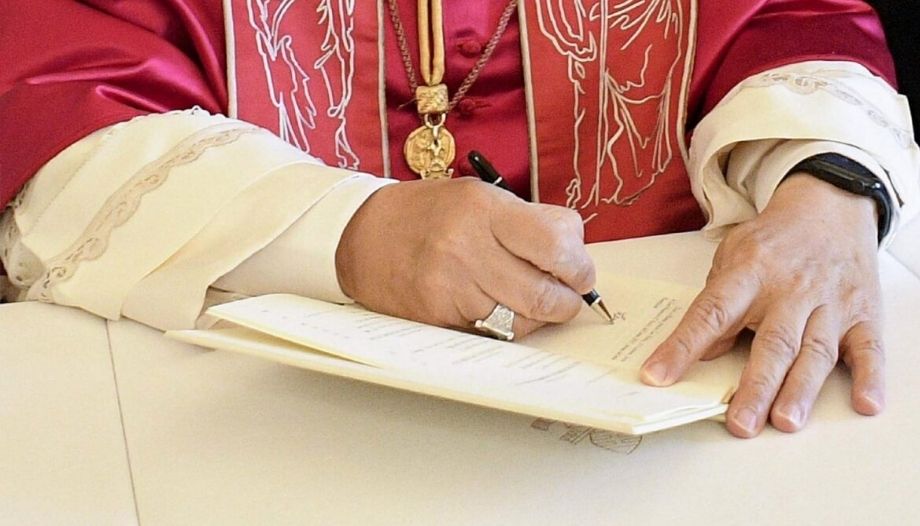
Encyclicals are not considered divinely inspired nor do they contain new revelations. They are, however, considered instruments of the ordinary magisterium containing the authoritative teaching of the Vicar of Christ.
On the question of the binding authority of the teaching contained in an encyclical, Pope Pius XII stated the following in his encyclical «Humani generis» of August 12, 1950:
“Nor should it be thought that what is contained in an encyclical does not in itself demand assent, on the pretext that the Popes do not exercise in them the supreme power of their magisterium. Rather, such teachings belong to the ordinary magisterium, of which it is true to say: “He who hears you hears Me” (Lk 10:16)”.
“Moreover, for the most part, what is expounded and indicated in the encyclicals already belongs to Catholic doctrine for other reasons.”.
Magisterium of the Roman Pontiff, even if not ‘ex cathedra’.’
The Second Vatican Council declared in «Lumen gentium»: “Religious submission of will and thought must be manifested in a special way to the authentic teaching of the Roman Pontiff, even when he does not speak ex cathedra”.
“That is to say, he must manifest himself in such a way that his supreme Magisterium is recognized with reverence and his judgments are sincerely obeyed, according to his manifest will and thought. His will and thought in the matter may be known principally by the character of the documents, by his frequent repetition of the same doctrine, or by his manner of speaking.”.
Sources of joy and challenge
At times, the Church has received papal encyclicals with joy because they addressed issues of popular piety or devotion.
In others, the Popes have written encyclicals on the great moral questions of their time. These letters have often been the subject of intense debate among various scholars and theologians.
Encyclicals are not, in themselves, considered infallible pronouncements of the pontiff. And while the teachings they contain may at times be difficult for some to accept and follow, Catholics of good will throughout the world are obliged to recognize their apostolic authority and to strive to humbly accept their teaching.
How blessed the Church has been to receive the Lord's teaching and the guidance of the Holy Spirit found in the encyclicals of the Popes down through the centuries!
———————
- Father Joseph L. Parisi received his master's degree in pastoral theology from the University of St. Thomas Aquinas in Rome in 1974 and his licentiate in canon law from St. Paul University in Ottawa, Canada, in 1986. He is a retired priest of the Archdiocese of St. Louis.





 Español
  English
  Italiano
  Français
  Deutsch
  Polski
  简体中文
简体中文