



A few years ago, a well-known brand of baby food conducted an interesting test on a group of children to demonstrate that the sense of beauty changes from childhood to adulthood. To do this, the children were brought one by one in front of a table covered with portraits of women and asked to choose the prettiest one. Most of the images were of advertising models, but among them was one of a woman who was, let’s say, quite ordinary. Surprisingly, all the children thought the most beautiful woman was, in fact, the least striking one according to the beauty standards of fashion magazines. The explanation had nothing to do with a shift in perception from childhood to adulthood; rather, the photo of the woman chosen as the most beautiful was, in fact, that of the mother of the child taking the test.
When it comes to our mothers, we tend to exaggerate and let love cloud our judgment. Our mother is the most beautiful, but she also makes the best potato omelet and the best rice dish. And what about the meatballs? Our mother is usually unbeatable at almost everything, and she makes us lose our objectivity so many times.
We also go too far with our heavenly mother, the Virgin Mary—not out of malice, but out of an excess of love—and it is good for us to make this known and take precautions so that we do not err ourselves or lead those who observe us from the outside into error.
During these days, when the Feast of the Assumption is celebrated throughout the Catholic world, bringing together millions of the faithful, we can reflect on what the Catechism tells us about the veneration of Mary. It states that she «is rightly honored by the Church with a special devotion. And, in fact, from the earliest times, the Blessed Virgin has been venerated under the title «Mother of God,» under whose protection the supplicating faithful seek refuge in all their dangers and needs»; though it also warns us that «this devotion […] although entirely unique, is essentially different from the worship given to the Incarnate Word, as well as to the Father and the Holy Spirit.» Although, it adds, «it promotes it very powerfully.» Herein lies the key to the famous «Ad Jesum per Mariam» (To Jesus through Mary), which explains that devotion to Mary is a very good path to reaching the true God.
When Devotion Is Limited to Mary Alone
However, there are still manifestations of popular piety that remain stuck in a loop focused on «per Mariam» without reaching «ad Jesum» and what it entails to become his follower. There are also those who, despite the Council’s insistence that «we must not expect another public revelation before the glorious manifestation of our Lord Jesus Christ,» spend more time paying attention to supposed new revelations from the Virgin Mary than to the Gospel—the place where Christ, the Incarnate Word. He is the Word we must listen to.
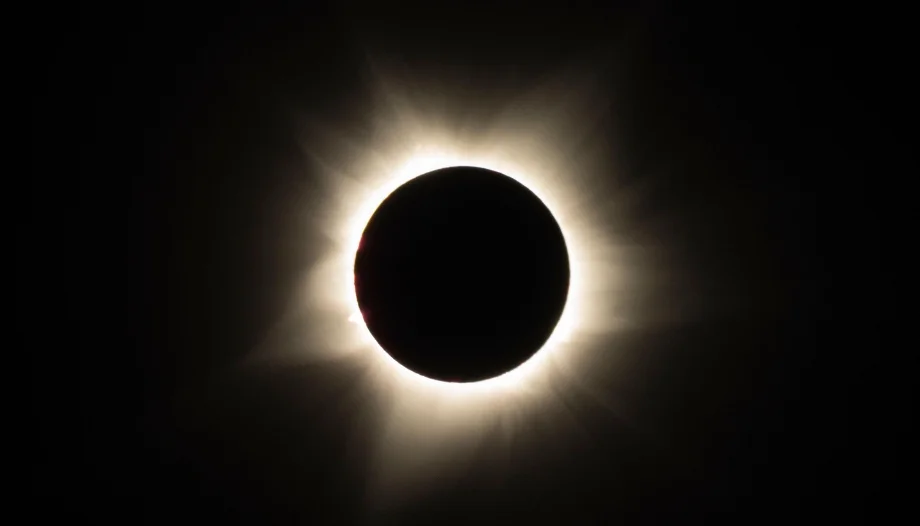
Putting Mary before God can lead us down the same path as those who, despite the warnings, watched last Wednesday’s solar eclipse without proper protection and ended up in the emergency room. It is true that Mary, like the moon, is sweeter to look at, more pleasing, because she is closer to us. Marian devotion is more appealing because the girl from Nazareth is one of our own, but let us not forget that her radiance is only a reflection of the light of the «Sun that rises from on high.» If we insist on equating her so closely with God that she hides His face from us, we may become blind—that is, we may end up believing in anything but the true God revealed in Jesus Christ.
The moon that lights the way to heaven
The identification of the Virgin (or her archetypal figure, Mother Church) with the moon—the famous «mysterium lunae»—dates back to the early centuries of Christianity. The «woman clothed with the sun, with the moon under her feet» from the Book of Revelation—an image so perfectly embodied by Our Lady of Guadalupe—is Mary clothed in Christ, according to the Church Fathers. The moon, with its cycles, is also a symbol of the passage of time. Therefore, by placing her above it, we are shown a woman who transcends time, for she was chosen even before she came into existence (Immaculate Conception) and, after her time on earth, now lives forever in body and soul in heaven (Assumption).
Pope Francis also shared another lunar image of Mary with us on the very day of the Assumption. He said that, just as the first man to set foot on the moon said, «This is one small step for a man, but one giant leap for mankind,» so too did little Mary, through her Assumption, take the first step as one of us into heaven, thereby opening the way for all of humanity along with her.
So, let's congratulate ourselves on this small but significant step we're celebrating these days, and let's not forget our protective glasses when we contemplate the mystery of a mother we love madly—lest her beauty blind us.
Journalist. Graduate in Communication Sciences and Bachelor in Religious Sciences. He works in the Diocesan Delegation of Media in Malaga. His numerous "threads" on Twitter about faith and daily life have a great popularity.






 Español
  English
  Italiano