




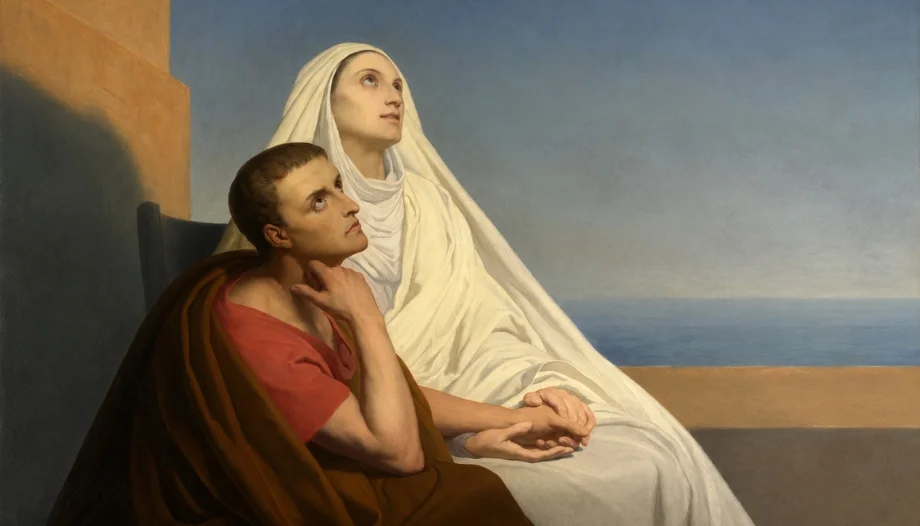
There are people for whom we pray for years. A child who has strayed from the faith, a friend going through a crisis, a sick relative, someone who seems to have taken a path from which we don’t know how they’ll ever be able to return. We pray for them again and again, and yet time passes and nothing seems to change.
So one wonders: How long should we keep praying for someone?
Sometimes the answer we're looking for is actually an expiration date. How long do I have to wait? How many times do I have to ask for the same thing? What if, after so many years, God still doesn't answer?
The story of Saint Monica, whose feast day is celebrated on August 27, offers us a hopeful answer.
The Example of Saint Monica
Mónica knew all too well the anguish of watching someone she loved drift away. Her son, Agustín, was a brilliant, restless, and ambitious young man. But he was also searching for answers far from the faith in which he had been raised.
His mother suffered greatly because of it. For years, she watched as Agustín went down paths she could neither control nor set him back on the right track. His conversion did not come immediately.
In fact, when Augustine left North Africa to go to Italy, Monica tried to stop him. Like so many who pray for someone they love, she, too, had to learn that loving someone does not mean making decisions for them.
She couldn't force her son to believe. She couldn't walk his inner path for him. All she could do was continue to love him, be there for him whenever possible, and entrust him to God's care time and time again.
When It Seems Like God Isn't Answering
One of the greatest challenges of praying for someone else is that we expect to see results. This can be painful, especially when we’ve been asking for something we consider good for years. However, persevering in prayer also means accepting that God may act in a different way and at a different time than we had imagined.
Santa Monica had to wait. And while she waited, Agustín kept searching.
Much later, that young man would eventually find in Christ what he had sought in so many other places. His conversion, however, was not the result of a single moment or a single prayer. It was the end—or, rather, the beginning—of a long journey.
Praying Without Trying to Control Things
Perhaps one of the most difficult lessons from Saint Monica is precisely this: praying for someone does not mean taking control of their life.
We can pray for a child, a friend, or our husband or wife, while still recognizing that that person has their own freedom and their own relationship with God.
Sometimes, behind our persistence may also lie the desire for the other person to change according to our own plans. We want them to come back, to make a decision, to stop doing something, to be different.
But prayer can even purify the way we love. Over time, we may discover that we no longer pray simply for that person to become what we expect them to be, but rather for them to find the truth, goodness, and happiness to which they are called. And that means trusting in God even when we don’t understand the path.
Prayer also changes the person who prays
When we pray for someone for years, we don't just hope that person will change. We, too, are transformed by that waiting.
Persistent prayer compels us to acknowledge our limitations. It reminds us that we cannot save anyone on our own. We can offer advice, provide support, talk, and be there for others. But there are decisions and wounds we cannot reach.
For many people, that sense of helplessness is precisely one of the reasons they begin to pray. When we no longer know what to do, we discover that we can still love.
Continuing to bring someone before God can thus become a way to stay close even when the distance is great. Perhaps we cannot change his heart. But we can pray for him.
How long will this go on?
So, how long should we pray for someone?
The answer is probably not «until I get what I’m asking for.» Christian prayer does not come with a guarantee of results or a set timeline. Some requests are answered quickly, while others remain with us throughout our lives.
Perhaps the real question is a different one: When do we stop loving someone? As long as we love, we can keep praying. That doesn’t mean living in a state of obsession with the situation or repeating a petition out of anguish. Sometimes it will be necessary to rest, to stop dwelling on a problem, and to learn to trust. Perseverance does not mean forcing ourselves to suffer continuously. It means not closing our hearts.
Saint Monica did not know how her son's story would end. For years, she had no way of knowing that that restless young man would eventually become one of the great Fathers of the Church. She simply kept praying.
Perhaps that is one of the lessons his story teaches those who are waiting for someone today: we do not know what is going on in a person’s heart, nor how far God’s grace can reach.
We may not see the results and grow weary. We might even come to think that nothing is changing. But praying for someone is, at its core, a way of saying, «I can’t walk this path for you, but I won’t stop entrusting you to God.» And perhaps, sometimes, that’s the only thing we can do. And it’s also the most important thing.







 Español
  English
  Italiano