


Heaven and earth seem to meet at the doors of the basilica, a few minutes before the beginning of the services. The last ray of afternoon sunshine bathes hundreds of kneeling boys, many in shirts and ties, with its orange glow. The temple lights go out, solemnly replaced by candles. Jesus is going to rise tonight, and Rome already knows it: it prepares to celebrate.
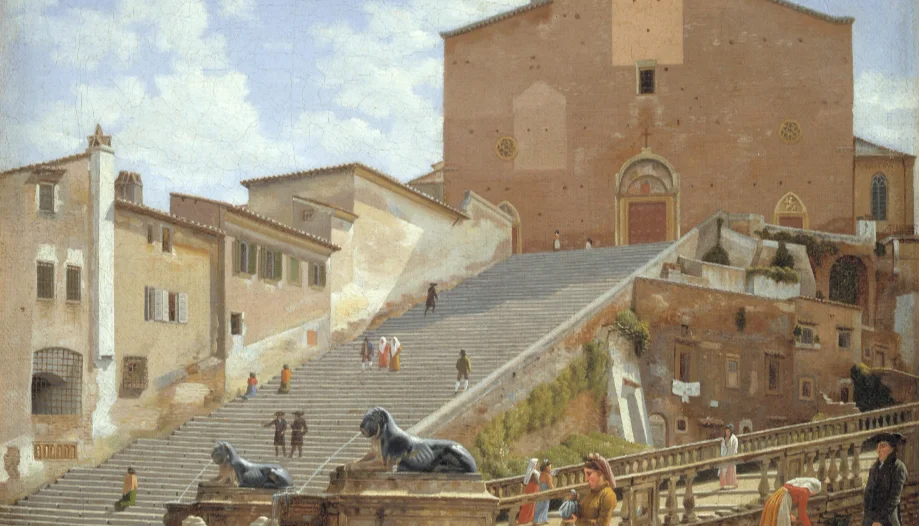
This scene takes place in Santa Maria dell'Ara Coeli, a church on the top of the Capitoline Hill. It is located between the Campidoglio, the heart of the greatest and most exuberant Empire of Classical Antiquity, and the Altar of the Fatherland. It is one of the many churches where you can contemplate with compunction the mystery of the Passion and celebrate like a child the Resurrection. Its only drawback is the height: there are so many stairs to climb that it seems that, if you still have the strength to finish, you can reach the sky with two more flights of stairs.
The center of the Catholic Church is a fundamental place of pilgrimage and, especially, a place to experience Holy Week in communion with all other Christians. From the balcony where Leo XIV prays the Angelus to the rosary store where you meet cardinals, to the ice cream parlors where a «how are you, Padre, how are you?» anticipates a great dessert and an even better conversation.
Young and old crowd around the popemobile's route, cherishing these scenes for the rest of their lives. They seem silly, but they are not. I have a photo with Francis from two years ago and I know that there is no one in my family who has not prayed for his pontificate, thanks in part to having that picture framed in the living room. You have to know the Church to love it.
Of course, such a large city with a millenary culture is capable of gathering within its walls a wide range of movements. The diversity of Catholicism is very edifying, no doubt. But, as a friend of mine rightly commented, this also brings with it its respective range of sensitivities. My mischievous and irreverent humor as a young Spanish Catholic has clashed several times with decency, decorum and geography, provoking more awkward situations than laughter. Alas, however, those conversations that have turned out well: I have met 17 nuns from Guatemala who are now praying for my intentions, or a pastor from Armenia with whom we insisted on having our picture taken.
Finally, Rome. Capital of an empire that dominated the past and cradle of a kingdom that will live forever. Where, since the times of Caesar and Trajan, art and beauty have been the maximum and have ended up finding God, on the altar of every church and in the marble of every monument. Jesus has risen, and in Rome they already know it, for everywhere one hears nothing but a joyous Buona Pasqua. In the city, salvation continues to be news and a reason to celebrate.
5th year student of Telecommunications Engineering and Business Analytics.






 Español
  English
  Italiano
  Français
  Deutsch
  Polski