



A few weeks ago, I called the only Mexican restaurant in my city that advertised a party platter. I was planning a small gathering with friends and liked the idea of everyone assembling their own tacos.
I asked if they offered takeaway. I would place the order, walk there myself, pay, collect it, and leave. "No," they said. "We only offer dine-in."
Disappointed, I began searching for alternatives. Surely another Mexican restaurant in the city would offer something similar. None did.
Instead, I found menu after menu charging extraordinary prices for what should be ordinary food. Burritos that once sold for three euros when I was a university student now cost nine. Other restaurants charged nearly twenty euros for a plate of enchiladas.
Twenty euros!? Unbelievable! My first thought was almost "those enchiladas better cure cancer if they cost that much."
It wasn't merely shock from the high price and small quantity. It made me wonder what had happened to restaurants that existed simply to feed people.
When Dining Out Becomes a Luxury
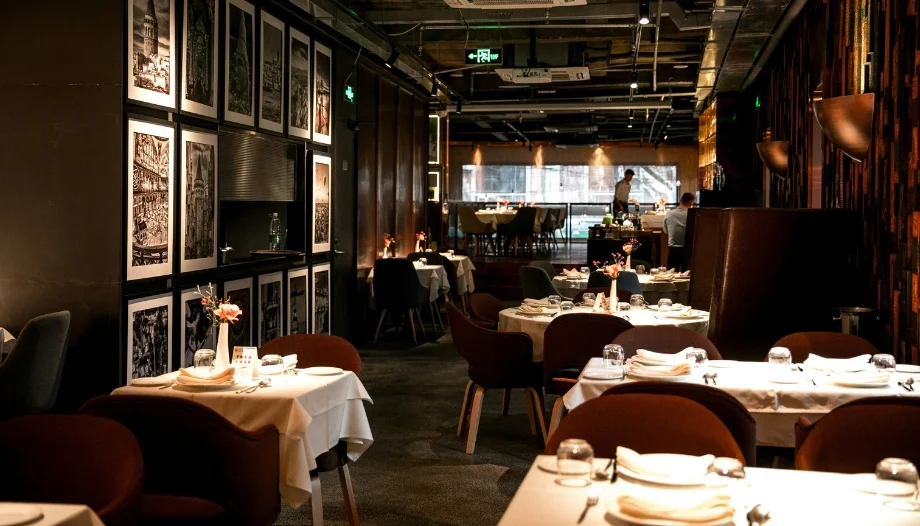
I will admit that maybe my shock is because I tend to be unfashionable. When I go to a restaurant, I am not looking for exposed brick walls, artisan lighting fixtures, handcrafted ceramic plates, fancy menus. I do not particularly care whether the furniture was designed by Scandinavian architects or whether the waiter explains where every ingredient was sourced.
I simply want an affordable meal that tastes good and leaves me full. In many ways, I have what could only be described as plebeian tastes. An example being that I drink cheap instant coffee, the type that serious coffee enthusiasts, like my fiancée would probably refuse to acknowledge as coffee at all. I eat to live rather than live to eat. If a meal is affordable, filling, and enjoyable, I am happy.
Somewhere along the way, however, restaurants seem to have forgotten people like me.
Dining out increasingly feels less about eating and more about purchasing an experience. Restaurants seem to be competing on aesthetics, branding, exclusivity and who can keep increasing prices without driving away customers. The food itself almost becomes secondary. Meanwhile, ordinary working-class people are left wondering when a burrito became a luxury purchase.
A Lesson from Warsaw
Whenever I think about this, my mind returns to a trip I made to Warsaw while I was still at university. A Polish friend took me to a Vietnamese restaurant tucked away on an ordinary street. It was not the sort of establishment that would ever appear in travel guides or Instagram posts. If you are not careful when walking the street, you would miss the entrance to the restaurant.
The tables were made from cheap white plastic, while the menu was a single laminated sheet of paper and the décor was almost non-existent.
At the counter sat a Vietnamese girl, perhaps eleven years old, quietly doing her homework. My friend placed our order in Polish, and she responded fluently before taking our payment and returning to her mathematics.
Her parents cooked in the kitchen behind her. When the food was ready, she rang a small bell and invited us to collect our bowls.
For five euros I received an enormous bowl of steaming Vietnamese noodles. It was fresh, delicious and to me, a poor university student without a job, it was honest and filling.
There was no show or drama, no attempt to sell us an "experience." No theatrical presentation. Just a hardworking Vietnamese immigrant family feeding their community.
Years later, I remember almost nothing else from that day in Warsaw. I don’t remember the places I visited or the people I met or even what that day looked like, but I do remember those noodles and that Vietnamese restaurant.
The Disappearance of the Ordinary
What happened to places like that? They once existed in nearly every city. Small family businesses where the owner knew regular customers by name. Restaurants that did not aspire to attain Michelin stars but simply sought to provide good food at fair prices.
These establishments served students living on tight budgets, they fed construction workers looking for a quick lunch. They served young families who wanted a simple night out. They gave poor pensioners the experience to eat something affordable without worrying about their wallets. In general, they helped people who simply wanted a decent meal without wondering whether they had just spent half their grocery budget.
Today, many of these places seem to be disappearing. Some have undoubtedly been driven out by rising rents, inflation, increasing labor costs or competition from larger chains.
Cities are often increasingly filled with restaurants designed for special occasions rather than everyday life. Reservation-only dining, with carefully curated interiors and where premium pricing is presented as normal.
There is nothing inherently wrong with fine dining. The problem arises when ordinary dining begins to disappear altogether. Every society needs places where ordinary people can gather without feeling excluded by price.
A Catholic Perspective
This is more than just food. Restaurants have always been places where communities gather and by doing so, they bind a neighborhood together.
Economic life should never exist solely to maximize profit. Markets are valuable servants, but they make poor masters. Businesses naturally seek to earn a living, and there is nothing immoral about making a profit. Yet profit should remain the reward for serving society, not society's ultimate purpose.
When businesses can no longer afford to serve ordinary people or choose not to, something valuable is lost.
The Church has long taught that economic life exists for the human person, not the other way around. Pope St. John Paul II, in Laborem Exercens, reminded us that work possesses dignity because it serves people and families. Likewise, the Church teaches that society should be ordered toward the common good, ensuring that ordinary people can participate fully in economic and social life.
The little Vietnamese restaurant in Warsaw embodied many of those principles without ever preaching them. You had a family worked together in service to their neighborhood, they charged prices that ordinary people could afford, their labor was not glamorous, but it was dignified and no doubt, a worthy sanctification of its own when offered up to God. They were not selling a premium sense of exclusivity either but rather were offering hospitality in their own way.
The Gospels repeatedly place Christ around a table. He dined with fishermen, tax collectors, and sinners, and when He fed the multitudes, He did so not with extravagant delicacies but with loaves and fishes, the simple food of ordinary people.
In first-century Galilee, barley bread and fish from the Sea of Galilee formed the staple diet of labourers, fishermen and the poor. Even after His Resurrection, Christ prepared breakfast of bread and fish over a charcoal fire for His disciples on the shore, meeting them once again amid their ordinary working lives.
The Last Supper reminds Christians that a shared meal is more than a means of satisfying hunger; it is an expression of communion, fellowship, and hospitality. It is no coincidence that so many of Christ's encounters with others took place over and around food,
The Christian tradition has long understood that welcoming others to the table is one of the simplest and most profound acts of charity.
What We Have Lost
I do not believe every restaurant should be inexpensive. There will always be room for fine dining, ambitious chefs and culinary artistry. But there should also be room for the working man, for the students with 10 euros in his wallet, for a young family celebrating a birthday, for a pensioner who simply wants a hot meal without worrying about the bill and for friends gathering around tacos without needing to reserve a table weeks in advance.
Maybe what I miss is not cheap Mexican food at all, maybe I miss a society that made space for ordinary people.
The little Vietnamese restaurant in Warsaw had no designer furniture, no polished branding, and no carefully curated image. Yet it possessed something increasingly difficult to find: honest work, fair prices, genuine hospitality and food that welcomed everyone.
Those are the hidden gems our cities once had and I cannot help but wonder whether, in chasing sophistication, we have forgotten the simple virtue of feeding our neighbors well.
Journalist and essayist born in the United Arab Emirates and based in Lithuania. He is a contributor to Omnes, EWTN News and CNA Deutsch.






 Español
  English
  Italiano
  Français
  Deutsch
  Polski
  简体中文
简体中文