


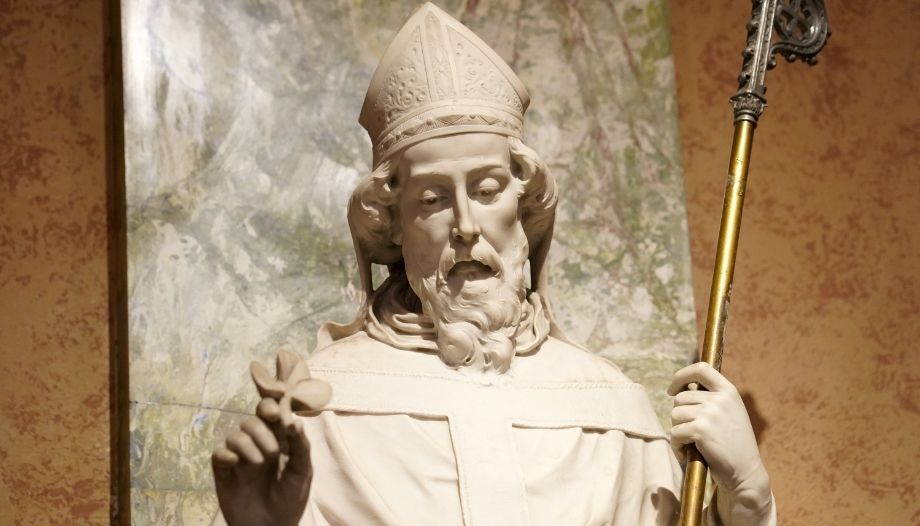
After his captivity, St. Patrick escaped and returned to Britain, but his desire to convert the Irish pagans prompted him to study for the priesthood. He was eventually ordained a bishop and returned to Ireland, where he succeeded in spreading Christianity. He is believed to have died on March 17, 461.
While that great evangelizer of Ireland gets a lot of attention, here are 11 Irish-born saints who continued St. Patrick's efforts to spread the Gospel, and who also deserve a toast in his name. Cheers!
1. St. Benen (5th century)
According to legends, this son of an Irish chief from Meath may have attended the first Easter mass of St. Patrick in Ireland around 433.
There are several stories about his first encounter with Patrick: in one, he was so impressed by Patrick's words that he scattered flowers over the future saint as he slept.
In others he asked to travel with Patrick, and it was Patrick who chose the baptismal name Benen, from the Latin «benignus,» meaning kindly. Benen became a close disciple of Patrick and, as one of his successors, was the first to evangelize Clare and Kerry in the west of Ireland. His feast day is celebrated on November 9.
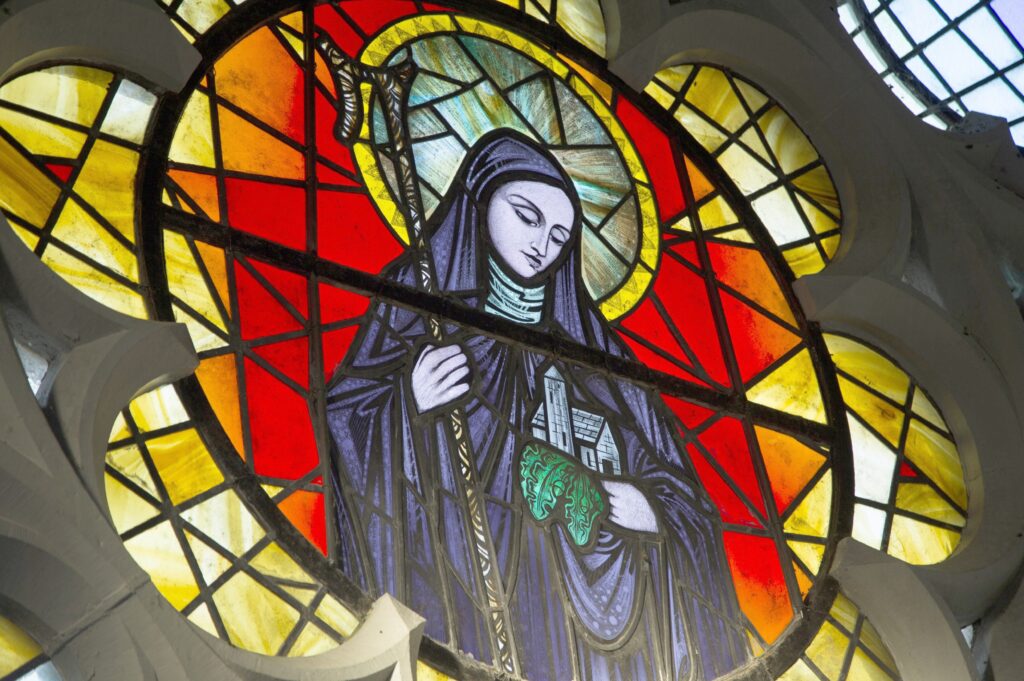
2. Saint Bridget of Kildare (451-525)
Numerous popular legends, and even her association with a pre-Christian goddess of the Druids, relate to this Irish abbess. However, one fact from her earliest biography, from the 7th century, remains undisputed: she was superior of a double monastery - for nuns and monks - in Kildare, in the years after the death of St. Patrick. Together with St. Patrick and St. Columba, this “Mary of the Gaels” is the patron saint of Ireland. Her feast day is celebrated on February 1 and is a public holiday in Ireland.
3. St. Finnian of Clonard (470-549)
This Irish abbot, known as “the teacher” and “master of saints” in the period after St. Patrick, is said to have originated from Leinster, where he began founding monasteries. He traveled to Wales and studied its traditional monasticism, which emphasized the superiority of monastic over secular life and the importance of learning.
After returning to Ireland, he founded numerous churches and monasteries, including his great monastery at Clonard, on the banks of the Boyne, which attracted 3,000 disciples, among them St. Ciaran of Clonmacnois, St. Columba of Iona and St. Brendan the Traveler. It is not known if he was also a bishop. He died of the plague, probably contracted while attending to other sick people. His feast day is celebrated on December 12.
4. Saint Ita of Killeedy (475-570)
Originally called Dierdre, she received the name Ita, which means “thirst for holiness”. Her story has much in common with that of St. Bridget. For many years, Ita led a community of devout women in Killeedy, County Limerick. She ran a school for young children who were taught «faith in God with purity of heart; simplicity of life with religiosity; generosity with love.».
St. Brendan the Traveler is said to have been her pupil. The legend of St. Ita emphasizes physical austerity and includes some rather extraordinary miracles. Her feast day is celebrated on January 15.
5. St. Kevin of Glendalough (498-618)
Oral tradition preserved and embellished the story of the founder of one of Ireland's major pilgrimage sites. Born in Leinster and baptized by St. Cronan, Kevin was educated in a monastery near Dublin. After ordination, he lived alone in a cave for seven years, which compromised his health and led him to use a Bronze Age stone tomb as a church.
After recovering, he gathered some disciples and founded Glendalough Abbey in Wicklow. According to legend, he made a pilgrimage to Rome, visited St. Kieran in Clonmacnoise and lived to be 120 years old. His feast day is celebrated on June 3.
6. St. Samthann of Clombroney (6th century)
Samthann, an Irish abbess known for her wisdom, is believed to have become a nun in Donegal after a nobleman to whom she was betrothed agreed to her wish to marry God alone. She founded Clonbroney Abbey in Longford, where she opted for a simple life.
He refused large estates for the abbey, and his herd was limited to six cows. According to one biography, he advised a monk who asked him about the proper posture for prayer that one could pray in any position: sitting, standing, kneeling, or lying down. His name appears in the litany and canon of the Stowe Missal, and several miracles are attributed to him through his intercession. His feast day is celebrated on December 18.
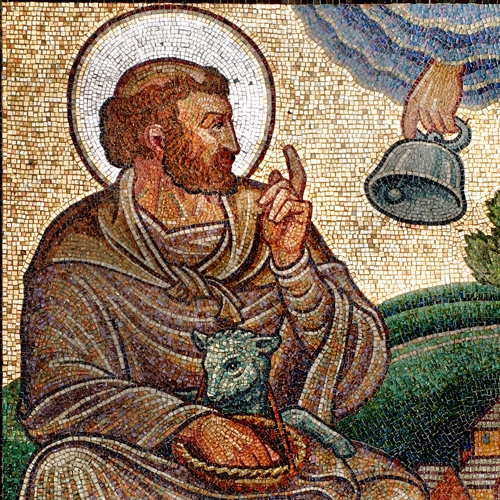
7. Saint Kieran of Clonmacnoise (516-549)
From his birthplace in Connaught, Ireland, Kieran traveled at age 15 to study with St. Finnian in Clonard. According to legend, he took a cow with him to obtain milk. He became the most learned monk there and then spent seven years with St. Enda in the Aran Islands, where he was ordained a priest.
He later moved to Isel, but soon left because other monks complained about his generosity to the poor. Around 545, together with eight companions, he founded the monastery of Clonmacnoise, on the banks of the Shannon River, which became a famous religious center for its manuscripts and metal liturgical objects. His feast day is celebrated on September 9.
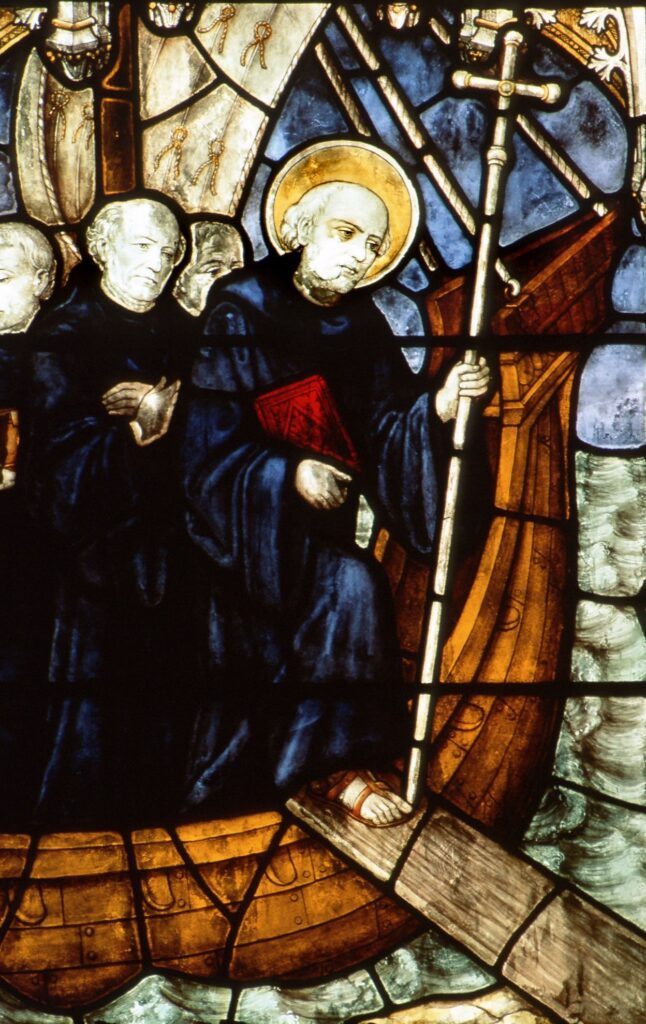
8. St. Columba of Iona (521-597)
This abbot, one of the patron saints of Scotland, was born in Ireland. Also educated and ordained in Ireland, he spent fifteen years preaching and founding monasteries, including Derry, Durrow and Kells. However, his clashes with King Diarmaid over a copy of a psalter and the right of asylum led to a clan feud and a battle in which 3,000 men died.
Choosing exile as penance, Columba left for Scotland with twelve relatives around 561 to found the island monastery of Iona. He evangelized the Picts and converted their king. The monks of Iona undertook missions throughout Europe and their monastic rule was the norm until the Rule of St. Benedict. Columba, also called Colmcille (from Columba and cell), had an enormous influence on Western monasticism. His feast day is celebrated on June 9.
9. Saint Columbanus (543-615)
This great Irish missionary monk entered a monastery in Bangor, where he taught for 30 years. Around 590, he and twelve companions were sent as missionaries to Gaul (France), where Columbanus founded three monasteries in Burgundy and became abbot of Luxeuil.
He preached against the laxity of the clergy and immorality at court, and introduced a strict Celtic penance. After being expelled from Burgundy, Columbanus preached in Switzerland, and upon his expulsion from there founded a monastery in Bobbio, Italy, which became a center of learning. His feast day is celebrated on November 23.
10. St. Colmán of Lindisfarne (605-676)
Of Irish origin, Colman was a monk on Iona before being elected third bishop of Lindisfarne, England, in 661. During his three years there, he defended Irish monastic customs and Celtic rites. In 664, he attended the Synod of Whitby, where the date of Easter, the style of tonsure, the role of local bishops and the relationship between the English churches and Rome were decided.
Colman defended the Irish tradition, but was defeated by St. Wilfrid, bishop of York, who preferred the Roman rites. Colman resigned his diocese and returned to Ireland, where he founded monasteries in Galway and Mayo, and was abbot of both until his death. The history of Venerable Bede is the main source of information about his life. His feast day is celebrated on February 18.
11. St. Donatus of Fiesole (829-876)
According to tradition, this bishop was one of many Irishmen who toured Europe in the early Middle Ages. He arrived in Fiesole, Italy, from Rome just as the see became vacant and he was elected bishop. It is said that he was a teacher in the service of the Frankish kings. There is a record, from the year 850, of his donation of a church and a hospice, St. Bridget in Piacenza, to the abbey founded by St. Columbanus in Bobbio. It is said that St. Andrew of Fiesole was his Irish traveling companion, but there is no reliable evidence of his existence. The feast of St. Donatus is celebrated on October 22.





 Español
  English
  Italiano