



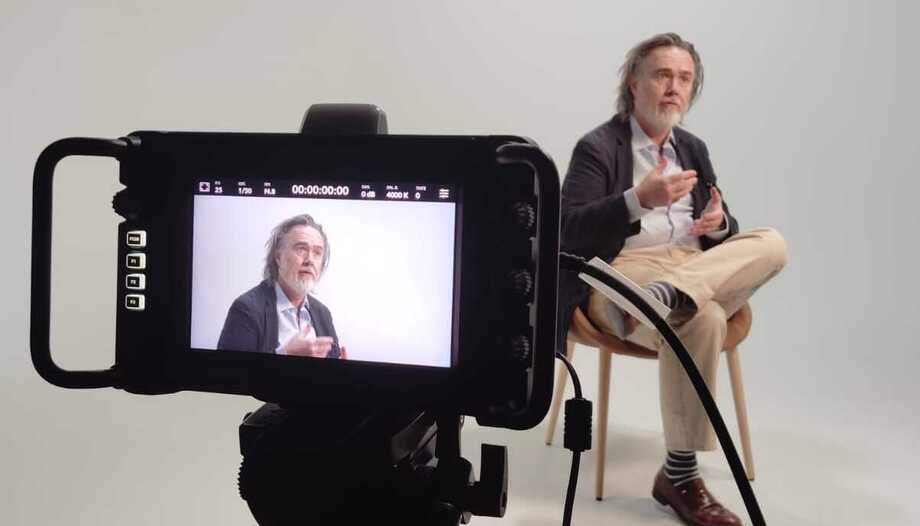
 Rod Dreher: “We live in an increasingly esoteric world”.”Rod DreherIf we Christians are not willing to suffer, we will disappear".
Rod Dreher does not speak of faith from comfort. American journalist and writer based in Europe, author of three “bestsellers” in the New York Times, has paid a high price for his convictions: a crisis that shook his foundations, a broken marriage, estrangement from his family. His latest book, “Living in Amazement”, which he spoke about in the published interview by Omnes, is the attempt of one who has lost much to find God in what is left. Among his closest interlocutors is J.D. Vance, the American vice-president who entered the Catholic Church thanks, among others, to Dreher himself.
Rod Dreher learned to differentiate thinking about God from having a true encounter with Him after losing the ability to believe in the Catholic faith. He tells Omnes that when he first became interested in Catholicism in 1991, he was working as a journalist in Louisiana. An older colleague encouraged him to volunteer in the soup kitchen of the Missionaries of Charity - Mother Teresa's work. He accepted and, although it wasn't what he expected, he put on his apron and began scrubbing pots and peeling potatoes: “I remember thinking, I'm an intellectual; my time would be better spent reading theology books. I never went back to the dining room.”.
Many years later, with his Catholic faith in ruins, he wondered if his faith might have been stronger if he had spent as much time in the dining hall as he did in theology books: “It was an important lesson about the trap of living too much in your head. I don't think there's anything wrong with reading theology - it's important to know the faith - but there are other ways of knowing,” he assures. “You can know it intellectually, which is important, but I think religion is not fundamentally about a concept but a perception: what we learn through the senses. That's why liturgy is so important. That's why devotions are so important. Working in a dining room or embodying the faith in the body is more important than living it only in the head. Both matter, but one matters more than the other. Because when you live the faith in the body, sacred history and religion penetrate to the bone in a way that doesn't happen when you stay in intellectual abstraction,” he says.
To young people who say they are Christians but live as if they are not, he gives them no choice: “You can't have it both ways. Either Christ is the Lord of your life, or he is not. There is no middle ground.” He himself wanted to rebel against this thinking in his university years, when he wanted to put conditions on God - among them, that he be allowed to live his sexual freedom - until he understood the contradiction. He formally converted to Catholicism in 1993 and embraced a life of chastityIt's very hard to be in your early twenties in Washington and suddenly be chaste. But I knew that was the price of following Jesus“. He adds: ”Don't lie to yourselves. Either you are with Christ, or you are not. But at the same time, it's not just a harsh message: there is a life in Christ that the world cannot offer you. And the more you die to yourselves -by going to confession, to Mass, The more you will change the way you see yourselves and the world, the more you will begin to see the great gift of faith. You will begin to see the great gift that is faith. And it is infinitely more powerful than what the world offers.”.
Crisis of faith
Dreher describes his move from Methodism to Catholicism and then to Eastern Orthodoxy as a process of unlearning the habit of intellectualizing God. For years he was a convinced Catholic: he knew the doctrine thoroughly and believed that, as long as he had the dogmas clear in his head, his faith was unassailable. But it didn't turn out that way. Nine years after his conversion, he began investigating the sexual abuse scandal in the American Church. A priest who assisted him in that investigation warned him early on: “Rod, I see you are a serious Catholic. I want to warn you: if you continue down this investigative path, it will lead you to darker places than you imagine.” Dreher responded that he felt he had to do it so that the victims would get justice. The priest told him, “Fine. I'll help you in any way I can, but be prepared.”.
He was not prepared. The case that marked him the most was that of Cardinal McCarrick, who was John Paul II put at the forefront of the American bishops“ fight against abuse. Dreher had known since 2002 that McCarrick himself was an abuser of seminarians, but without public statements and documents he could not publish: ‘I had to endure seeing McCarrick appear on television saying, ’We are so shocked by what is going on, we are so saddened,” knowing that he was. In fact, his lawyer called my editor to ask him to stop my investigation. I had to carry within me, as a Catholic, the burden of knowing he was a liar while everyone believed him. I saw that attitude in so many bishops of that time: they cared more about protecting the image of the institution than the victims and their families. I saw families ruined by lawsuits. The Church put lawyers to work to sink those victims".
Still, Dreher acknowledges that not all of the Church looked the other way. He agrees that the Pope Benedict XVI did a lot to address those scandals: “Yes, he did. I love Benedict. And even though years later, the Church expelled McCarrick from the clerical state, what I had seen and learned was simply devastating. It's like if you pick up an iron frying pan with your bare hands over a fire: eventually you have to let go. And that's what happened to me.
In his case, he tried to get out of the crisis intellectually, reading books on Catholicism and papal authority, then orthodox books, without being able to make up his mind. Then one day, in prayer, he came to a certainty that would change everything: “If any of us are saved, it is because we have a transforming relationship with Jesus Christ. The truth is not propositions; the truth is that incarnate man, God made flesh”. And he said to the Lord, “I don't know if I am making the right decision in becoming Orthodox, but if I am wrong, have mercy on me, because I cannot find you in the Catholic Church. Not because Christ is not in the Catholic Church - I believe he is, even today - but because of my own fragility and that of the Church at that time. There was a wall,” he explains.
In Orthodoxy, he admits that he found a more mystical path, closer to the body and to prayer. And a lesson in humility that he had not expected: “As a Catholic I had been intellectually arrogant. That was my fault, not the Church's. It was a great grace that God gave me. It was a great grace that God broke me of that arrogance. Now I love Orthodoxy, but I see my work as an attempt to help all Christians - Catholic, Protestant and Orthodox - to know and love Jesus more. We have much more in common in the face of the post-Christian world than what separates us.” He learned this from studying Christians imprisoned by the Communists: when they arrived in prison, they understood that they were not there because they were Catholic or Orthodox, but because they confessed Jesus Christ.
Faith and politics
There is a story Dreher tells with a mixture of affection and concern. It was he who sought out the priest who instructed the vice president. J.D. Vance in the Catholic faith. She knows him well. And that is precisely why he prays for him: “I know him well enough to know that he takes his faith seriously, and he must be tormented inside by what is happening. No vice president can ever go against the president. But I believe that, ultimately, people have to choose, and they must choose faith over worldly power.”.
Last November, Dreher was at Vance's home. At the time, anti-Semitism and racism were growing among some American right-wing “influencers” - a sector that hates Vance precisely because he married a woman of Indian origin. Dreher pleaded with him directly: “As my friend, as a brother in Christ, you are a Catholic: you have to speak out against this.” He still hasn't. “I don't think there's anything racist or anti-Semitic about J.D. Vance, but I think he's concerned about his political future. I remember when he had a disagreement with Pope Francis on migration: he disagreed with the Holy Father, but he did it intelligently, using arguments from St. Augustine, I would like to say, in a respectful manner. Trump has no respect for the pope or anyone else. And so I think it must be very painful for J.D. to live with that tension.” He can only hope and pray, he concludes, that he understands that his first loyalty is to Jesus Christ: “In the end, as the Bible says, you cannot serve two masters.”.






 Español
  English
  Italiano
  Français
  Deutsch
  Polski