


Every person, whether he knows it or not, lives according to a creed. He has fundamental convictions about who he is, where he comes from and where he is going; beliefs that guide his decisions and give meaning to his existence. The Christian Creed is precisely that, but precisely formulated and shared in the Church: an articulated response to the most radical questions that human beings can ask themselves.
The Creed is one of the most repeated texts in human history. For almost two thousand years, millions of Christians have recited it at the Sunday liturgy, at baptism, on their deathbed. It is not a text that is read: it is a text that is declared or professed. In this difference there is something essential: the Creed is not a doctrinal summary to be studied, but a public declaration of belonging and faith.
Two Credos
The explanation we are going to offer does not pretend to offer a very profound theology -which would imply analyzing the history, the etymology of the different parts and the content of each word-, but something more accessible: by studying the articles of the Creed we will try to enter into the mysteries of the faith so that they may serve as a guide and focus us on the essential.
The Creed is a very important reference, as is the Catechism of the Catholic Church, but with a difference: the Catechism is a much broader work, while the Creed is a compendium. Moreover, the Creed is much older: it is the official confession of the Church.
In Spanish we call it Credo by its first Latin word: “Credo in unum Deum”.” -I believe in one God“. “Credo” means in Latin “I believe”.
In the liturgy we use two creeds: a longer one and a shorter one. The shorter one is very venerable and very old, probably from the second century or perhaps earlier. It is called Apostles' Creed and contains the general Christian doctrine in order. It is difficult to determine exactly when it was first used, but its antiquity is deduced from its ancient use and its doctrine; it is usually dated around the middle of the second century or much earlier, depending on the authors.
The longest, on the other hand, has a perfectly determined date. But before explaining it, it is useful to understand where the creeds come from.
The baptismal origin of the Creed
The Creeds are born spontaneously through the ceremony of baptism. In baptism, one is baptized in the name of the Father, the Son and the Holy Spirit, and the person to be baptized - especially if he/she is an adult - must be instructed beforehand.
In the first centuries of the Church, there was an abundance of adult baptisms, which followed a process of catechumenate that was organized and developed from the second to the sixth century. Later, when the population was massively Christian, baptisms became predominantly of children, and this preparation or catechumenate was reduced. Today, with the de-Christianization, we also have numerous adult conversions.
The structure of the catechumenate followed the Trinitarian scheme: what refers to the Father, what refers to the Son and what refers to the Holy Spirit. All the fundamental contents of the faith were organized around the three persons of the Trinity.
In the old catechumenate there was a ceremony for the delivery of the Creed: “Look, you are going to be Christians; we give you the Creed to be yours to learn and recite.”. This was done on the Sundays of Lent, before Easter, because the baptisms of adults were celebrated at the Easter Vigil. One Sunday in Lent the catechumens received the Creed, learned it, and the following Sunday recited it publicly.
Thus, the different churches scattered around the world were generating their own Creeds, copying each other or developing their own. A classic book on this subject is that of Kelly, Early Christian faiths, which collects some of them and explains in detail this baptismal function.
The Long Creed: Nicaea and Constantinople
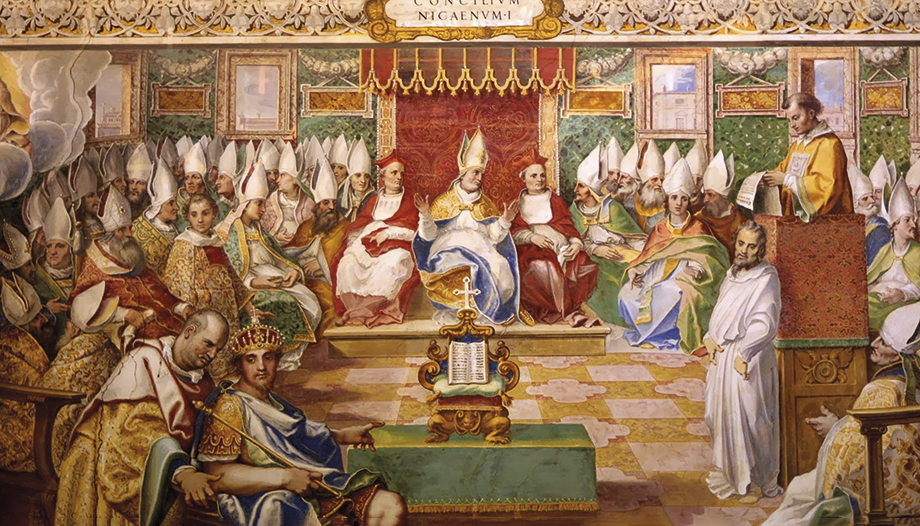
The long Creed, which we use today, is composed in two stages. The first takes place in 325, at the Council of Nicaea. By then, the Church had achieved a certain independence: it was no longer persecuted and was recognized as acceptable in the Roman Empire by Emperor Constantine, who had converted, although he was not baptized until the end of his life. In this climate of peace it was possible to confront serious internal problems, the most important of which was Arianism: a dispute about the figure of Jesus Christ, about whether or not he was equal to the Father. To resolve this question and to formulate a common and clear confession of faith, the Council drew up a Creed that was no longer only baptismal, but also doctrinal.
Nicaea is relatively close to Constantinople, on the other side of the sea. And it was precisely in Constantinople where, in 381, a second Council completed that Creed, developing the third part on the Holy Spirit, which in Nicaea was limited to the phrase: “I believe in the Holy Spirit.”.
What the Creed is for today
This long Creed is the one we will use to expound the main contents of the faith and to give them a theological basis. It is not that theology is more important than catechesis, far from it; but when we want to rethink the faith and have a well-articulated idea of what Christianity is, it is essential to have recourse to these sources.
The Creed, as the first ordination of Christian doctrine, serves as a reference for us to ask ourselves: what are the Christian mysteries, how do we explain them, what difficulties do they pose today? This path has been trodden by many before us.
The then professor Joseph Ratzinger - later cardinal and then Pope Benedict XVI - wrote his Introduction to Christianity as an explanation of the doctrine based on the three parts of the Creed. St. Thomas Aquinas left a commentary on the Apostolic Creed. And the first part of the Catechism of the Catholic Church -the second universal catechism in history- is in fact an extensive commentary on the Creed, followed by an explanation of the liturgy, morals and prayer.
The Creed is not studied in order to know more, but to live better. Knowing who God is, who Christ is, what the Church is or what eternal life means are not data to be filed away: they are convictions that transform our way of being in the world. That is why the Church has always put the Creed in the mouths of her faithful, not in her libraries.






 Español
  English
  Italiano