



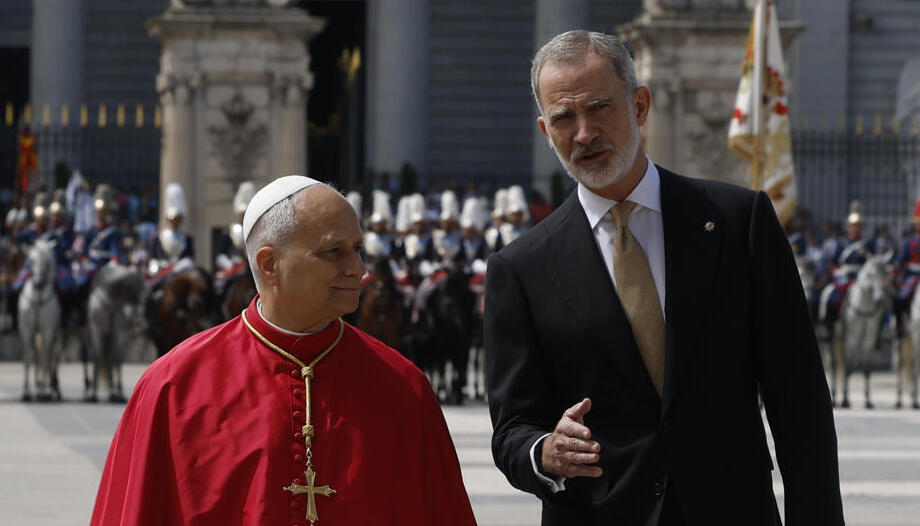
 The Pope is already in Spain
The King and Queen of Spain, together with their daughters and the Diplomatic Corps, are the first to welcome Pope Leo XIV after landing in Spain.
The welcoming ceremony took place at the Royal Palace in Madrid, where, amid military honors and chants of the gathered faithful, King Felipe VI greeted His Holiness, highlighting “the immense joy” felt by all the Spanish people to receive the Holy Father.
The Church in Spain
In his speech, the king highlighted “the enormous social work of the Catholic Church, fruit of the commitment of religious men and women, priests, deacons, young people who are involved in the life of the parish, volunteers who help in residences, shelters, soup kitchens and shelters”.
Likewise, Felipe VI mentioned “the thousands of missionaries of our country who carry out their social, educational, welfare and pastoral work in so many needy places in the world, often remote or still very disconnected”.
His Majesty also took the opportunity to recall “the cases of abuse, which are not and cannot be representative of the immense ecclesial community”.
A Pope for Today
The King then praised the Pope, “a man of solid scientific formation”. He also highlighted the Pontiff as a man “with a great social conscience and a profound attention to change”.
Felipe VI also made an analysis of current affairs, warning that “we run the risk of forgetting what really matters, of slipping into the mistaken belief that -abolished many of our references by the pulse of current affairs- anything goes, everything is admissible, negotiable and justifiable”.
However, His Majesty affirmed, alluding to the mathematical profile of Pope Leo XIV, “the dignity of the person, human rights, democratic values and international legality must continue to be our prime numbers... Because in them - in their multiple combinations - is the arithmetic of freedom, equality and justice; that which adds and multiplies, not that which subtracts and divides”.
Call for unity
Felipe VI concluded by affirming that “unity as an aspiration arises from the awareness of our fragility as individuals, of our contingency, of our limitations; but also of that inexhaustible capacity for good and beauty that reaches its peak when human beings love their neighbors, when they open up and give themselves to others”.
Spain and Christianity
Pope Leo XIV thanked the King for his words and began by highlighting “the very ancient bond between the Christian faith and this land”, which “although on the one hand does not exhaust the multifaceted identity of your people, on the other hand has deeply shaped its culture and represents a source of hope and guidance among the challenges that today, as a human family, we must face together”.
The Holy Father affirmed that his trip aims to “confirm, encourage and inspire a renewed fidelity of believers to the Gospel, as well as a deeper reconciliation and cooperation among the various forces of this Nation”.
Spiritual Search
For this reason, His Holiness referred to “two figures from this country who, for five centuries, have nourished the life of the Church and the spiritual search of many, even beyond its visible borders”: St. John of the Cross and St. Teresa of Avila.
Following the example of St. John, the Pope said, today “we need, also in public life, men and women who sense, in the darkness, the light; in the end, a possible beginning, almost the bursting forth of a truth as a light that still blinds but that - if we trust and find peace - will lead us gently towards itself”.
Leo XIV insisted that “we need culture, interiority, a free and quality education, we need transcendence”.
In this sense, “the Catholic Church is at the service of this thirst of the human heart”. For this reason, the Pope invited “everyone, for love of the truth, to abandon divisive and polarizing narratives of your social reality and its history, and to move from sterile simplifications to a fruitful appreciation of complexity”.
This, said the Holy Father, is “a specific vocation of Europe, of which Spain is the original and fundamental protagonist”. It is “the gift that the Old Continent can give to the world if it wants to remain young, because young is the one who feels that it has a future and a mission that still challenges”.
Investing in culture and dialogue
For this reason, the Pope affirmed that we must “make a qualitative leap, a change of direction in investments in schools, universities and research, in local communities and in civil society as a seedbed of participation and cultural mediation”.
In addition, the Holy Father alluded to “the presence of Islam in the Iberian Peninsula”, a time when “there was not only confrontation, but also an attempt to create a space for contact, conversation and dialogue on the meaning of truth between Christians, Muslims and Jews”.
Pope Leo concluded his address by encouraging the promotion and cultivation of “dialogue and social friendship, to take into account the perspectives of the poor and the young in imagining the future, to harmonize the demands for autonomy and unity, and to promote the process of European union, not in opposition to other powers, but as a gift for the whole human family.”.
The Pope is already in Spain






 Español
  English
  Italiano
  Français
  Deutsch
  Polski