


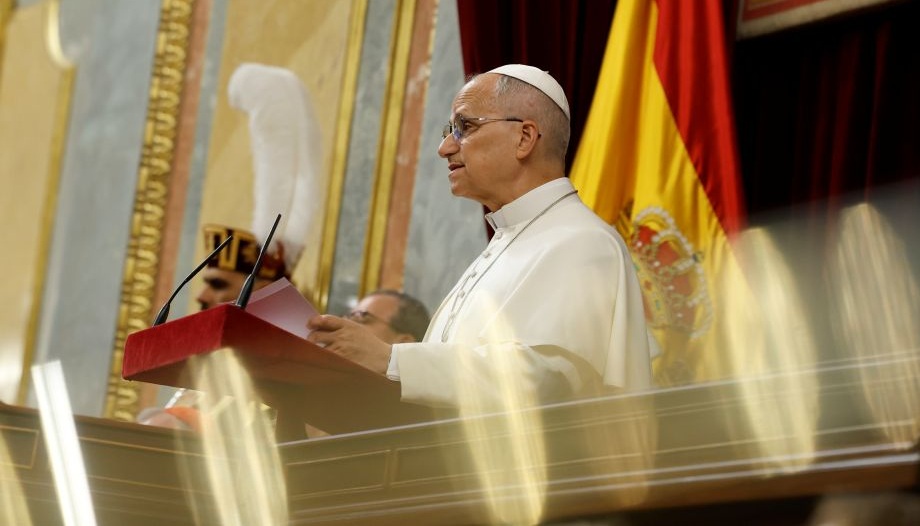
On Monday morning, Monday 8, we had the opportunity to listen to the speech of Leo XIV in the Congress of Deputies, one of those that has generated more expectation in this visit to our country.
In it he referred, as could not be otherwise, to the immortal Francisco de Vitoria and the School of Salamanca: “In that university seat, five hundred years ago, when new worlds and immense possibilities were opening up in relations between peoples, some teachers understood that reason could not be invoked to clothe the legitimacy of what force or interest presented as convenient”. Precisely on the eve of the Pope's arrival, the university, honored with the privilege of the magisterium of this Dominican scholar, awarded him a doctorate “honoris causa”.
In fact, throughout this year 2026 the anniversary of the beginning of his teaching in the classrooms of the City of Tormes is being celebrated as the fifth centenary of the School of Salamanca, of which he is widely considered the founder. But all this is going unnoticed by the general public. Not even in the ecclesiastical sphere is this eminent figure of our intellectual past remembered too much. Just as the centenary of the canonization of St. John of the Cross, another glorious mind of the greatest century of Spanish history, is not being talked about as much as it should be, although he is still mentioned in the Pope's speeches.
God's law and human law
This neglect of our intellectual past contrasts with the Pope's wise desire to remind Spaniards where we can find the answers to many of our questions. To us, who so often look with self-consciousness to all sorts of novelties in an attempt to “bring ourselves up to date”, the Pope reminds us that Spain was the inventor of modernity. It was in our country where an unprecedented way of thinking emerged, capable of guiding people through previously unknown crossroads.
The solution of Vitoria and his school is at the antipodes of the type of thinking that governs our institutions. While nowadays legal positivism is at large, the School of Salamanca offers us another way of understanding coexistence. This positivism believes that justice is born of the law and the dispositions of the rulers. The Pope's speech, on the other hand, enunciates the type of institutional mentality that has always guided the Church and which the authors of Salamanca knew how to expose in a contemporary way: “Politics also needs to recognize a measure that precedes and surpasses it”. The law does not establish the good, but it is a way of recognizing it, welcoming it, protecting it and promoting it. The law is not primarily aimed at creating reality, but at actively accepting reality.
A good philosophy and the Christian faith recognize that all that reality, good, luminous, fruitful, at whose service the law is, comes from God. Therefore, Vitoria taught the world that the law of God is above the laws of men, and international law, like all law, is not at the discretion of the most powerful, but of a justice to which every human being and every people must abide.
Assistant Professor, Faculty of Philosophy, San Daámaso Ecclesiastical University






 Español
  English
  Italiano