



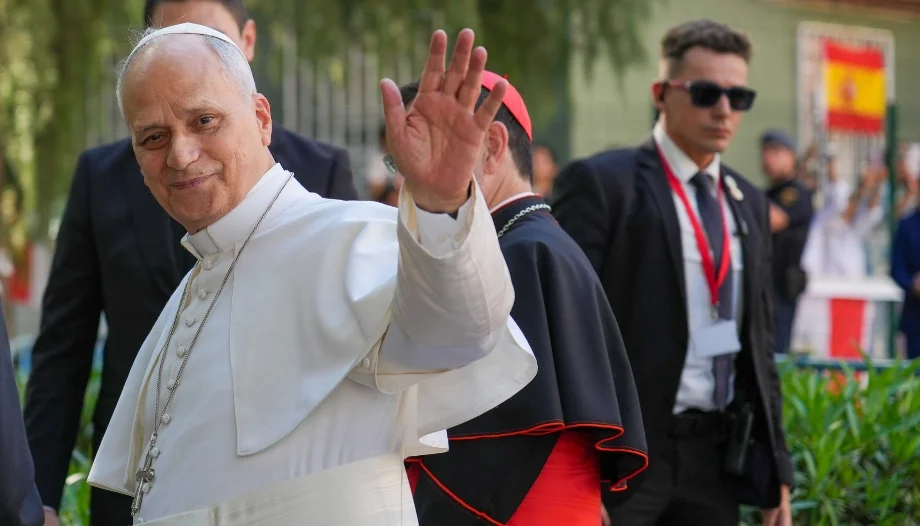
Pope Leo XIV began his first trip He not only prepared himself spiritually and did all the necessary documentation, but he also talked to the journalists on the plane and went row by row to meet each one of them.
This has been the keynote of this long and intense journey: looking for people, getting close to people, to each person; authorities, members of the escort, the public in the street, politicians or people of culture.
Undoubtedly, the program of official events was very full, and above all very well thought out, but it must also be recognized that the private agenda was also very full of visits and attention to special cases, people in need and delicate problems.
The greetings and handshakes of the Holy Father were never formal; his conversations with the school children who received him at the airport or with Queen Leticia, were affable conversations, smiling hugs, open and endearing.
The Holy Father is very human and very divine, and he preached by example what was to come out in all his interventions: fraternal dialogue, learning from the other, being attentive to others. Certainly he has clearly reflected the heart of an Augustinian missionary who was always with the people and who lived with the indigenous people and that now continues to beat in a universal heart.
The Holy Father has come to Spain to meet each one of us and to give us his affection, his cordiality and his overwhelming sympathy. Leo XIV is the living figure of St. Augustine: a man touched by the love of God whose mission was simply to love every person he met and to teach love through his preaching, his life and his writings.
The most repeated phrase during these days was the framework-announcement of the visit: “raise your eyes”. This, certainly, could be done in many ways: as St. John Paul II, Benedict XVI, Francis, or as Leo XIV did: being Christ who passes through our land, who attracts with his gaze, with his smile, with his Augustinian and American naturalness.
After reading the book of the “Conversions“ of St. Augustine, his “De civitate Dei”, “de unico baptismo” or that of “bono matrimonii”, one certainly concludes that we are not in the oriental discourse of the Polish pontiff nor in the warm rationality of Ratzinger, nor in the thrust of Francis, but in the ardent heart of St. Augustine as reflected in the pontifical coat of arms of Leo XIV.
The ideas he was going to convey had already been announced in his Encyclical “Magnifica humanitas” (May 25, 2026), which certainly upset all those who had written their speeches in May to have everything prepared and controlled: speeches, newspaper articles or newspaper columns and jokes of the talk show hosts.
But it is one thing to see the speeches written, to hear them, to listen to them carefully with pen and paper, and quite another to realize that the Holy Spirit had decided on a change of gears of greater depth than we had imagined. We have returned to Plato, to the world of ideas, to the passionate heart. To the short sentences or to the beautiful speeches of the classical literature of the golden century of Castilian letters. We needed someone to give us a cultural shake-up and remind us of Spain's Christian roots.
Just as German Romanticism arose after Kant and Descartes, it was necessary for the heart of Augustine to emerge after the Thomism renewed by the School of Salamanca, which had already been the nerve of the Holy Father's discourse from the day he arrived.
Certainly, in the speech at the Palace of Oriente, the Holy Father began by thanking Spain for its contribution to international law and that upset some who did not see Vitoria and its law of nations, but thought of the Pontiff's diatribes with Trump and Sanchez.
We are celebrating the V Centenary of the beginning of the School of Salamanca and with them the beginning of teaching as Professor of Prima of the Faculty of Theology of the University of Salamanca.
The School of Salamanca, started by Francisco de Vitoria, brought together all the great thinkers of his time, Jesuits, Dominicans, Franciscans, Augustinians of his time, to invent Christian humanism, which was the transition from the pagan humanism of the Renaissance to an international humanism thanks to natural law, love of freedom and the defense of the dignity of the human person.
Certainly in Grotius and in the universal declaration of human rights of 1948 the principles of the Relections of Francisco de Vitoria were transcribed, but they were founded: those rights consistent with the dignity of the person were based on the fact that man is and will always be the image and likeness of God.
This morning the Holy Father presented to the politicians of this country a program identical to the one he later reminded the bishops gathered in the Spanish Episcopal Conference celebrating the sixtieth anniversary of its constitution.
Certainly, it is possible to be modern and live the Gospel, as he said John Paul II In Columbus, it is enough to live the Christian humanism recommended to us by Pope Leo XIV as he learned from the School of Salamanca and the virtue of charity as Pope Francis and St. Augustine taught us.
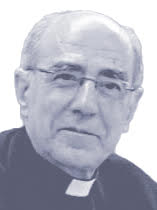
Member of the Academy of Ecclesiastical History. Professor of the master's degree in the Causes of Saints of the Dicastery, advisor to the Spanish Episcopal Conference and director of the office of the Causes of Saints of Opus Dei in Spain.






 Español
  English
  Italiano
  Français
  Deutsch
  Polski