


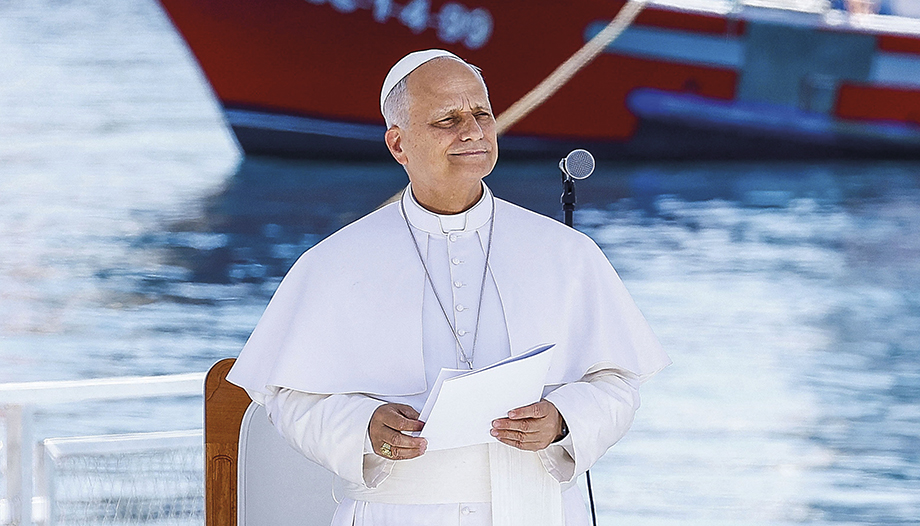
 Pope in Tenerife: "we are all migrants and pilgrims on the way to the heavenly homeland"."Leo XIV confronts the harshest realities in Barcelona: suicide, family violence and existential emptinessThe Bernabéu once again experienced an apotheosic night: Leo XIV "Today the Church of Madrid has scored a goal for all time"."
“Look up!” (John 4:35). Leo XIV explained the motto of his trip to Spain from “grand cathedrals as well as state-of-the-art stadiums”, in his encounters with young people, migrants, and prisoners—with all those who have been willing to listen to him.
What was it all about? The Pope has been teaching us this in recent days through his actions and words. As if to echo this, he himself has left us with this summary: “Let us learn from Jesus to look at our neighbors, other people, and the world ‘through God’s eyes’—that is, with love, respect, and compassion” (General Audience, June 17, 2026).
He has asked us Christians to work together to build the City of God (His Kingdom, which grows unseen throughout history) “from the heart of cities” of mankind. To all of us, as citizens, He has set forth a sure path that is also a challenge: “Learning to move forward with others, to grow together.”.
Madrid: A Family Learning the Art of Polyphony
Leo XIV reveals to Europe—through its great history of bridging languages, religions, and fields of knowledge, and of uniting historical action with the clarity of moral reason—the vocation of “appreciate its complexity and study it” with a forward-looking vision. A task that involves overcoming polarization through discernment, “to learn to move forward with others, to grow together” (Speech greeting the authorities at the Royal Palace, June 6, 2026).
In this context, Spain’s contribution is framed in reference to the saints who have cultivated a “mysticism with open eyes” to reality (St. John of the Cross, St. Teresa of Ávila, St. Ignatius of Loyola).
Even today, the Pope affirms, eternity can permeate daily life, uniting tradition and progress, the search for truth and dialogue, holiness and social commitment centered on charity.
A Spark of a New Humanity
That first evening, he asked the young people in Lima’s main square (see Address at the Prayer Vigil, June 6, 2026) to be “a spark of a new humanity” and to change history through love. He encouraged them not to be afraid of a priestly vocation, religious life, marriage, or other forms of service to the Church; to always seek the truth and reject other paths: “God is the truth! If it leads you away from God, it’s not the truth!””.He showed them the paths of prayer, spiritual guidance, Eucharistic adoration, and fervor in spreading the fire of God’s love.
He entrusted them with the mission of being human, “real men and women. Not facades, but genuine faces”. And also “missionaries of the Gospel in the face of the material and spiritual poverty of our time".
The next day, during the Corpus Christi Mass in Cibeles Square, he explained the significance of the procession with the monstrance: “The procession shows that He does not remain confined to the temple, but comes out to meet us. Jesus walks through the streets, crosses the squares, visits our neighborhoods, and dwells in the places of our daily lives. (…) The Christ who passes through the streets in the monstrance is the same one who identifies with the poor, the downtrodden, and those who are lonely and helpless..” (Homily, June 7, 2026).
New threads to weave new nets
That afternoon, he met with representatives from the worlds of culture and the arts, the economy, and sports (see Address at the Movistar Arena, June 7, 2026). He emphasized the need to safeguard and serve “the soul” of everything society produces. That is, the desire for goodness, beauty, and truth that lies in the human heart. He then invited everyone to “be new threads to weave new nets that bring harmony to all aspects of life, to weave together a renewed society where time is imbued with eternity".
At the beginning of the week, and for the first time in Spain’s history, a pope addressed Parliament (see Address to the Congress of Deputies, June 7, 2026). In a speech that drew prolonged applause, he presented himself as a servant of the human person and a champion of human dignity. He referred to the legacy of the School of Salamanca and to Francisco de Vitoria in establishing the foundations of human rights at the international level.
He confirmed that a just society is measured by its ability to protect life when it is at its most vulnerable, “from its conception to its natural end”. He warned that the law loses its meaning if it becomes a commodity or if it ignores those who lack the power to make their voices heard. He defended the family and its freedom to choose the type of education for its children. He emphasized how the migration crisis today challenges the conscience of nations and the ethical foundation of the international order. In the face of the “a profound spiritual and cultural crisis” which spans the globe, praised the efforts toward peace. He invoked freedom of thought, conscience, and religion (which must not be excluded from public life), including respect for the sacramental seal of confession.
"That Spain "—he suggested—" may it continue to be a land of encounter, culture, solidarity, and hope. And may its public life always combine the firmness of convictions with the nobility of dialogue and the greatness of service".
Artisans from the Heart of Cities
Turning to ecclesial matters, on Tuesday Leo XIV met with the bishops (see Address at the headquarters of the Episcopal Conference, June 8, 2026). He spoke to them about listening, discerning, and serving, through the proclamation of the Gospel and the sacramental life, even in the midst of difficulties, for “The night is a time of salvation”. He asked them to be builders of unity and to pay special attention to vocational ministry and priestly formation
Next came the match at the Santiago Bernabéu Stadium, which the Pope described as a “A spectacular goal by Madrid’s Iglesia” (Speech, June 8, 2026). In it, he presented the Church as a “A family learning the art of polyphony”, where unity does not mean uniformity, but rather a harmony that values the diversity of charisms and the relationships between “real people”.
In the shared building of the city, who we are and what we do as Christians must, in the words of Pope Francis, “where new narratives and paradigms take shape,” that is, the “deepest recesses of the soul of cities” (Evangelii gaudium 74).
At IFEMA, before leaving for Barcelona, he praised the volunteers for representing the “the yeast of generosity” (Speech, June 8, 2026).
Barcelona: Broken Hearts and Beauty in the Making
Once in Barcelona, his message was delivered during the Midday Prayer at the Cathedral of the Holy Cross and Saint Eulalia (see Homily, June 8, 2026), with a call for ecclesial unity and brotherhood—for harmony beyond all polarization—seeking to be “builders of unity”.
That evening, he joined the young people for a prayer vigil and engaged in a dialogue with them, followed by a homily (see Homily at the Lluís Companys Stadium, June 9, 2026). In his homily, he drew on the image of Nicodemus, ”pilgrim in the night” of the human condition and the journey of faith. “We, too, are called not to judge the ‘nights’—neither the nights of our own lives, nor those of the Church, nor those of the society around us”. We must set out on this journey, engaging in dialogue with God and with one another, seeking the truth that guides us toward unity while respecting diversity. And in this way, we will experience “A blessing presence, a selfless love that will help us move from darkness into light.”.
On Wednesday, the Pope visited the prison Brians 1 (see Address, June 10, 2026). There he proclaimed the dignity of every human being by the mere fact that “to have been desired, created, and loved by God" (Magnifica humanitas, 52). He told the inmates that “The past does not determine the future”, because we can always start over, grow, change, and above all, reconcile and forgive: “God loves you just the way you are, but He dreams of you being even better!”".
On the occasion of the recitation of the Rosary at Montserrat, Leo XIV asked, “a reconciled heart” and disarmed also through words and attitudes, so that hatred may give way to hope and peace. He spoke along the same lines during his meeting, also on the 10th, with the diocesan charitable and assistance organizations at the Church of Sant Agustí.
Living, luminous stones
The Catalan leg of the journey—which, through various avenues, explored the path of beauty as a means of evangelization—concluded with the grand finale of the Mass at the Basilica of the Sagrada Familia.
"We are all the living stones of this work, which has Christ as its foundation and crowning glory, its beginning and end”. Likewise, this work of art that is our life is not an unfinished work, but a temple under construction—which implies a commitment to collaborate with the Holy Spirit’s masterpiece in God’s plan.
All of this calls for consistency: “We cannot believe in Jesus and promote war. We cannot believe in Jesus and kill the innocent even before they are born. We cannot believe in Jesus and abandon those who suffer, those who weep, and those who flee from misery.”. And we must go through the Lord’s passion, because “The cross is the radiant sign of His love".
Canary Islands: No human being is an island
The highlight of the trip, given its prophetic significance, was the visit to the Canary Islands. During the meeting with representatives of the church community, he asked them to be “wise architects” in building the civilization of love (cf. Magnifica humanitas, 236), embracing the cross of Christ and cultivating a Eucharistic spirituality. Christian solidarity is the preeminent expression of this spirituality (cf. Homily in Las Palmas de Gran Canaria, June 11, 2026).
At the Gran Canaria stadium, he explained that “Love is inherent in human nature; indeed, it is a prerequisite for the fulfillment of human existence itself"and that "We must step down from the pedestals of arrogance that divide us, so that we may find one another in the humility that unites us.” (Homily, June 11, 2026). We are all migrants, pilgrims who must not forget our roots (Address at the “Las Raíces” Center, Tenerife, June 12, 2026). We are all called to welcome and open ourselves to others, to share and to participate (cf. Address in the Plaza del Cristo in La Laguna, June 12, 2026).
At the heart of the migration routes, Pedro’s successor was unequivocal in stating that “No human being is an island” and that the secret of the heart lies in the call to encounter (cf. Homily in Santa Cruz de Tenerife, June 12, 2026). Faced with the tragedy of the cayucos, the successor of Peter strongly denounced those who “They prey on people's desperation” and turn the suffering of others into a business, warning them that they will have to face justice. He assured the migrants: “Your life is not a waste; your dignity has not been washed away” (Speech in La Laguna, June 12, 2026).
As he bid farewell at the port of Santa Cruz de Tenerife, and referring to the heart of Christ—which is the heart of the Gospel—he asked everyone to open themselves to “this sea of love”. He repeated the slogan “Look up!”precisely toward the Crucified One, who is the source of forgiveness, reconciliation, and peace.".
A few days later, upon his return to Rome, the Pope said that in the Canary Islands he had found “a general interpretive framework”. And he states it as follows: “We are called to re-examine the Gospel in today’s world by sharing the gifts of our respective cultures and, in particular, the fruits that the fruitfulness of Christ’s message produces in them".
In other words: “We are called to be witnesses to Christ by sharing our faith and our culture with others. We are invited to engage in dialogue among individuals and peoples, in a spirit of brotherhood. This path is not easy; it requires goodwill and God’s help, but it is the path that leads us to the civilization of love.”r" (General Audience, June 17, 2026).
Pope in Tenerife: "we are all migrants and pilgrims on the way to the heavenly homeland"."Leo XIV confronts the harshest realities in Barcelona: suicide, family violence and existential emptinessThe Bernabéu once again experienced an apotheosic night: Leo XIV "Today the Church of Madrid has scored a goal for all time"."





 Español
  English
  Italiano
  Français
  Deutsch
  Polski
  简体中文
简体中文