


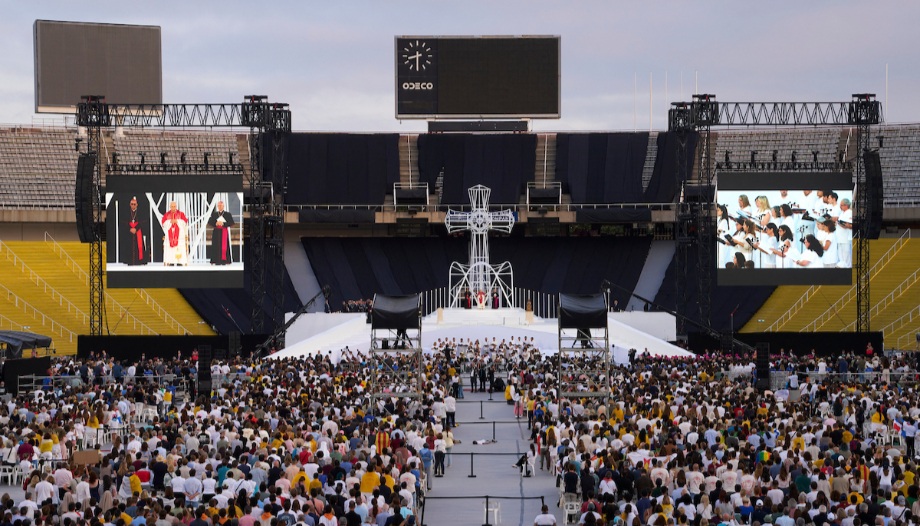
The Olympic Stadium Lluís Companys of Barcelona hosted last night a Prayer Vigil presided over by Pope Leo XIV before more than 40,000 people. The Pontiff arrived at the stadium shortly before 8:00 pm, after a private meeting with members of the Augustinian Order and the blessing of 30 ambulances bound for Ukraine, accompanied by Sister Lucia Caram.
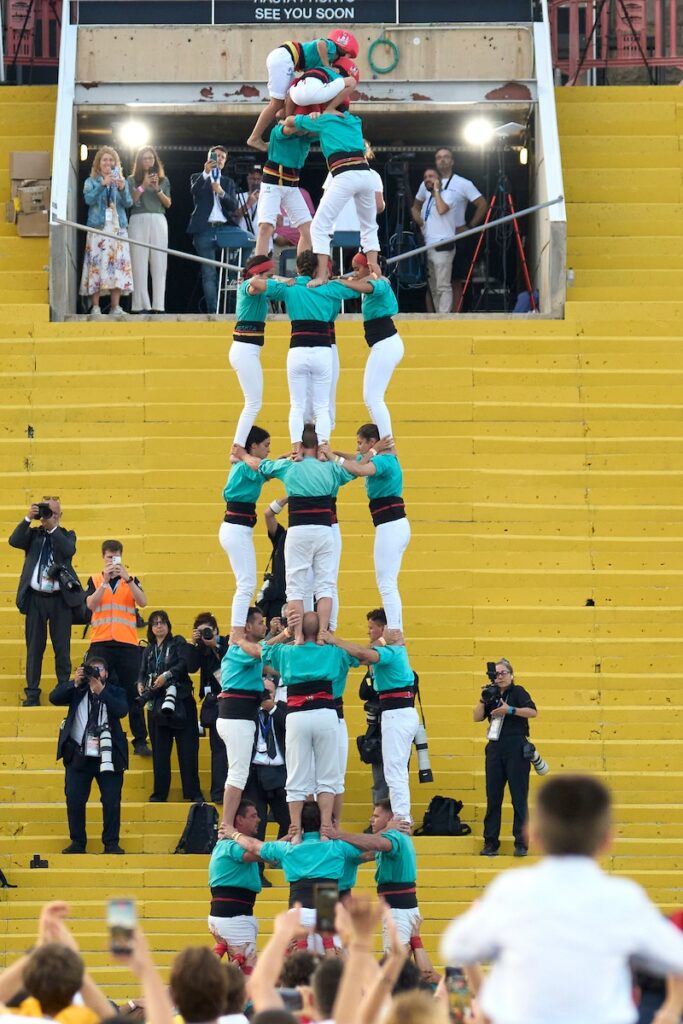
Once at the stadium, he made a lap of honor in the popemobile amidst the cheers of the young people and was welcomed with one of the traditional castellers -The Catalan human towers, “a beautiful manifestation of what we human beings are capable of doing when we work together with the same purpose,” as Cardinal Omella explained in his welcoming remarks.
The vigil was followed by a dialogue between the Pope and three young people who shared their stories in front of the stadium in silence.
Existential void
The first recounted how, growing up in a culture that values only production, success and image, he found an immense emptiness that led him to search for answers until he was baptized at the last Easter. He asked the Pope how to keep his eyes raised to what really matters.
Leo XIV responded that the spiritual restlessness felt by that young man is in reality a gift: «We are made to measure for the infinite and therefore, every finite horizon, every step, every conquest, while satisfying us at the same time impels us forward.» The Pope encouraged us to cultivate that restlessness by «descending inwardly,» setting aside moments of silence, reading the Gospel and walking together with others in community, because «it is in this world that we must cultivate restlessness, not in another.».
Depression
The second testimony was the most shocking: a young woman confessed that one Friday night she tried to take her own life and that she is alive because, she said, God gave her a second chance. She put on the table the «silent disease» that is depression.
The Pope addressed the subject with gravity and tenderness. He affirmed that mental health is «increasingly threatened in the context of societies that consider themselves advanced» and that this «is a sign that there is something profoundly wrong.» He denounced that certain cultural models «always want us to be winners and perfect», confining pain «to the deafening silence of loneliness or even shame». And he assured that God does not abandon us in those moments: «The cross of Jesus tells us that God does not abandon us, that He continues crucified with us in the moment of pain and extreme loneliness».
Leo XIV demanded that the Church not spiritualize suffering: «We must not superficially redirect it to the ‘will of God’ or to some mysterious plan of his, because this runs the risk of minimizing this suffering, of silencing it, of wounding people».
Violence in the family
The third testimony was given by a young woman whose father tried to kill her mother when she was a child -saved by a young man who lost his life-, who grew up under the care of social services, found faith in a juvenile center, but who admitted to having rebelled against God many times. Her question was direct and painful: how to forgive her father, how to reconcile with God?
The Pope did not shirk the crudeness of the story. He noted that family violence and femicide remain a scourge, and he was clear not to hold God responsible: «We cannot attribute to God what has been entrusted to our responsibility.» On forgiveness, Leo XIV described it as «powerful medicine against evil that heals our inner wounds,» but insisted that it is a process, not an immediate mandate: «Forgiveness above all we must invoke it from the Lord; continue to ask - perhaps throughout our lives - that the Lord enlarge in us the space of love precisely where we have been wounded.».
The Pope's speech
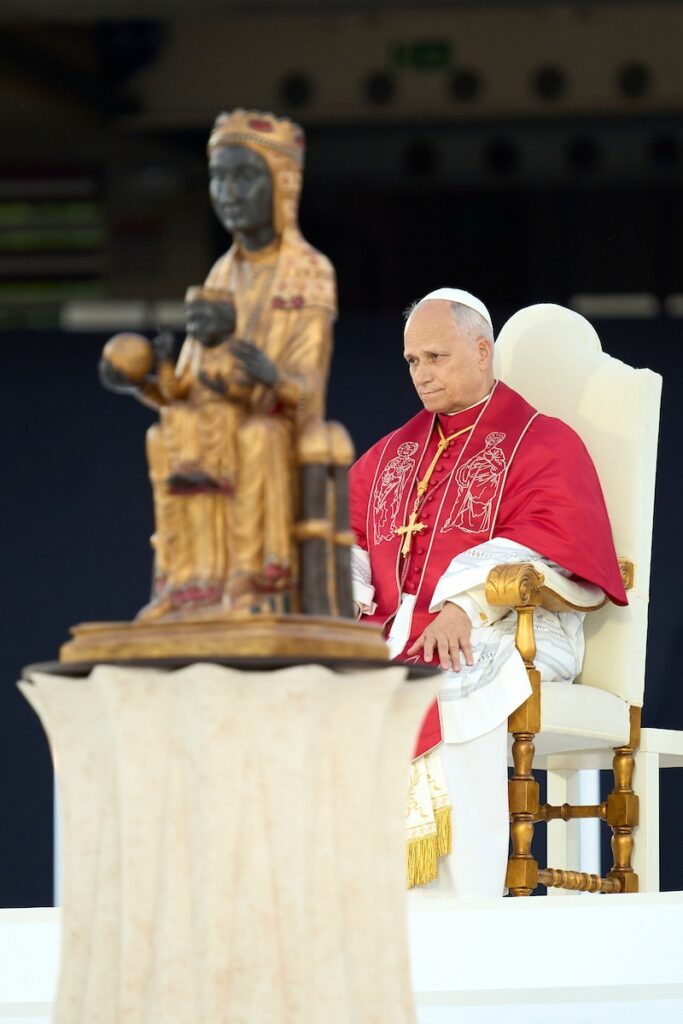
In his address to the stadium, Leo XIV took the Gospel figure of Nicodemus - the Pharisee who went to see Jesus by night - as a common thread to speak of personal, ecclesial and social «nights».
The Pope called not to judge one's own nights or those of others, neither those of the Church nor those of society. In the darkness, he said, we must set out on the road like Nicodemus, continue to question the Lord and open ourselves to the Spirit, in order to «welcome the night no longer as a sign of failure but as the beginning of a new life. He invited to ask oneself honestly what are the nights that each one is going through - in personal life, in the ecclesial journey, in the cities of Spain, in their old and new poverties - and what do these darknesses suggest.
Leo XIV concluded with a call not to cease in the search and in dialogue, «with God and with each other, also in the heart of the night.», He urged us to open ourselves to the gift of the Spirit «in the certainty that we will experience in ourselves a new life, a gratuitous love that will help us to pass from night to light. His last word was one of absolute hope: »God wants nothing to be lost and already now wishes to give us eternal life, to lead us to the happiness that has no end.«





 Español
  English
  Italiano
  Français
  Deutsch
  Polski