


 What does Magnifica Humanitas say to Catholics today? “Magnifica humanitas”: human dignity in the face of artificial intelligence.
Early in the morning, when the light begins to glide across Lake Albano and the olive trees of the papal villas still cast long shadows, the Borgo Laudato Si -A workshop where young people learn to care for our shared home while training for a trade- turns out to be too peaceful a place to talk about nuclear war.
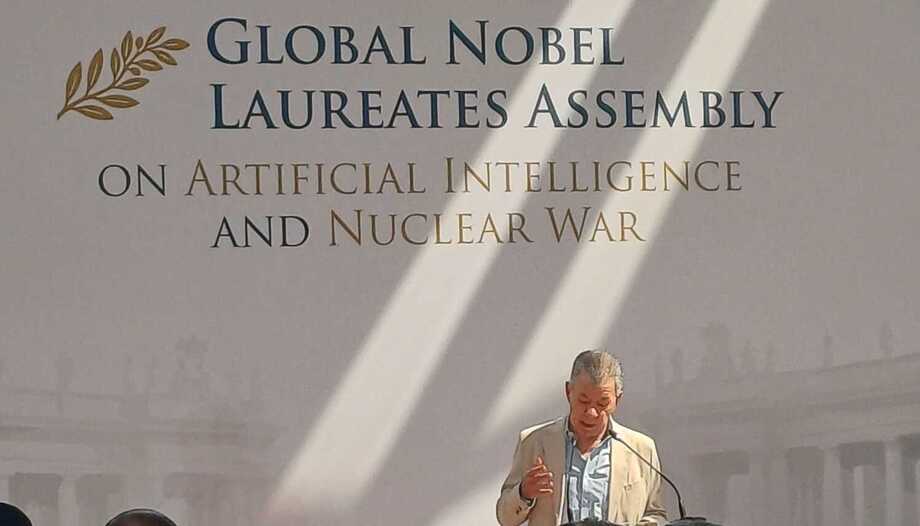
More than two hundred people from different continents—including Nobel laureates, former heads of state, scientists, and experts in artificial intelligence—gathered at this Vatican-sponsored laboratory for integral ecology to discuss two forces that are redefining our era: the resurgence of nuclear risk and the rapid growth of artificial intelligence.
It’s not often that you see Nobel laureates like David Gross, Maria Ressa, and Muhammad Yunus; political leaders like Juan Manuel Santos and Romano Prodi; and researchers like Tristan Harris—who is affiliated with OpenAI, Anthropic, or Google DeepMind—all in the same room. That mix is a sign of the times.
– Supernatural artificial intelligence It has democratized questions that for a long time seemed reserved for a minority of experts: Who decides? Who is in control? Who takes responsibility? These are issues that no longer concern only government officials or engineers. They affect us all.
More Than Just the Absence of War
At the opening session, the cardinal Fabio Baggio, deputy prefect of the Dicastery for the Comprehensive Human Development Service and executive director of the Center for Advanced Training at the Borgo Laudato Si, he noted that peace cannot be reduced to the absence of conflict: “It is an order founded on justice, mutual trust, respect for the law, and the inviolable dignity of every human being,” he said.
At a time marked by open wars, nuclear threats, and a technological race whose pace seems to outstrip our capacity for political and ethical reflection, he emphasized the need for shared principles capable of guiding progress toward genuinely human ends.
Between Babel and Jerusalem
If there was one image capable of capturing the spirit of the gathering, it was the one presented by Cardinal Silvano Maria Tomasi. The veteran cardinal described humanity standing at a crossroads: either building a new ‘technological Babel,’ where power, data, and control become idols, or working toward a ‘new Jerusalem,’ where technology serves the cause of fraternity. “The language of deterrence has once again come to dominate international relations,” he warned.
During the discussions, concerns were repeatedly raised about a new arms race in which artificial intelligence and nuclear weapons could reinforce each other.
Regulating Artificial Intelligence
One of the most eagerly anticipated speeches was that of Juan Manuel Santos. The Nobel Peace Prize laureate and former Colombian president argued that it will be impossible to ensure that artificial intelligence serves the common good without effective governance based on accountability, transparency, and the rule of law.
Muhammad Yunus went even further. He asserted that we are simultaneously witnessing the end of one civilization and the birth of another, and he reminded us that the decisions we make today will shape the world that young people will inherit.
Romano Prodi also spoke. In an increasingly fragmented world, he warned, no nation will be able to tackle challenges such as artificial intelligence, global security, or the regulation of increasingly powerful technologies on its own.
For her part, Kerry Kennedy, who currently chairs Robert F. Kennedy Human Rights—an organization dedicated to the defense of human rights—and is the daughter of Robert F. Kennedy, the senator and former U.S. attorney general who was assassinated in Los Angeles on June 5, 1968, while campaigning for the presidency, called for “no automated system to be allowed to decide on the use of nuclear weapons”—an idea that was incorporated into the Rome Declaration through the requirement for effective human control over such systems.
A conversation that goes way back
The Vatican's concern about these issues, of course, did not begin this week. In July of last year, it laid the groundwork for this meeting by convening an international roundtable on artificial intelligence, whose discussions led to the document Fraternity in the Age of AI, featuring some of the most influential voices in the field. Among them are Yoshua Bengio, Stuart Russell, Max Tegmark, Geoffrey Hinton, Yuval Noah Harari, Maria Ressa, and other international experts.
The starting point is to recognize that artificial intelligence can become an institutional actor: participating in markets, drafting contracts, influencing collective decisions, and managing complex systems without full human understanding. Harari, who has been in the news recently, argues that AI has begun to «hack the code of human civilization» by mastering language, the primary operating system of human societies. He also insists that AI is highly intelligent but not conscious: «intelligence is not the same as consciousness.» The question was essentially the same one that has been on everyone’s mind these past few days in Castel Gandolfo: how to ensure that artificial intelligence contributes to creating more humane, fairer, and more inclusive societies.
From Borgo to the Campidoglio: Peace, a Form of Intelligence
On the morning of July 16, the scene changed. The debates left the tranquility of the olive groves and moved to the Giulio Cesare Hall at the Campidoglio, the political heart of Rome. It was there that the Rome Declaration for a Disarmed and Disarming Peace in the Age of Artificial Intelligence, Nuclear Weapons, and Autonomous Systems, marking the conclusion of the Assembly held in Castel Gandolfo.
Cardinal Baldassare Reina presented the Declaration as a call to responsibility. He spoke of the need to educate new generations in critical thinking, ethics, and scientific responsibility because, as he stated, “peace requires both science and conscience.” He also reminded the audience that every technological, political, or economic decision must keep the dignity of the human person at its core.
The Declaration is intended as a call to uphold life, reason, brotherhood, and shared responsibility. At a time when security seems to be once again based on threats and deterrence, Reina argued that “peace is a form of intelligence.”.
Nobel Prize in Physics laureate David Gross issued an equally clear warning: “Our survival is at stake.” And Sharon Stone, the brand’s ambassador—and a nod to the media buzz—summed up the spirit of the day by declaring that “human dignity is not an algorithm,” as the meeting’s closing statement.
During the press conference that followed, Omnes She asked how we could measure, five years from now, whether we have truly made progress toward the future, whether the principles proclaimed in Rome have been translated into action—in short: what three specific indicators would be used to determine that AI is strengthening human dignity and not just economic productivity. Maria Ressa replied that the criterion will lie with people: determining whether citizens are receiving more reliable information, whether democracies are emerging stronger, and whether human beings retain a real capacity for decision-making in the face of increasingly influential systems. She also warned about the growing role of chatbots and conversational assistants. The question, she said, will not be how much machines know, but whether they help us think better or end up thinking for us.
No one has traveled all the way to Borgo Laudato Si’ just to talk about algorithms. The discussion has centered on freedom, responsibility, power, and the future. In the end, the image that remains is not that of the experts or the signed documents. It is that of brilliant minds gathered among chickens, ponies, vegetable gardens, and olive trees to debate the future of civilization while recognizing that everything begins with caring for small, concrete realities.
Machines are becoming increasingly intelligent. But the future will continue to depend on something much older than any algorithm: the human ability to discern what deserves to be protected and put to work for the common good. After all, the big question is no longer what artificial intelligence can do. The question is a different one: in whose hands are we?






 Español
  English
  Italiano
  Français
  Deutsch
  Polski