


In the novel The Fisherman's Sandals (1963), Australian writer Morris West predicts the election of a Slavic pope in a world on the brink of World War III. After seventeen years as a prisoner in a gulag, a Slavic priest is released from prison and, shortly thereafter, elevated to the See of St. Peter. Five years later, this simple and entertaining play was loosely adapted into a film of the same name, The Fisherman's Sandals (1968), directed by Michael Anderson and starring Anthony Quinn.
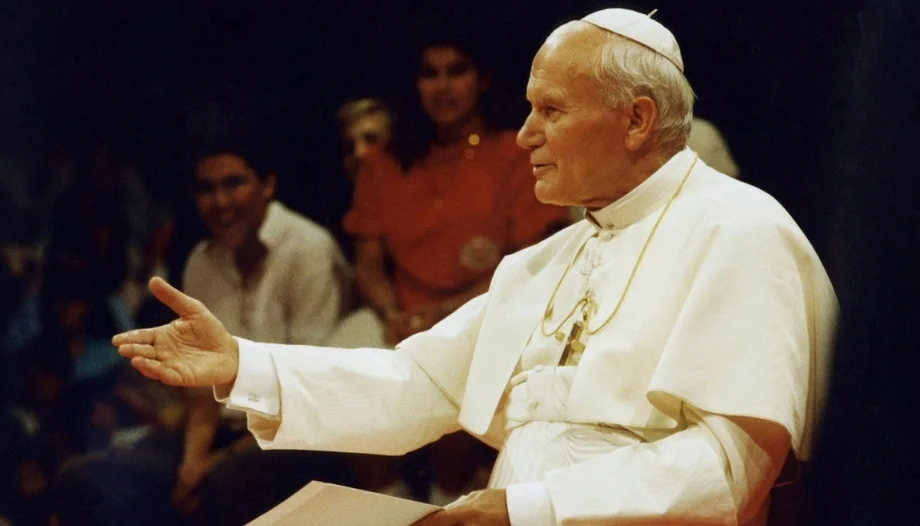
In 1978, this prophecy was fulfilled, breaking the five-century-long tradition of Italian popes. Furthermore, there were three popes that year. Following the death of Paul VI, the Patriarch of Venice, Albino Luciani (1912–1978)—a simple man raised in a humble Christian family and the eldest of four siblings—assumed the papacy. John Paul I’s pontificate lasted thirty-three days. He did not have time to write an encyclical, nor even to move his books and belongings to the Vatican. The “Smiling Pope” died suddenly on September 29, 1978. Once again, the council fathers gathered to vote. In the conclave, they elected the Cardinal of Krakow, Karol Wojtyla, as his successor; he took the name John Paul II.
With both feet on the ground
On election day, Stefan Wyszynski, the Cardinal Primate of Poland, spoke some prophetic words to the newly elected pontiff: “The new pope’s task will be to lead the Church into the third millennium.” Another prophecy that came true.
Also on the very day of the election, John Paul II issued the message “Do not be afraid” at a time when the world seemed to be on the brink of World War III (as in The Fisherman's Sandals). At that time, Europe was undergoing a deep economic crisis, and the process of de-Christianization in the West was accelerating. The Catholic Church was still suffering the consequences of the post-conciliar period.
Thus, a Polish pope was elected who had a deep concern for the problems of contemporary society. Poland had not undergone the process of increasing secularization seen in Western countries; instead, it had experienced religious persecution in recent years. In his encyclicals, the Polish pope denounced the disparities between rich and poor countries, criticized both Marxist and capitalist systems, and proposed ideas—drawn from moral theology and Christian anthropology—in favor of a labor market and economy tailored to human beings rather than to states and multinational corporations.
Humanistic Concerns
Another defining characteristic of this pontiff was his philosophical training; he was well-versed in the works of the great masters, from Thomas Aquinas to Max Scheler, which led him to explore anthropological issues in depth. In the encyclical Fides et ratio (1998) explained that reason and faith should go hand in hand because they were not opposed to one another. He then pointed out the existence of truths that transcend reason—that is, truths that can only be attained through faith. On the one hand, faith goes beyond reason; it is a complement that neither destroys nor replaces human rational capacity. On the other hand, reason plays a fundamental role in accessing truth through philosophy, which helps resolve many of the questions surrounding human existence.
His oratory and gestural skills, acquired during his youth when he devoted part of his time to theater and literature, were evident in his speeches and addresses, such as the one he delivered on human rights and freedom at the UN in 1995. He called for respect for every person, for the family, and for every people, and proposed a new world order governed by a balance between the particular (family and people) and the universal (states and international organizations). He concluded his address with a plea: to join forces to overcome fear of the future and thus build a civilization based on love and freedom.
In short, among the most distinctive traits of this pontiff, it is worth highlighting his Slavic heritage, which brought a fresh perspective to the papacy—which had been linked for more than four centuries to Italian culture— his humanistic education as someone who, from his youth, was connected to theater, poetry, and philosophy; and his capacity for openness and dialogue in addressing the great challenges of today’s world. Stanisław Dziwisz, his personal secretary from 1966 to 2005, summarized his multifaceted personality in three traits: a man of letters, a man of piety, and a man of dialogue.
This kind and magnanimous man turned out to be a thorn in the side of some people. On May 13, 1981, the Turkish national Ali Agca shot the pope as he was greeting the faithful gathered in St. Peter’s Square. Up until that day, this assassin had never failed in his attempts. Everything seems to point to the Bulgarian secret police—and likely the KGB as well—orchestrating the attack that wounded, but did not kill, the pontiff.
A Genuine Pope
Through his travels, his writings, and his actions, John Paul II was a pope who left his mark on an era in the history of the Church and the history of humanity. To a certain extent, he influenced recent events during his nearly twenty-seven-year pontificate, becoming the second-longest-serving pope in history, after Pius IX’s 32-year reign. He was the pope who lived through the end of the Cold War and the emergence of the radical Islamist threat. He was the pope who prayed in Assisi with representatives of other religions. He was the pope who observed a Day of Forgiveness (March 12, 2000) for unedifying events in the history of the Church (divisions, violence, etc.), for the use of methods that were far from evangelical in spreading the truth, and for sins committed against human rights. He was the pope whose funeral was attended by more than two hundred heads of state. Some have even described him as the pope who changed the course of history. Twenty years have now passed since his death in 2005, and many more years will pass before we can access valuable documentation held in the Vatican archives to uncover the magnanimity of one of the greatest pontiffs in human history.
The magazine was not wrong Time when he was named Person of the Year in 1994. John Paul II knew how to draw in young people from all over the world and captured the attention of all kinds of media outlets. He was undoubtedly a charismatic figure.
Shortly before his death, Polish film director Krzysztof Kieślowski completed a trilogy titled Three Colors, as a tribute to the principles of the French Revolution and the tricolor flag. Red (1994) is the third film, an ode to brotherhood. It begins with the appearance of a young, very beautiful model (played by Irène Jacob) who runs over the dog of a retired widower. This elderly, lonely man falls platonically in love with her because she reminds him of his first love. A curious relationship begins—one that changes their lives as they search for happiness. Red It brings the trilogy to a close with an ode to understanding and compassion, even among people who seem to be polar opposites. In this film, as in the other parts of the trilogy, the Polish director dares to explore themes vital to every human being—such as love—within a framework that remains open to transcendence.
All things considered, the life of John Paul II could be compared to that of the protagonist of Red, a good person who always tries to help others. May the legacy of this holy pope be brought to life in today’s polarized world.
Researcher at the University of Navarra and author of the book History of the Popes in the 20th century






 Español
  English
  Italiano