


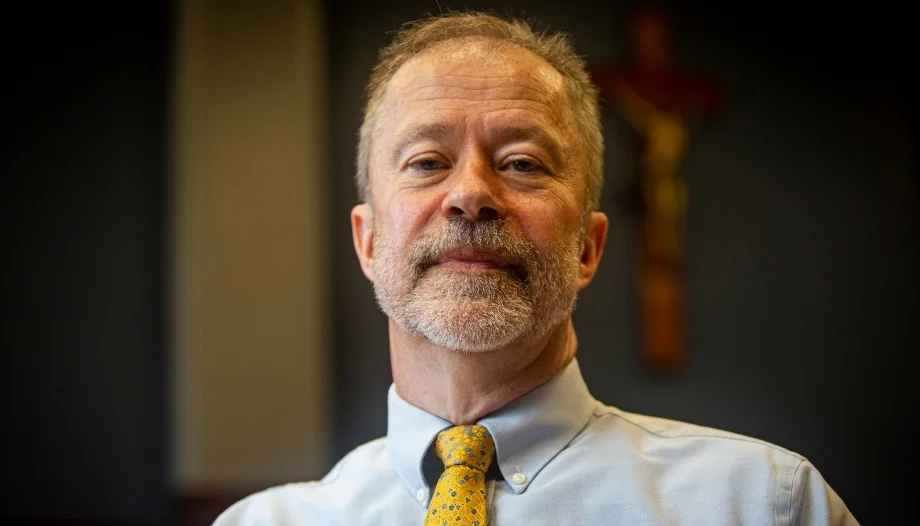
Is society forgetting what it means to be human? In this age of artificial intelligence and new technologies, John S. Grabowski, professor of moral theology and ethics at The Catholic University of America, presents his new book: *A Catholic Guide to Being Human*. He recently spoke with Charles Camosy of OSV News about how identity in Christ addresses the lack of self-knowledge and the confusion that exists in the world regarding our own humanity.
One might think that a book that serves as a guide to «being human» is a bit strange. Isn’t being human simply what human beings do? Why do we need a guide?
–It would be understandable to think that this topic and a book devoted to it are rather strange. After all, we don’t have to do anything to be human; it’s simply who we are. Why would we need any kind of guide?
But, in fact, we are deeply confused about what it means to be human. More than 60 years ago, the fathers of the Second Vatican Council, in the pastoral constitution on the Church, *Gaudium et Spes*, pointed out that, despite our growing scientific knowledge and technological prowess, we do not understand ourselves. As a result, we do not know how to think about these technologies or how to use them well. The passing of the decades and the emergence of new and even more powerful technologies have not changed this situation. They have made it worse.
The truth is that we cannot fully understand ourselves without God’s self-revelation to us in Jesus Christ. The Council document itself states: «Christ, the last Adam, through the revelation of the mystery of the Father and his love, fully reveals man to himself and makes clear his supreme vocation.».
There is growing interest in the idea that large language models (so-called artificial intelligences) might be a kind of person. How should Catholics What do you think about this kind of speech?
–This is a perfect example of the problem identified by the Council. Because we are unsure of what it truly means to be human and what our ultimate purpose is, powerful machines that can generate and compile data better than we can seem very human. This, in turn, tends to create either an exaggerated optimism that AI will fix us, or an excessive fear that it will dominate and enslave us. Think of all the movies Hollywood has given us over the years that play on these fears.
But, as Pope Leo XIV points out in «Magnifica Humanitas»: «So-called artificial intelligences do not experience, do not possess a body, do not feel joy or pain, do not mature through relationships, and do not know from within what love, work, friendship, or responsibility mean.» They lack the capacity to feel empathy or to make moral judgments. While they are «useful tools,» they are not—nor can they be—persons. They lack the capacities and relational nature that constitute the essence of a person. They can only be a «thing,» not a “someone.”.
The very fact that this is even a question reveals the depth of our confusion about ourselves.
Speaking of technology, your book warns about all kinds of technological distortions of our humanity when it comes to the creation of new human life. Why did this capture your attention in such a particular way?
–I think there are two reasons. One is more practical; the other is more substantive.
On a practical level, my main areas of teaching and writing over the years have been marriage, family, and sexuality. Therefore, I believe I am more attuned to the ways in which our culture gets these issues wrong, because that is where I tend to focus my attention.
But on a deeper level, I believe that a recurring theme in Scripture is that when we lose sight of who God is, this manifests itself in a distorted understanding of sexuality. On the contrary, disordered sexual practices easily cloud our minds, harden our hearts, and distance us from our Creator. That is why the Church considers sexual sin to be always serious—not because of an underlying puritanical mindset.
Sexual difference and fertility are deeply rooted in our identity as people. They are not merely biological or superficial. After all, when we bring children into the world, we cooperate with God in His creative work of bringing human beings into being in His image and likeness. This is not something to be taken lightly. Our sexually differentiated bodies are made to give life and express love.
Unfortunately, our culture tends to view sex in terms of recreation rather than love and procreation. Fertility is often regarded as a disease to be treated through mechanical, chemical, or surgical means rather than as a gift and a blessing. When people seek or desire children, it is sometimes as if they were mere adornments or accessories to adult happiness. Some people turn to the fertility industry to help them obtain «designer babies» tailored to their specifications regarding gender, race, and abilities.
Modern contraceptive and fertility treatments share a common drive with transhumanism. We seek to transcend our nature rather than understand it and live in accordance with it. We need the humility to seek and strive to live in accordance with God’s plan for us as embodied men and women, not to find technological means to remake ourselves.
Let's end on a more positive note. Where do you see the most hope for this vision of humanity to take root in our culture?
–I believe the key is evangelization. If it is true that «When God is forgotten… the creature itself becomes incomprehensible,» then it is also true that knowing God and His plan helps us discover ourselves, our true dignity, and our destiny. True humanism has God at its center. The fact that we are hearing and seeing reports of a growing number of people joining the Church in places where faith seemed to be waning is, without a doubt, a source of hope.
I also think about the growing awareness of the potential harm caused by screens and social media, which are often used as substitutes for real human interaction and connection.
Finally, I sense in the students I have the privilege of teaching a deep longing for friendship, lasting love, and the beauty of marriage or consecrated life. They are aware of the devastation the sexual revolution has wrought on our culture and of the destructive nature of casual relationships and pornography. They know there is something more for them, and they long for it.
By Charles Camosy, OSV News
Charles Camosy teaches moral theology and bioethics at The Catholic University of America in Washington.






 Español
  English
  Italiano