



- Gina Christian, OSV News
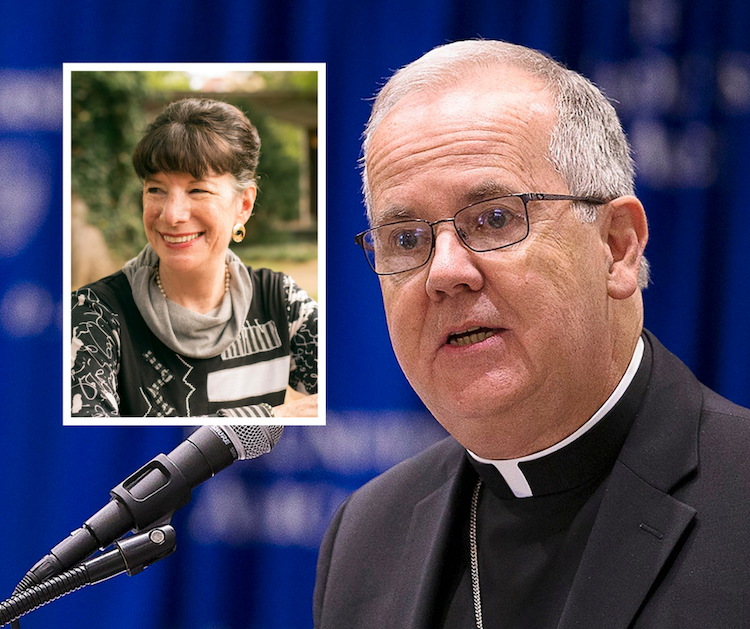
Amy-Jill Levine is the first Jewish person to lead the Catholic Biblical Association, which had previously been chaired by various scholars of Roman Catholic and Protestant affiliation.
Levine, an internationally renowned expert on the New Testament, is the Rabbi Stanley M. Kessler Distinguished Professor of New Testament and Jewish Studies at the Hartford International University for Religion and Peace, and professor emerita of New Testament and Jewish Studies at Vanderbilt University.
Bishop Joseph C. Bambera, chair of the Committee on Ecumenical and Interreligious Affairs of the United States Conference of Catholic Bishops, has stated its strong support for biblical scholar Amy-Jill Levine in the face of anti-Semitic reactions. Amy-Jill Levine has now spoken with OSV News.
What is your vision for the Catholic Biblical Association, and how do you hope to help guide and shape it as president?
– Levine: During my one-year term, I will work with the board of directors and the members to advance the association's goals, including promoting excellence in biblical studies.
I would also like to continue my work with Catholic clergy and clergy from other denominations, as well as with religious educators, to help eradicate anti-Semitic teachings that stem from a combination of ignorance and a lack of sensitivity.
I would like to work with the United States Conference of Catholic Bishops to help ensure that the textbooks used in parish schools, catechesis, and sermons do not promote anti-Semitic messages.
What does his historic appointment mean in the broader context of Catholic-Jewish relations following ‘Nostra Aetate’ the Second Vatican Council's Declaration on the Church's Relationship with Non-Christian Religions?
– Levine: It is clear evidence of the rapprochement between the Catholic Church and the Jewish people over the past 60 years. Pope Benedict XVI wrote (in his 2011 book, *Jesus of Nazareth, Part Two*) that “after centuries of antagonism, we now see that our task is to bring our two ways of reinterpreting the biblical texts—the Christian and the Jewish—into dialogue if we are to correctly understand God’s will and His word.”.
In *Evangelli gaudium*, Pope Francis wrote that ‘God continues to work among the peoples of the Old Covenant and to bring forth treasures of wisdom that spring from their encounter with his word. For this reason, the Church is also enriched by receiving the values of Judaism.’.
My appointment, therefore, is in line with the teachings of the Church. It reflects the trust and respect that people have in me, as well as in the CBA.
Perhaps this position will allow me to work more closely with the Catholic clergy and religious educators to demonstrate that understanding Jesus and Paul requires knowledge of first-century Jewish practices and beliefs—and that it is not necessary to disparage Judaism or use it as a negative foil to make Jesus look good.
Can you mention any other goals? For example, regarding collaboration between Christians and Jews?
- Levine: Perhaps this will encourage the United States Conference of Catholic Bishops (USCCB), seminaries, and publishers to make more extensive information available to Catholic readers on Jewish biblical interpretation, the Jewish context of the Gospels and Paul, and the history of Jewish-Catholic relations.
Perhaps this will help inform Jews—many of whom are unaware of the changes in Church doctrine since “Nostra Aetate”—of the enormous progress that has been made.
In this dialogue, we do not set aside the distinctive features of our own traditions for the sake of interreligious sensitivity. We will disagree on fundamental theological issues, and these will not be resolved until the Messianic age is fully realized.
But in the meantime, we can collaborate to learn from one another and support one another when hatred arises.
How would you summarize, for the average person in church or synagogue, the importance of collaboration among Catholic, Christian, and Jewish scholars in biblical research?
– Levine: We are stronger when we do this work together, when we can identify gaps in our knowledge, and when we can contribute different questions to the text based on our own traditions.
From a Jewish perspective, reading the New Testament is part of Jewish history. Mary and Jesus were Jewish; Paul, Peter, and James were Jewish as well, and they never lost, denied, or rejected that identity. My work can fill in aspects of my own history that the synagogue did not preserve.
As for the Christian position, the 2002 document from the Pontifical Biblical Commission, ‘The Jewish People and Their Sacred Scriptures in the Christian Bible,’ states: “Dialogue is possible, since Jews and Christians share a rich common heritage that unites them. It is highly desirable that prejudices and misunderstandings be gradually eliminated on both sides, in order to foster a better understanding of the heritage they share and to strengthen the bonds that unite them.”.
“Reclaiming our shared history, better understanding why and how we disagree”
- Levine: By reading together, we can learn what meanings the texts had in their original contexts, how they have been interpreted over time, and how Jews and Christians came to draw different messages from the shared Scriptures. This work is explored in the book I co-authored with Marc Z. Brettler, *The Bible with and without Jesus: How Jews and Christians Read the Same Stories Differently*.
We are also co-editors of the *Annotated Jewish New Testament* (currently in its third edition, published in 2026 by Oxford University Press). The notes and essays in this volume demonstrate the profound influence of Christian origins on Jewish sources and practices. By studying texts together, we learn more about our neighbors and also about ourselves.
We can rediscover our shared history, better understand why and how we disagree, see how our relationships have changed over the centuries, and recognize that demonization is not based on facts, nor is it the norm.
In which areas of biblical studies are there significant research opportunities at this time?
– Levine: New Testament scholars are recognizing the importance of understanding Jesus and Paul as first-century Jews.
We realize that Jesus is not abolishing the Torah, but is, in fact, making it stricter. To the commandment against murder, He adds a commandment against anger; to the commandment against adultery, He adds a commandment against lust. These verses from the Sermon on the Mount are not antitheses, but intensifications.
Regarding the question of ‘an eye for an eye’ versus ‘turning the other cheek,’ we know that Jews do not go around gouging out people’s eyes. Rather, Rabbinic Judaism makes it clear that, in cases of physical injury, the victim must be compensated. Thus, the rabbis address the aggressor’s responsibility.
Jesus quotes the saying ‘an eye for an eye’ and then changes the subject, speaking of a slap on the right cheek—a light tap with the back of the hand intended to rebuke, not to harm. He then gives instructions not to the aggressor, but to the victim.
St. Paul and the Torah
With regard to ritual purity, we now recognize that Jesus does not disregard the laws of purity, but rather restores people to a state of purity. Furthermore, thanks to archaeology, we have a better understanding of the importance that purity and other Jewish practices held for first-century Jews. These practices reaffirmed Jewish identity in the face of Roman pressure and made Judaism a way of life, rather than merely a belief system.
We take Paul seriously as the ‘Apostle to the Gentiles’ and, therefore, understand that his comments on the Torah are not directed at the Jews. His interest lies in convincing the Gentiles to worship the God of Israel, but not as converts to Judaism—for then only Jews would worship God, and Jews generally expected that in the messianic age the nations would turn to the God of Israel without converting—but as Gentiles in Christ.
How would you respond to anti-Semitic reactions—especially on social media—regarding your appointment?
– Levine: Ever since my choices were made public, I have been accused of being the daughter of Satan, a cannibal, someone who seeks to destroy the Church, a supporter of the Palestinian genocide, an enemy of Jesus and the Church, and so on. Some people have contacted the CBA office to demand my dismissal.
Ever since I was a child, I have not only studied but also appreciated the beauty of Catholic worship and traditions. As someone who has dedicated my life to fostering better relations between Jews and Christians, with a special focus on Catholicism, I find this sad and a clear sign of the enduring power of the anti-Semitism.
Readers who question how a Jew who does not recognize Jesus as the Messiah can preside over an association dedicated to Catholic biblical studies are not anti-Semitic. It is a legitimate question. The association has had Protestant presidents, and I do not recall their appointments sparking virulent reactions. (Editor’s note: Former CBA presidents Paul J. Achtemeier and Charles H. Talbert belonged to Protestant denominations; Talbert was a Baptist pastor.).
I have been a member of the CBA for decades, I have served on numerous CBA committees, taught at the Pontifical Biblical Institute in Rome, developed numerous programs for Catholic elementary and secondary schools (especially in Australia), and defended Catholic doctrine to Jews, Protestants, and people without religious affiliation who were unfamiliar with the faith. My work has strengthened the Christian faith and improved Jewish-Christian relations.
You respect the fundamentals of the Catholic tradition.
- Levine: I do not question the fundamentals of the Catholic tradition, such as the Incarnation, the Resurrection, etc. Although I do not share these beliefs, I can honor them, respect them, and even give them additional meaning by placing them in their historical context.
When it comes to the Incarnation, I am interested in the Jewish stories of miraculous births, the Jewish philosopher Philo’s description of the Logos, how the Nativity stories might have been received by their earliest audiences, and how they relate to the Scriptures of Israel.
I'm also very interested in Mary: what life was like for Jewish women in Galilee, how her story is portrayed differently in the Gospels, and how texts from the 2nd and 3rd centuries recounted stories of her childhood and death.
The Resurrection
With regard to the Resurrection, I am interested in placing the accounts of it within the context of the various Jewish views on the resurrection or life after death, and how those views have changed over time. From the disagreements between the Pharisees and the Sadducees, through the rabbinic insistence on the resurrection of the body, to the questioning of this idea by the Reform movement in the 19th century, and the various Jewish views today.
I'm also interested in how belief in Jesus' resurrection changed the way people behaved at that time and afterward.
It is not necessary to believe in Catholic doctrine (part of which is post-biblical in its formulation, such as the creeds) to interpret Matthew, for example, as a text that proclaims the lordship of Jesus.
We should always read the writings of others with generosity and grace. In this process, I consider myself an ally of the Catholic tradition.
——————-
Gina Christian is a multimedia reporter for OSV News. You can follow her on X @GinaJesseReina.
This interview was originally published in OSV News, and you can read it here.
—————–






 Español
  English
  Italiano
  Français
  Deutsch
  Polski