


 Malta, the island where Europe speaks Arabic
In the previous article about Malta we talked about how, on this small island and its archipelago, the political and cultural events of the Mediterranean have been concentrated for millennia.
In this article we will see how some unique individuals, starting with a famous castaway, have shaped one of the main characteristics of the Maltese: the Christian faith.
Saint Paul in Malta
There is one event that, more than many others, marks the moment when Malta and Christianity become almost one and the same.
The year is 60 AD. A ship that sailed from Crete, with nearly 280 people on board, among them a certain Paul of Tarsus—a prisoner being escorted by the centurion Julius to Rome to be tried before the emperor—has been at the mercy of a storm unleashed by the wind called «Euroaquilone» for fourteen days. It seems that there is no salvation for the vessel and that the passengers are doomed, but this Paul promises them that they will be saved, because an angel had appeared to him to assure him that they would reach land.
And so it happens. The ship runs aground off the island called «Melita,» and the chained prisoner, along with the other shipwreck survivors, manages to reach the shore. There, the inhabitants, who are called «barbarians» (in Latin and Greek, this term designates foreigners who speak neither Latin nor Greek; in fact, the Maltese of that time still spoke Phoenician in its Punic, that is, Carthaginian, variant), welcome the shipwrecked men and light a bonfire.
While gathering firewood, a viper coils around Paul's hand, leading the islanders to believe he is cursed. But the apostle throws it into the fire unharmed, and his reputation among the Maltese changes completely, especially after Paul heals the father of a local notable, Publius, and subsequently other sick people during the three months he spends in Malta.
According to tradition, Paul's shipwreck occurred on an islet called Gżejjer ta’ San Pawl, in the bay now known as San Pawl il-Baħar, or St. Paul's Bay. There stands a 17th-century church dedicated to the saint, St. Pawl Milqi, built upon the ruins of a Roman agricultural villa, which some believe to be that of Publius. Publius is said to have later become the first bishop of Malta and one of the island's patron saints, which is why the Maltese Church is considered to have been founded directly by the Apostle to the Nations.
The place where Paul stayed and was imprisoned, as well as where he preached in the Maltese archipelago, is instead located on the island of Gozo, in Rabat, where there is a cave that is still venerated today.
The Knights of Malta
The Knights of Malta (officially: Sovereign Military Order of Malta) were not founded in Malta, and their official headquarters are no longer there, but in Rome. However, they have an unbreakable historical bond with the island.
It's one of the oldest Catholic religious orders in the world, and that surprised me. In fact, at first I thought it was a secular institution, since I know some married members.
In reality, they are, for all intents and purposes, a Catholic religious order, although with a unique structure and nature within the Church.
Unlike friars or monks of other orders, the vast majority of members of the Order of Malta do not live in a convent or monastery. And, unlike other institutes of consecrated life, they are also a sovereign subject of international law: a state without territory.
Founded in Jerusalem in 1048 as the Hospitaller Order of St. John to care for pilgrims in the Holy Land and officially recognized by the Church in 1113, it later assumed a military role in defense of the Holy Places, remaining there until 1291, the year of the fall of Acre to the Mamluks. The Hospitallers who survived the fierce and bloody resistance in Acre took refuge in Cyprus, and the Order became a naval power, especially after 1310, when the Knights moved to Rhodes, over which they obtained territorial sovereignty, and later to Malta, when, in 1530, Charles V ceded the island to the Order of St. John, which then became known as the Knights of Malta.
Malta offered them a strategic port and an ideal location, between Sicily, North Africa, and the Levant, at the heart of the trade routes linking Christian Europe with the Ottoman world. And, indeed, it became their architectural masterpiece. The Knights reinforced its defenses, built fortresses, arsenals, warehouses, churches, and hospitals, transforming it into both a stronghold and a civil and healthcare center, with facilities considered among the most advanced in the Mediterranean at the time for the care of the sick, wounded, poor, and sailors—much like the Maltese had done long before with Saint Paul.
The siege and the expulsion: from Malta to the world
They built their fortifications so well that the Knights of Malta were able to withstand the Great Ottoman Siege of 1565, when the Sublime Porte, determined to eliminate the Order's stronghold, sent a wave of ships and men against the island, besieging it for months. However, the Knights and the Maltese population, entrenched in the fortresses of St. Elmo, St. Michael, and St. Angelo, and with support from Sicily, managed to repel the siege, and their victory was celebrated throughout Europe.
Later, Grand Master Jean Parisot de Valette decided to build a new city on the promontory overlooking Port il-Kbir, the Grand Harbour: Valletta. The project envisioned a fortress city, rationally structured and capable of withstanding further attacks, but also one that would worthily represent the Order that governed the archipelago, with bastions, churches, and palaces.
The Knights were «of Malta» until 1798, when Napoleon expelled them from the archipelago after having occupied it during the expedition to Egypt.
Thus, the Order lost its island, but preserved its memory in the name, and continued to exist, as the Sovereign Military Order of Malta, to dedicate itself primarily to humanitarian works.
Its approximately 13,500 members worldwide are divided into three categories: the Professed Knights, religious in every sense who take vows of poverty, chastity and obedience, from among whom the Grand Master is elected; the Knights and Dames in Obedience, linked to the Order through a promise of Christian life; and, finally, the lay people, who participate in the hospital, welfare and humanitarian works of the Order throughout the world.
Culture, faith and legislation today: the soul and laws of Malta
Malta's social and cultural fabric is inextricably linked to its Catholic heritage. The Republic's Constitution itself establishes Catholicism as the state religion (Art. 2).
This is reflected in legislation that, compared to other countries in Europe and the world, is distinguished by its markedly conservative character in matters of family law and ethics.
Abortion, for example, remains strictly prohibited and is considered a criminal offense. It wasn't until 2023 that an amendment was introduced into the Penal Code—which criminalizes abortion—that, at the time, was the subject of intense debate: abortion is now permitted only when the woman's life or health is in grave and imminent danger. In all other cases, including rape, incest, and fetal abnormalities, women who undergo an abortion and those who perform it face up to three years in prison. However, there are several cases of Maltese women traveling abroad (especially to Italy or the United Kingdom) to have abortions or resorting to clandestinely purchasing abortion pills.
However, with regard to the rights of homosexual people, Malta has taken the opposite path, moving notably away from the Catholic perspective that characterizes other areas of its jurisprudence. Civil unions (with the right to adoption) were introduced as early as 2014, while in 2017 Parliament legalized same-sex marriage almost unanimously (with only one vote against), replacing references to «husband» and «wife» in civil law with gender-neutral terms.
Malta is therefore a paradox: a constitutionally and culturally Catholic country with very restrictive legislation on abortion, but with an opposite stance regarding the recognition of same-sex marriage.
On the other hand, the gap between «faith» and religious and cultural «devotion» also remains paradoxical.
While around 96% of Maltese still identify as Roman Catholic, confirming a deep-rooted «official» adherence to the Church, religious practice has declined from 82% (1967) to 35-40% (15-20% among young people) of the current population of approximately 550,000 (a figure that, nevertheless, remains among the highest in the European Union). Furthermore, another 70-74% of citizens report attending religious services at least once a month or on major holidays.
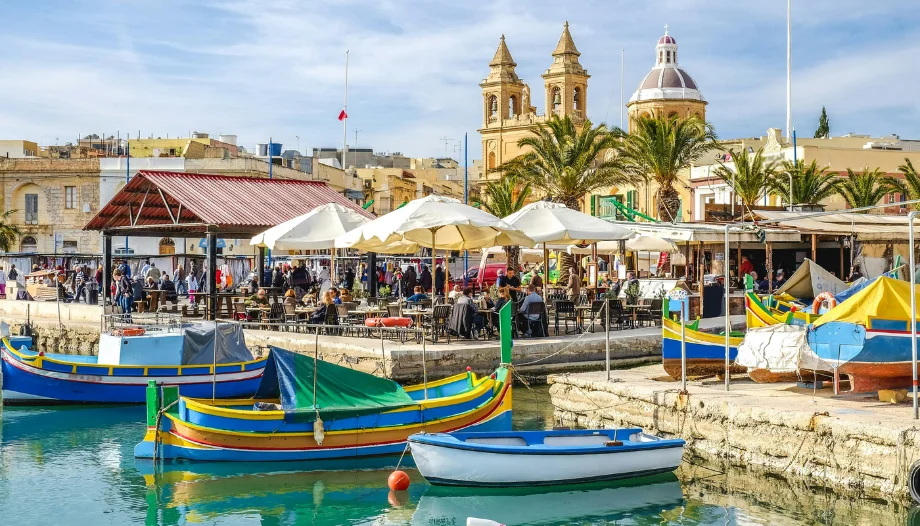
Nevertheless, popular participation in sacraments such as baptisms, weddings and first communions remains very high, as well as in major community events such as patron saint festivals and processions, particularly those dedicated to Saint Paul (February 10) and the summer ones, with illuminations («pavaljuni»), band parades and pyrotechnic displays («giggifogu»), or traditions such as the blessing of «the luzzu» (the colorful fishing boats with protective eyes painted on the bow).
In conclusion, with its unique characteristics, its ancient history, its culture, its languages, its gastronomy and its faith, Malta is truly a «beautiful island».





 Español
 English
 Italiano
 Français
 Deutsch
 Polski