


 The International Theological Commission at the service of commission and dialogueThe ecological issue is a theological one, according to the International Theological Commission
The Pope recalled that the Apostolic Tradition must be understood as the living and faithful transmission of the presence of Christ throughout the generations, and that the cultural forms of transmission of the faith, which in his opinion require a new stage of inculturation today, must be understood in accordance with it.
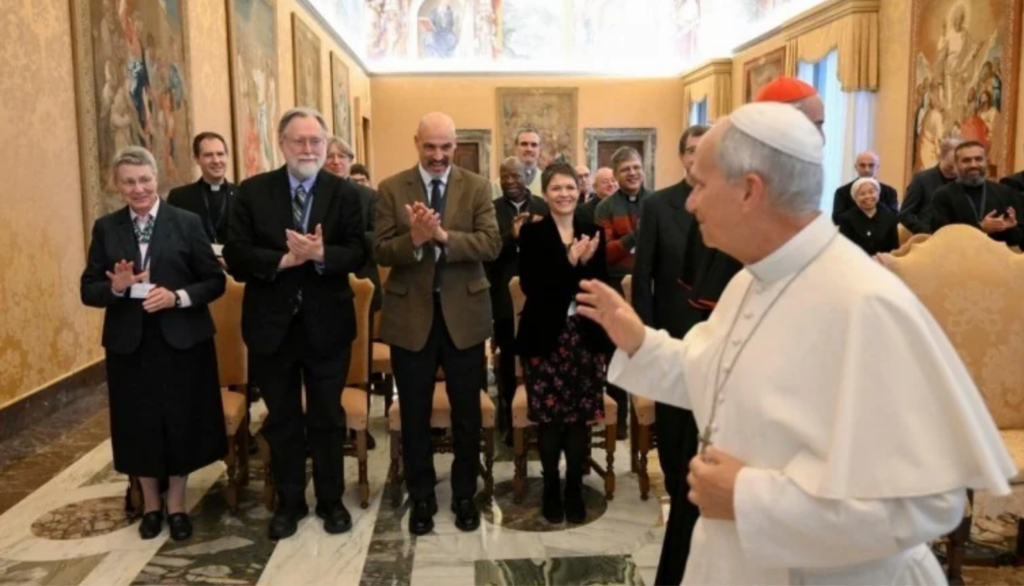
The Pope received the recently renewed International Theological Commission on the occasion of its plenary assembly. speech, He encouraged theologians to delve deeper into two central, related themes: the Apostolic Tradition and the inculturation of the faith.
The Tradition
Regarding Tradition, Leo XIV affirmed that it refers “to the heart of the Church’s identity and mission.” He recalled that the Church “perpetuates and transmits to all generations all that she herself is, all that she believes.” He made mention of Benedict XVI, for whom Tradition is “the permanent presence of the Savior who comes to meet us.” To proclaim and bear witness to this living presence, transmitting it with fidelity and integrity, is, he affirmed, “the indispensable good for the Church.”.
The Holy Father emphasized that Tradition is a living reality, and therefore its understanding is subject to constant deepening. On the one hand, he warned against a kind of “emancipation” that would imply a distancing, “almost a pseudo-liberation,” from what the Church has authoritatively taught.
On the other hand, he acknowledged that there is a growth in the understanding of things and of the words transmitted. He clarified that this “does not imply a break in the teaching of the Magisterium, but a development of the principles that animate it,” and mentioned war, slavery, and the death penalty as examples, in reference to Magnifica humanitas.
Pope Prevost emphasized that this Tradition springs from the Holy Trinity and is directed to all humanity, which commits to fidelity to the “once and for all” event of Jesus.
At the same time, this Tradition encourages us to listen to what “the Spirit says to the Churches” throughout history. He quoted John Paul II, who pointed out that the Spirit raises up signs of his presence in universal human experience, which help disciples to understand more deeply the message they bear, so that “the Church recognizes that she has not only given, but has also received from history and the development of humankind.”.
The inculturation of faith
Speaking about the inculturation of the faith, the Pope emphasized that it constitutes “an indispensable dimension” of the coherent witness of faith from generation to generation. He recalled Paul VI, who called for evangelizing “the culture and cultures of man” in depth and to their very roots, and John Paul II, for whom “a faith that does not become culture is a faith that has not been fully embraced.”.
Leo XIV pointed out that this approach requires discerning particular contexts and attending to the specific characteristics of peoples, cultural spheres, and social situations in the world today. In his opinion, “the current historical stage demands a new stage of inculturation of the faith.” Therefore, a reflection on fundamental theological principles and practical guidelines for interpreting, evaluating, and promoting the forms of proclamation, catechesis, preaching, teaching, and celebration of the faith is more valuable than ever.
In this context, Leo XIV highlighted the value of popular piety, in which, in the words of Pope Francis, “one can appreciate how the received faith has been embodied in a culture and continues to be transmitted.” He explained that popular piety shows how the inculturation of the Gospel makes culture itself a means of transmitting the faith.
An appeal to theologians
In closing, the Pope emphasized that Apostolic Tradition and inculturation are two fundamental aspects of the work of pastors. Their combination demands “fidelity and competence, wisdom and creativity, love for the people of God and trust in the action of the Holy Spirit.”.
Therefore, he asked the members of the Commission to be theologians capable of reflecting on the living and life-giving Truth, which «has the face of Jesus Christ» and which, precisely for that reason, can continue to be transmitted throughout history and embodied in successive cultures.





 Español
 English
 Italiano
 Français
 Deutsch
 Polski