



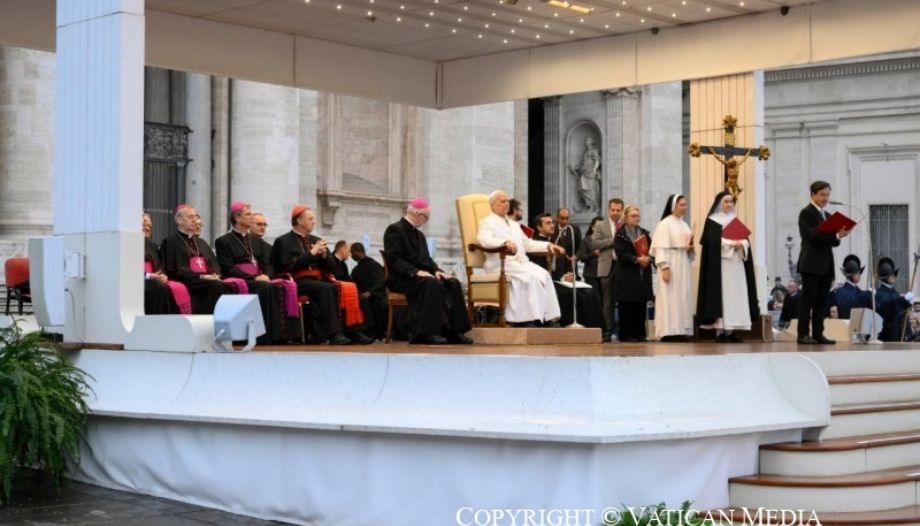
“Christians are called to be the salt of the earth and the light of the world. (…) We must not be afraid to be on the front lines in building peace and defending human dignity, both through constant prayer and through consistent social and political choices.”.
This has been one of the main messages of Pope Leo XIV in the Audience This morning's catechesis, dedicated to the cycle of catechesis on “The Documents of the Second Vatican Council”, focused on the theme: the Constitution Gaudium et spes. The promotion of peace (Gaudium et Spes, 77-93), with a reading from the prophet Isaiah, 32, 17-20.
“The family of the children of God”
The Council Fathers contemplate, above all, God's plan for humanity, that is, “to become in Christ Jesus the family of the children of God” (GS, 92), Pope Leo X stated. “As such, in the name of the Lord we are called to be brothers and sisters, and to build a world of peace. This hopeful perspective seeks to embrace not only humanity, but also all of creation, as suggested by St. Paul's Letter to the Colossians.”.
Later, he pointed out: “True peace, which springs from the cross of Christ, is offered to all as a fruit of redemption; it is a gift of grace to which corresponds the commitment of our freedom.”.
The Council Fathers combined their firm condemnation of war with a solemn appeal to convert minds and hearts to Christ, King of Peace, inviting people to break ideological chains and economic interests that foster conflicts.
The digital revolution, hybrid forms
In his catechesis, the Pope recalled that “there is no place for resignation, as if violence were inevitable,” and reflected on “the characteristics of modern wars.”.
We see that “the digital revolution is changing the grammar of conflict. In addition to visible warfare, there are hybrid forms: cyberattacks, information manipulation, influence campaigns, and the automation of strategic decisions. […] What begins as protection can quickly become an attack, and the boundary between protection and aggression tends to blur” (Magnifica humanitas, 183).
Right to self-defense
Faced with the evidence of conflicts that are “increasingly inhumane and devastating,” hatred and injustice among peoples are on the rise, and creation and its beauty are being disfigured, the Successor of Peter pointed out.
Therefore, the Pope recognizes “the right to legitimate self-defense,” which “is thus linked to the promotion of international institutions that serve to peace between peoples and to integral human development.”.
The Vicar of Christ has paused on this point, reiterating that “the right of legitimate self-defense to governments is not at all denied (GS, 79), but rather the need for international bodies capable of intervening effectively to restore violated justice is made clear, acting in defense of those who suffer oppression.
Care of creation
At the end of the Audience, the Pope expressed his concern following the recent COP31 climate summit, which concluded without agreements.
Leo XIV has called upon the international community and each individual to promote a culture of care for creation, which places at its center the dignity bestowed by God upon every human being, the common good and solidarity towards the poorest and future generations.
Advent: the comings of the Lord in everyday life
Before concluding, the Vicar of Christ reminded the faithful, speaking in different languages, that “Advent begins in a few days. May the new liturgical year renew in each of us the inner desire to sharpen our eyes of faith, which allows us to discover the mysterious, yet real, comings of the Lord in our daily lives.”.
Postscript on the family: 45 years of ‘Familiaris consortio’
Addressing Polish-speaking pilgrims and faithful, the Pope recalled that “forty-five years after the publication of the Apostolic Exhortation ‘Familiaris consortio’ of St. John Paul II, we continue to present the family as the “domestic church” and “sanctuary of life”.”.
‘Reading the challenges addressed in ’Amoris Laetitia” in light of this teaching, let us also place at the center of pastoral care the accompaniment of young people in their preparation for marriage,” Pope Leo encouraged.




 Español
 English
 Italiano
 Français
 Deutsch
 Polski