


 Benedict XVI's unpublished letter: "My resignation is full and valid".Joseph Ratzinger. A life spent in the service of the ChurchGänswein on Benedict XVI: "an indelible mark"."
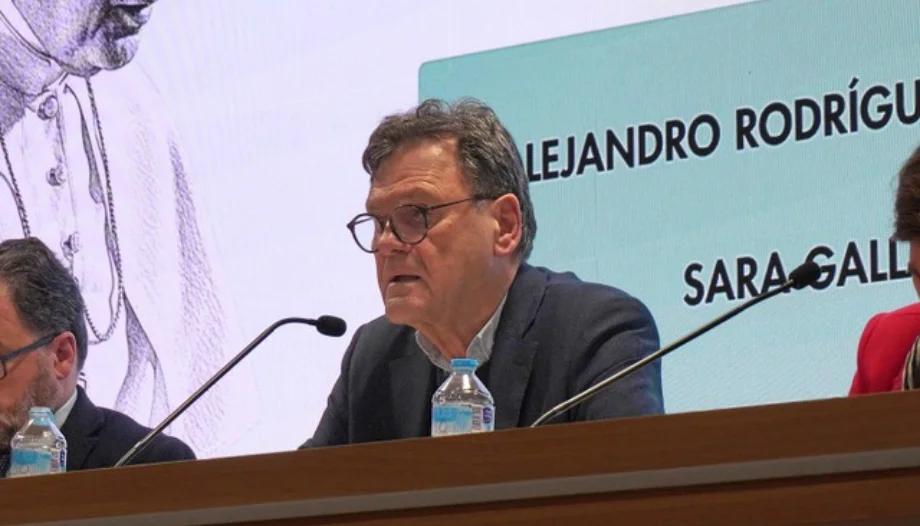
German journalist Peter Seewald is convinced that Benedict XVI's cause for canonization will succeed. He expressed this view on November 18th at CEU San Pablo University, where he delivered a lecture on the legacy of the German Pope as part of the events organized by CEU and the Ángel Herrera Oria Cultural Foundation to commemorate the centenary of his birth. Seewald is the author of four books of interviews with Ratzinger and a biography. Benedict XVI. A Life, spoke in German, with translation by Sara Gallardo, professor at UCAV and member of the board of trustees of the Ratzinger International Foundation.
In 2027, five years will have passed since his death, the deadline set by the Church for opening a cause for canonization. His biographer has acknowledged that Benedict was always “a touchstone,” someone before whom opinions are divided, and that there are forces capable of halting the process. But, in his view, that will not change the outcome: “The process cannot be stopped. Because I, as his biographer, can testify that he led a holy life.” Ratzinger himself acknowledged his failings, although Seewald found hardly any, and testimonies are already being collected from people who claim to have experienced miracles after invoking him. In his opinion, canonization will come sooner or later: “I am completely convinced that one day we will speak of Saint Benedict XVI. The question is when.”.
A young Marxist facing the “man in black”
Seewald did not come to Ratzinger through faith. In the early seventies, he was a young Marxist eager to leave the Church and, as he has humorously recounted, he could barely distinguish “between the Confessions of Saint Augustine and an erotic novel, or between the Sistine Chapel and a jazz band.” Even so, in the fall of 1992 the editor of the magazine of Süddeutsche Zeitung He commissioned him to write an extensive report on the Vatican's “man in black.” Upon reading his texts, he encountered a contradiction: “I identified as far-left, while Ratzinger was considered far-right. And I had a problem, because I believed what he said was true.”.
Nor did the cardinal who received him in Rome resemble a “Grand Inquisitor” at all. He was a modest and approachable man, of delicate constitution and with a high, somewhat fragile voice, “much shorter” than he had expected, and with whom it was very easy to converse. “Not for a moment was there the slightest trace of clerical vanity,” he affirmed. From that encounter were born The salt of the earth and then, God and the world, Light of the world y Latest conversations, And along the way, he himself returned to the Church. Benedict himself wrote in the prologue to his complete works, read at the presentation of the event, that over time his interviewer “no longer asked questions simply as a journalist. The questions he posed were his own questions.”.
“Now you have to help me”
The Ratzinger that Seewald described bears little resemblance to his public image. He liked his dry humor and his nonconformity. During interviews, when he leaned back and tugged at his suspenders, the journalist knew he was enjoying formulating ideas that perhaps even he himself had never heard before. He was also extremely punctual. With him, it was impossible to extend a session by fifteen minutes, he joked, and having a whisky afterward was unthinkable.
During breaks, he would withdraw to “meditate.” He didn't believe he could do anything on his own and often felt “weak and powerless,” unable to live up to what was asked of him. He could only get through it with God's help, to whom he would pray: “Now you have to help me; I can't go on anymore.”.
This frailty was compounded by serious health problems, including almost constant migraines since his student days, the aftereffects of a stroke, and an infection that threatened his left eye. According to the journalist, Benedict had already lost sight in that eye at the beginning of his pontificate, something very few people knew. At the end of their first conversation in 1992, the cardinal confessed that he was exhausted: “I’m old now. I’m at my limit.” In that same meeting, the journalist asked him if he was a happy person. “I’m at peace with my life,” he replied.
No fear of big things
His biographer has linked his 2013 resignation to a phrase Ratzinger uttered in his youth: “I have never been afraid of great things.” Taking that step required courage, theological depth, and practicality, and no one should have been surprised. Light of the world, In a letter published in 2010, the Pope had already explained that one cannot resign while the problems are not resolved, “but when this is clarified, if a Pope feels that he does not have the strength to continue with his mission, he not only has the right, but he has the duty to resign.”.
Ratzinger was convinced, in fact, that John Paul II would resign. It didn't happen, and Ratzinger considered it a good thing, because he saw in his predecessor a special calling that he himself hadn't received. There wasn't really a friendship between them, because Ratzinger's admiration was so great that he didn't see himself as his equal, although they formed “a fantastic team.”.
The enigma of insomnia
When he made the decision, Benedict was at the end of his rope. In a letter written a month or two before his death—the contents of which were revealed in 2023—he confided to Seewald that he suffered from insomnia that forced him to take increasingly higher doses of medication. The biographer still doesn't quite understand that silence: “Why didn't he want to say it clearly when he announced his resignation? It's a mystery to me.” In his opinion, it was because he didn't like to talk about himself, and even less about his illnesses.
He also couldn't understand how someone so exhausted could live another ten years. When asked, Benedict replied that he still had to remain. During that time, he wondered more than once if he had done the right thing, and he never doubted that he had. For the German journalist, he also managed to create a figure that didn't exist before, that of Pope Emeritus: “The truth is, he did it very well.”.
The Church of the Little Ones
The journalist also focused on an intuition Ratzinger had during his years as a professor in Regensburg: “The Church of the future,‘ he said in a vision formulated in 1970, ’will become small‘ and will lose, along with some of its faithful, many of the social privileges it had enjoyed. But precisely as a ’Church of the small,” made up of men and women who are not guided by the fleeting slogans of cultural fashion but who have deep roots, it will rediscover its true center in faith and prayer.” He confessed that today he finds it electrifying to see the extent to which this has come to pass.
A simple stroll through Madrid, he said, is enough to see that the new must-do holiday is called Black Friday. He also highlighted the emergence of vibrant new businesses and expressed his astonishment that there are Catholic universities here with thousands of students, something unthinkable in his country.
The situation of the Church in Germany greatly saddened Benedict in his later years, though it did not diminish the joy that always accompanied him. “God will not abandon his Church. In the end, Christ will triumph,” he assured his biographer when asked what comforted him during those difficult days.
Doctor of the Church?
Seewald has also expressed his support for Benedict XVI being declared a Doctor of the Church, although he has admitted that some theologians disagree. In his view, his work, consisting primarily of short writings rather than a long treatise, has the virtue of addressing contemporary problems and questions, and is “a providential aid to faith” in a highly secularized society.
For Seewald, perhaps the drama of his life was having to act defensively for decades, “like a watchman keeping vigil alone through the night to protect the house of God from danger.” But therein also lay his strength, and that is why his legacy will remain as that of a teacher and a pastor who sought to preserve amidst renewal and renew amidst preservation. Because, as Benedict himself affirmed, true reform means nothing other than “bringing the witness of faith, with renewed clarity, to the darkness of the world.”.





 Español
 English
 Italiano
 Français
 Deutsch
 Polski