



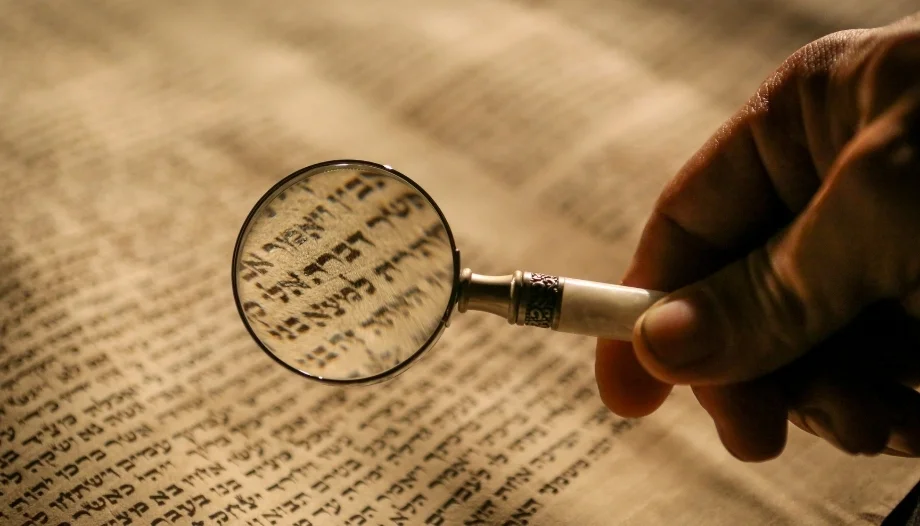
Writing an article about the Hebrew language gives me the opportunity to go back in time.
It was February 1991. I was 12 years old, and like so many Italians back then, I was glued to the TV watching the Sanremo Music Festival, a true national institution.
That year, each of the Italian contestants was accompanied by an international guest who reinterpreted the song in the competition. At one point, a beautiful woman appeared—with amber-colored skin, black hair, and eyes like two opals. She was wearing traditional Yemeni costumes, and when she was introduced, it was noted that she was Israeli and had achieved international success with a very old song written by the 17th-century Yemeni Jewish rabbi and poet Shalom Shabazi, titled «Im nin’alu.» The song had become famous in Europe in a dance-pop remix. Its lyrics went:
I'm not going to the beach
I didn't hear that from Dalté Maróm
Even if the nobles' doors are closed
The gates of heaven never close
In San Remo, however, Ofra Haza performed a song titled «Oggi un Dio non ho» in Italian, but which she called «Today I’ll Pray.» She sang it in English and Hebrew and captivated not only me but also the audience in the theater and television viewers. The song, a hymn to faith and peace, was dedicated to peacemakers and the victims of war.
At that time, I spoke neither English, nor Arabic, nor even Hebrew, so I didn’t understand those lyrics. But I didn’t understand them easily even after I began studying both Semitic languages. Ofra Haza, in fact, sang in Hebrew with a Yemeni pronunciation, not the standard Israeli pronunciation, which is similar to what is taught today in religious institutions.
It took me a few years before, drawn in by the charm of that voice, I decided to dedicate my senior thesis to the history of the Sephardic and Mizrahi Jewish communities, and to the different pronunciations of Hebrew—with the guttural consonants that European speakers tend to soften but which, having learned them in Arabic, allowed me to perceive much more clearly the closeness between Hebrew and Arabic, sister languages, both Semitic.
In Naples, Granada, Venice, Buenos Aires, and Jerusalem, I continued to learn Hebrew with Ashkenazi Jews, Sephardic Jews, and Israeli Arabs.
An Introduction to Hebrew
Hebrew is part of the broad family of Semitic languages (along with extinct languages such as Phoenician-Punic, Amorite, Moabite, Akkadian, or Assyrian-Babylonian, and languages that are still spoken today, such as Arabic, Amharic and Tigrinya, Aramaic, and the languages of southern Arabia) which, in turn, due to their similarities and affinities, forms part of the broader group of Afro-Asiatic languages (which also includes Ancient Egyptian, Coptic, Berber, etc.)
Semitic languages are further subdivided, based on their structure and geographic location, into Western and Eastern Semitic languages. Hebrew and the other Canaanite languages (Phoenician, Moabite, etc.) are part of the Western group, along with Aramaic.
Their current alphabet, consisting of twenty-two letters, is based on the square Aramaic script (adopted after the Babylonian captivity). Previously, they used Paleo-Hebrew, a system similar to Phoenician.
It is written from right to left, and, like Arabic, it consists primarily of consonants. The vowels (niqqud, a system of dots) were added by the Masoretes, Jewish scholars of the Early Middle Ages, to preserve the correct pronunciation of the biblical text.
An interesting fact in this regard: the need to introduce diacritical marks to determine the correct pronunciation of vowels (which in ancient times was undoubtedly different from today’s and much more complex) stemmed precisely from the need to standardize the pronunciation of a language considered sacred, but about which there was likely no longer any certainty—to such an extent that, for example, the name of the famous mountain we now know as Ararat, in Armenia, might originally have been Urartu, after the ancient kingdom of the Urartians (the Hebrew spelling only includes «rrt»).
For native speakers of Indo-European languages, approaching Hebrew and other Semitic languages means entering into a different logic. Into another universe, I would say. The lexicon of these languages is generally organized around roots, often consisting of three consonants. From a single root emerge verbs, nouns, adjectives, and nuances of meaning. When translating, one does not seek the specific term that appears in a text, but rather—through the application of grammatical rules—the root from which it is derived.
Let’s take the term *midbar*, for example. If I didn’t know its meaning, I would first have to identify the three fundamental root consonants, which I would obtain by removing the letter m (mem)—a letter also used as a prefix for participles or to express locative or privative meanings (like the alpha in Greek). I would be left with the roots d-b-r, the same ones that form dabar («word,» but also «thing,» «fact,» «event»). In this case, m + d-b-r literally means «without a word,» but it is translated as «desert.».
The same is true of «milhamah.» If I remove the «m» and «ah» at the end (which indicate the feminine gender), I’m left with «l-h-m,» the root of «lehem,» «bread» (in Arabic: «meat»). «Lack of bread» could be a literal meaning, but milhamah means «war.» It is curious, however, that Christ, born in Bethlehem (Bet-lehem, in Hebrew «house of bread,» in Arabic «house of meat»), taught his disciples to ask for their daily «bread» (although it would be more accurate to translate it as «what is necessary,» «essential,» just as bread was for the Jews, a sedentary people, and meat was for the Arabs, a nomadic people)—that is, the food that does not perish and gives life. With this food, I like to think, one is in Bet-lehem, «house of bread,» and not in milhamah, «war.».
A bit of history
The history of Hebrew is truly remarkable. In fact, most of the Hebrew Bible was written in this language (though some parts are in Aramaic). The Mishnah, prayers, and rabbinic studies are written in Hebrew. The language likely ceased to be a «living» language around the 2nd century C.E., becoming a language of culture, literature, poetry, and liturgy; moreover, it was chosen to regain prominence as the modern official language of the State of Israel, spoken daily by millions of people.
The earliest Paleo-Hebrew inscriptions date back to approximately the 10th century B.C. During this early period, known as Biblical or Classical Hebrew, the language was very similar to Phoenician and other Canaanite languages, such as Moabite and others mentioned in the Scriptures. It was in this language that the Torah, the Prophets, and part of the Writings were composed, although with different styles and vocabularies, depending on the period in which the texts were written (the terms “Archaic Biblical Hebrew,” “Standard Biblical Hebrew,” and “Late Biblical Hebrew” are used, the latter being typical of post-exilic books such as Ezra, Nehemiah, Daniel, and Chronicles).
After the Babylonian exile (6th–5th centuries B.C.), Aramaic—which was already the administrative language of the Persian Empire—also spread among the Jews exiled to those lands. In the next article, we will examine whether this language was still spoken in Palestine during the time of Christ and, if so, in what form.
Undoubtedly, in Second Temple-era Palestine, Hebrew was the language of scholarship and lived together Aramaic (which had various dialects, as the Gospels also note when they mention a Galilean pronunciation that differed from that of Judea), Greek, and Latin—in a manner not unlike what occurred in the Islamic Andalusia or in the The Middle East Today .
Between the last centuries B.C. and the first centuries A.D., Mishnaic or Rabbinic Hebrew gradually took shape. It is the language of the Mishnah , which is characterized by a vocabulary more closely tied to everyday life and by influences from Aramaic, Greek, and Latin.
After three o'clock Jewish Wars (between A.D. 66 and 135) and the destruction of the Temple in Jerusalem (A.D. 70), Hebrew became a kind of sacred «bond,» lashon ha-qodesh («holy tongue»), for all Jews already scattered throughout the world, who identified with this language, with religious traditions, and with the Law as their common root. It was used for study, prayer, writing poetry, and correspondence among scholars from different countries. The languages of the Diaspora, such as Yiddish, Judeo-Spanish, Judeo-Italian, and Judeo-Arabic, were written using Hebrew characters. Examples of this include figures such as the Sephardic poet and philosopher from al-Andalus Yehudah ha-Levi .
In the late 19th century, thanks to the work of Eliezer Ben Yehuda , Hebrew was revived as a spoken language and gradually established itself as a common language among people from very different linguistic backgrounds: Yiddish, Russian, Polish, German, Ladino, Arabic, French, Persian, Amharic, etc., until it became the official language of the newly established State of Israel.
I had the privilege of spending an entire month in Jerusalem to delve deeper into the study of Biblical Hebrew at the Polis Institute, alternating between listening to Yehudah Ha-Levi’s piyyutim, gazing at Jerusalem’s marvelous jasmine-scented sunsets, studying the Psalms, and engaging in conversation on the street. When speaking Hebrew with ordinary people, but also when watching Israeli TV series like *Fauda*, one realizes just how often words from colloquial speech appear in the Bible.






 Español
  English
  Italiano
  Français
  Deutsch
  Polski